The Cluster is considering climate adaptation strategies to coastal erosion in Abidjan, Accra, and Lagos that would be technically feasible, that could be implemented, and that would garner political support. The strategies include coastal defense to protect high value stretches of the coast; livelihood protection in situ, examining how to make coastal communities floodable but functional; and livelihood protection ex situ, the option of voluntary non-temporary resettlement of vulnerable coastal populations, either with or without compensation. An analysis of past and future sea level rise across the Gulf of Guinea and probabilistic projections of sea level change to 2100 CE will inform the Cluster’s understanding of the social and economic risks of erosion and flooding on six different vulnerable communities in these cities.
Examining the Impact of Sea-Level Rise, Urban Flooding, and Coastal Erosion on Settlement and Livelihoods in Côte d’Ivoire, Ghana, and Nigeria
Severe impacts of sea-level rise driven by global climate change – including coastal erosion, flooding, infrastructure damage, saltwater intrusion into freshwater supplies and an increase in water-borne disease – are already a reality across Africa and in particular the Gulf of Guinea. Adapting to the risk of climate change requires careful management informed by solid projections of sea level rise, monitoring of coastal processes, and sensitivity to local governance, socioeconomic pressures and culture.
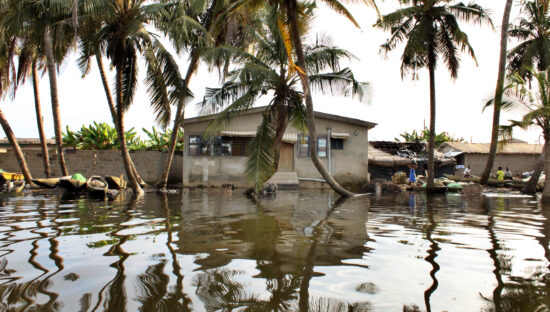
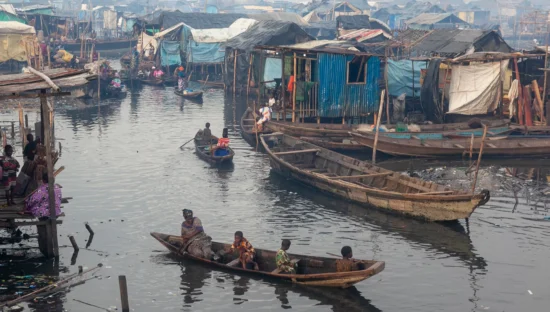
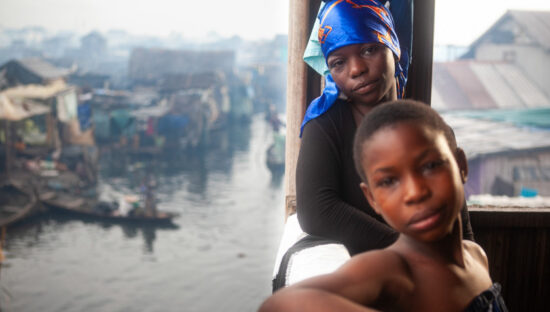
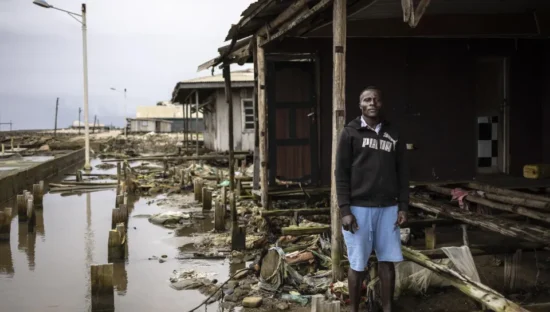
The Cluster is focusing on coastal communities in Abidjan, Accra, and Lagos that are at risk from sea-level rise and compounding impacts, such as flooding, saltwater intrusion, storm surge, and coastal erosion. In these communities, and other coastal ones in Africa, sea-level rise is jeopardizing livelihoods, impeding tourism, and damaging traditional fishing grounds. The goal of the project, therefore, is to identify viable climate adaptation strategies.
Harvard researchers are collaborating with their local counterparts, building local capacity in climate science through the training of African graduate students, partnering with local climate NGOs working in vulnerable communities, and collaborating with relevant government organizations to reinforce existing local endeavors and leverage first rate climate science to inform policy at the community and government levels.
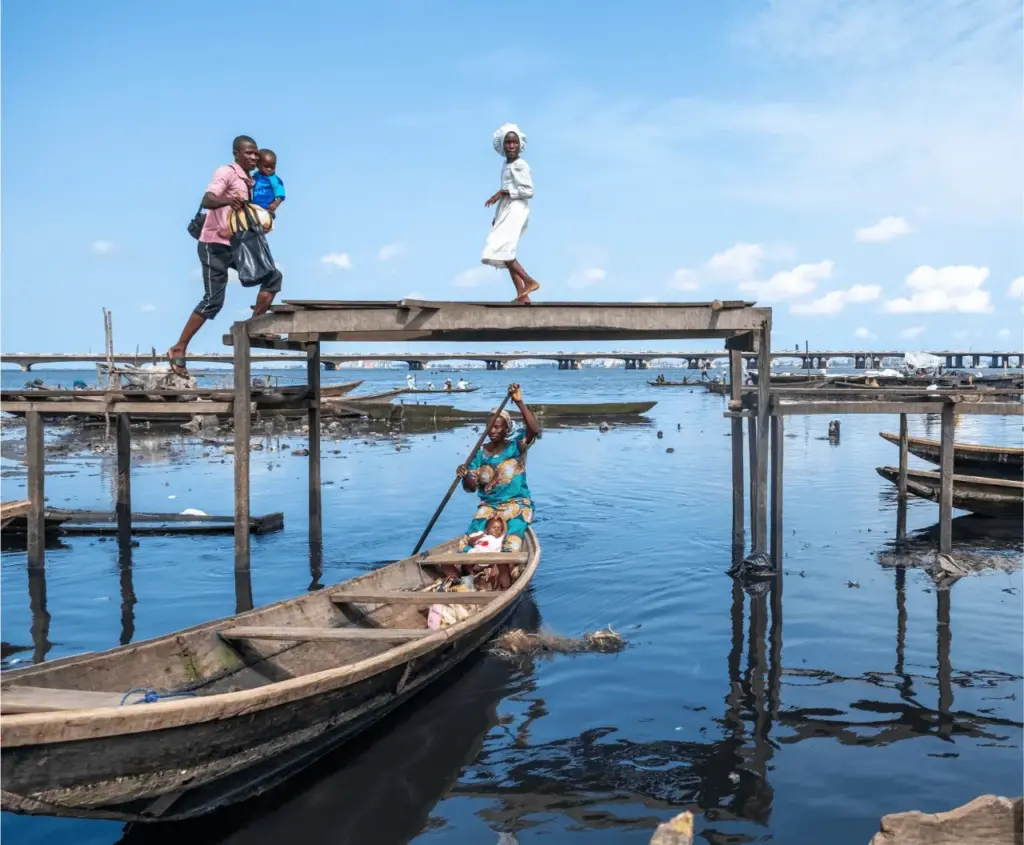
A local resident navigates flooded streets in Port Harcourt, Nigeria. Image Credit: Michael Uwemedimo
The Cluster intends to build local resilience capacity through a two-pronged approach. First, the cluster is analyzing past and future sea-level rise across the Gulf of Guinea, including the implications of this rise for coastal erosion, and social and economic disruption. This portion of the project will yield two critical tools: a map showing the extent of coastal recession across the gulf due to long-term sea level change since 1970; and a coastal vulnerability index that quantifies the potential for additional coastal recession from storm-driven erosion; estimates economic costs; and guides community-level based mitigation and adaptation policies.
A second component of the project is to produce an atlas of case studies on sea-level rise mitigation efforts. The atlas is to inform the comparison of three adaptation strategies.
Coastal defense – The protection of high value stretches of the coast with levees and surf barriers behind the beach, littoral dune reforestation, bringing in sand to compensate for beach erosion and halting the industrial mining of beach sand, or by building rock or concrete groins into the water to slow the longshore movement of sand, thus keeping vital ports and rivers open for navigation.
Livelihood protection, in situ: Making coastal communities floodable but functional, by upgrading construction materials, improving drainage, and providing insurance against property losses to homes, fishing boats, etc.
Livelihood protection, ex situ: The voluntary non-temporary resettlement of vulnerable coastal populations, either with or without compensation. This managed population retreat from threatened areas.
The Cluster is using the comparison to inform policy at the community and government levels. The work involves answering questions, such as, what have been the responses of coastal communities to their changing environment? How can these efforts be bolstered for those who chose not to relocate? How can we assist in recommending cost-effective measures to cash-strapped West African governments?
Professor Akyeampong joined the History faculty at Harvard upon receiving his Ph.D. in African History from the University of Virginia in 1993. He received his master’s degree at Wake Forest University in North Carolina in 1989, where he concentrated on English labor history, and his bachel...
Ellen Gurney Professor of History and Professor of African and African American Studies, Faculty of Arts and Sciences
Principal Investigator
Daniel E. Agbiboa is Assistant Professor of African and African American Studies at Harvard University. Before joining the Harvard faculty, he was Assistant Professor of Conflict Analysis and Resolution (2017-2019) at George Mason University’s Jimmy and Rosalynn Carter School for Peace and Confli...
Assistant Professor of African and African American Studies, Faculty of Arts and Sciences
Co-Investigator
Supriya Ambwani
Fellow in Climate and Sustainability; Research Associate at the Critical Landscapes Design Lab, Harvard Graduate School of Design
Co-Investigator
Jennifer Ashilevi
Research Fellow, Harvard T.H. Chan School of Public Health
Co-Investigator
Gareth Doherty is an Associate Professor of Landscape Architecture at the Harvard University Graduate School of Design and is the Director of the Critical Landscapes Design Lab. Doherty’s research and teaching explore human-centered issues alongside environmental and aesthetic concerns through a ...
Associate Professor of Landscape Architecture, Harvard Graduate School of Design
Co-Investigator
Jerry X. Mitrovica joined Harvard in 2009 as a Professor of Geophysics. His work focuses on the Earth’s response to external and internal forcings that have time scales ranging from seconds to billions of years. He has written extensively on topics ranging from the connection of mantle conv...
Frank B. Baird, Jr. Professor of Science, Faculty of Arts and Sciences
Co-Investigator
Robert Paarlberg is an Emeritus Professor of Political Science at Wellesley College, an Associate in the Sustainability Science Program at the Harvard Kennedy School, and an Associate at Harvard’s Weatherhead Center. He received his B.A. from Carleton College and a PhD in International Relations ...
Emeritus Professor of Political Science at Wellesley College; Associate in the Sustainability Science Program at the Harvard Kennedy School; and an Associate at Harvard’s Weatherhead Center, Harvard Kennedy School
Co-Investigator
External Collaborators
Select profile picture to see more
Professor in Coastal Processes, Department of Marine and Fisheries Sciences, University of Ghana
Kwasi Appeaning Addo
Professor in Coastal Processes, Department of Marine and Fisheries Sciences, University of Ghana
Olatunji Adejumo
Associate Professor of Landscape Architecture, University of Lagos, Nigeria, Department of Architecture
He is a researcher in the Ivorian Center for Economic and Social Research and a research fellow in Green Economy at the Institute for Natural Resources in Africa.
Dr. Tite Ehuitché Beke
Associate Professor and Researcher in Environmental Economics, University Félix Houphouët-Boigny of Abidjan (Côte d’Ivoire)
Mokolade Johnson
Senior Lecturer, Architecture & Urbanism Research Hub, University of Lagos
Kusimi John Manyimadin
Senior Lecturer, University of Ghana, Department of Geography and Resource Development
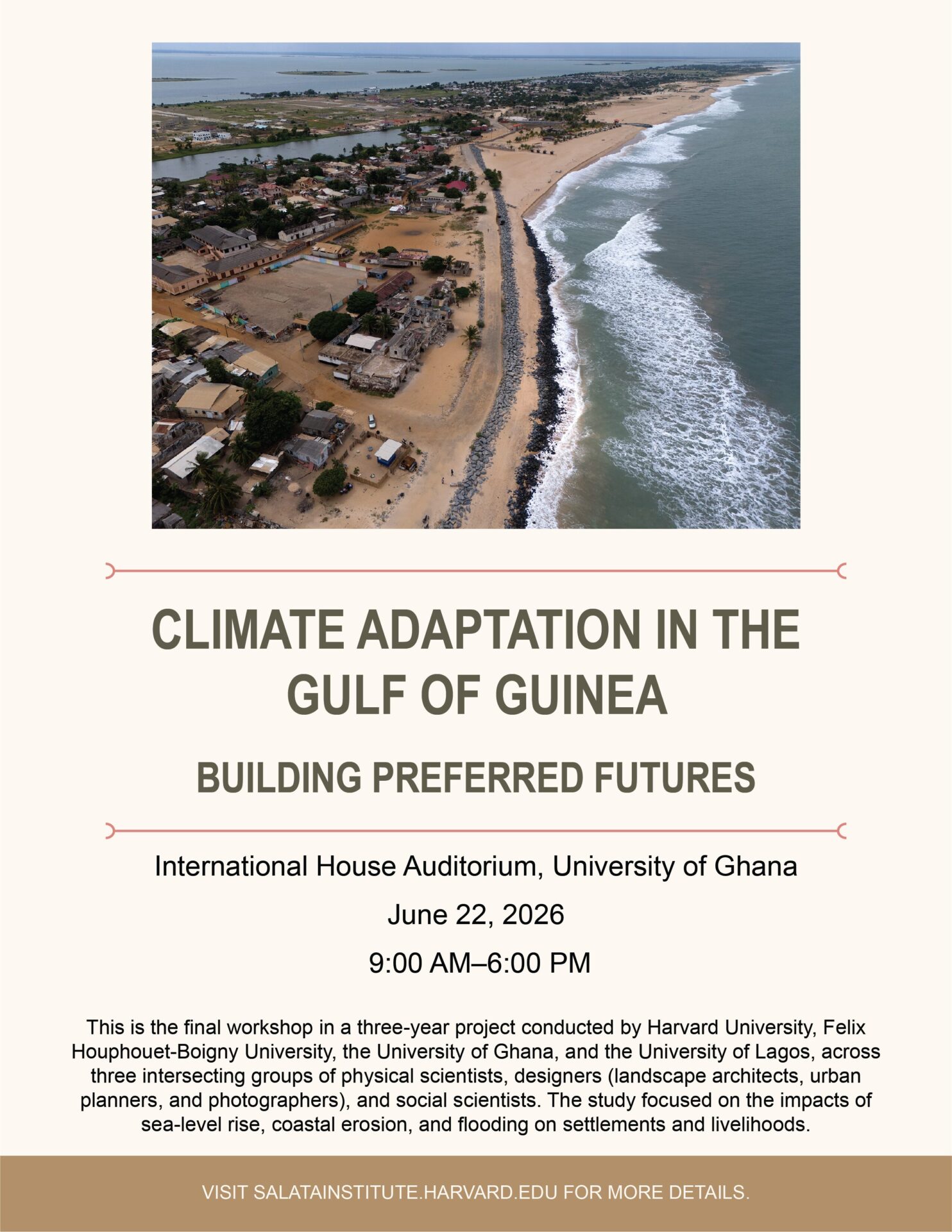
This is the final workshop in a three-year project conducted by Harvard University, Felix Houphouet-Boigny University, the University of Ghana, and the University of Lagos, across three intersecting g...
8:30 am - 8:00 pm
In-Person / International House Auditorium, University of Ghana
A new tool lets users click anywhere on Africa’s shoreline to visualize how sea level has changed since 1900, what forces are driving the accelerating change, and how much more to expect by 2100.
Mon, Jun 15, 2026
HARVARD UNIVERSITY
THE SALATA INSTITUTE FOR CLIMATE AND SUSTAINABILITY
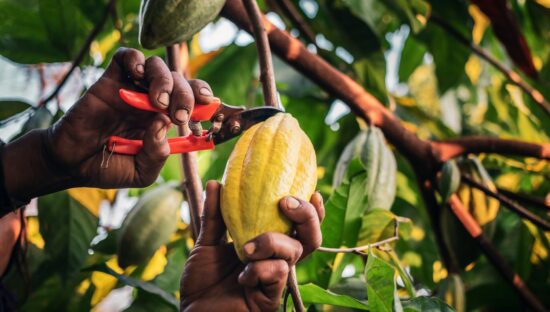
Wet conditions can damage cocoa plants and lead to increased chocolate prices according to research by Harvard University Environmental Fellow Anna Lea Albright.
Along West Africa’s Gulf of Guinea, Salata Institute research is helping communities and governments weigh excruciating choices about what to protect, how to adapt, and when to retreat
A Harvard survey of coastal communities in West Africa reveals high rates of distress, prompting researchers to see mental health care as a form of climate adaptation
Paris Match covers Salata Institute research into rapid coastal erosion in Nigeria and the nature-based solutions proposed by our collaborator at the University of Lagos (in French).
Historical and Projected Sources of Africa Sea-Level Rise
This tool lets users click anywhere on Africa’s shoreline to visualize how sea level has changed around the African coastline, looking back to 1900 and ahead to 2100 and helping fill one of Africa’s major climate-data gaps. The tool maps 950 coastal locations around Africa. Click any point to see how much sea level has changed, which physical processes are driving the change, and how much sea level could rise under different emissions scenarios.
Read more about this tool and the research around it in the Harvard Climate Blog.