get the brief in your inbox
Subscribe
Urban forestry is climate infrastructure hiding in plain sight
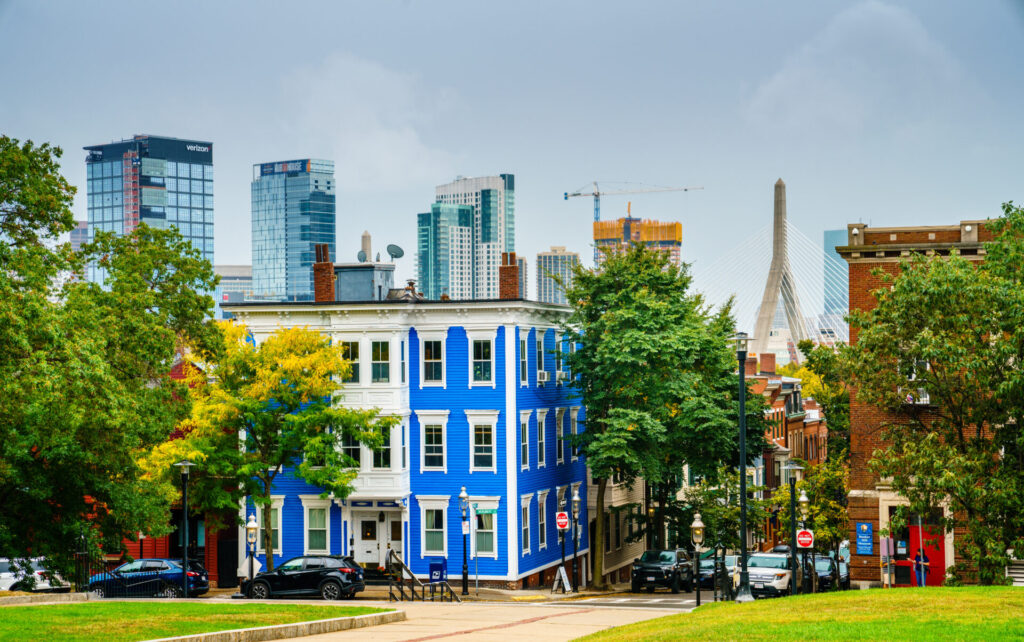
On a hot July afternoon, the most effective air conditioner in Boston and Cambridge might be a living one: the canopy that casts shade over sidewalks, cools the air through evapotranspiration, and softens the hard edges of the built environment.
These are benefits of the “urban forest,” what Max Piana describes as all the street trees, park plantings, backyard canopies and fragments of remnant woodland, spanning public and private land alike. The term surfaced in Cambridge as far back as 1894, Piana explains, but modern urban forestry took shape in the 1960s and has since fused traditions including the hands-on care of individual street trees and the longer-view management of forests and woodlots.
In recent years, Boston and Cambridge have adopted plans that turn that broad idea into an on-the-ground strategy for a warming region where trees are both essential and vulnerable. In both cities, equity is the organizing principle. Historic disinvestment and redlining helped produce stark canopy gaps, and the plans use heat risk and environmental justice criteria to decide where planting and care should go first. But they also reveal a stubborn civic dilemma. Trees deliver economic benefits – lower energy bills and reduced heat-related health costs, among others – yet greening arguments can lose political battles when they collide with the pressure to build housing and increase density.
In a conversation with the Harvard Climate Brief, Piana and two other experts behind those and other plans argue that success cannot be captured by a single citywide canopy target alone. Instead, it will be measured in fewer dangerous heat exposures, stronger protections against tree loss, better data, and the everyday work of shared responsibility, because the urban forest does not belong to City Hall so much as to everyone living beneath it.
You three contributed to the urban forestry plans for Boston (2022) and Cambridge (2020). Both plans include equity considerations. How did those influence where to prioritize planting and care?
Amy Whitesides: Historic exclusion – including redlining and decades of disinvestment – has helped produce stark canopy gaps: Boston averages about 27% cover, but some lower-income, previously redlined neighborhoods have as little as 7%, while wealthier, less diverse areas reach roughly 44%. Closing that inequity is a core aim of Boston’s urban forest plan.
A key recommendation to address this in Boston was to build capacity and accountability: create a Director of Urban Forestry so an understaffed division isn’t stuck in perpetual emergency response and can instead plan with communities and target the places that need trees most.
Eric Kramer: In Cambridge, we saw similar patterns of inequity. The Cambridge plan maps priority zones using similar environmental criteria, but the city’s recent planting has concentrated in two areas: neighborhoods with well-below-average canopy and “cool corridors” or primary roadways connecting important parts of the city. And the impacts are already being felt.
In the five-year update which our team is now undertaking for Cambridge, we are working to build a more nuanced framework that pairs a needs analysis with an opportunity analysis. The goal is to distinguish where new planting will be most effective from where existing canopy is most at risk – and therefore where the priority should shift to protection, care, and long-term management.
The Cambridge study found that most residents aren’t persuaded by the economic case for trees. How do you persuade people to invest in the urban forest and how do you reconcile the tension between housing affordability and canopy preservation, especially when zoning changes can remove trees and shrink planting space?
Kramer: Residents are more likely to act when we talk about the social, ecological, and spatial value of canopy, and because most economic models are broad rather than place-specific, we didn’t center our work on pricing the “value” of added trees.
The harder economic issue is the collision between housing affordability and a green, shady city. In Cambridge, recent zoning changes meant to enable more affordable housing are also seen as making it easier to remove existing trees, shrinking planting space, and even threatening nearby street trees. Until planners can align urban density and canopy goals in a coherent strategy, that tension will keep resurfacing.
Whitesides: Boston’s plan also doesn’t try to calculate the urban forest’s dollar value, but it does point to well-established economic benefits that can complement the social and ecological case for investing in trees, such as lower energy bills and reduced heat-related health costs.
Trees cut energy use in summer by cooling streets and buildings through shade and evapotranspiration, and they can also help in winter by reducing wind exposure; U.S. Forest Service research suggests they can reduce annual air-conditioning costs by about half. Because low-income households spend a larger share of their income on energy, those savings are also an equity issue – and by lowering extreme-heat exposure, trees can reduce health stresses and healthcare costs for people most at risk.
How should Boston and Cambridge define “success” for their urban forestry plans and what metrics would you prioritize over the next five to 25 years?
Kramer: Success should show up in heat mitigation, public health, civic engagement, mobility, and biodiversity – but those outcomes are hard to measure quickly, and baselines are often thin. For Cambridge’s five-year update, we’re using a few practical metrics, led by canopy cover measured city-wide and neighborhood-by-neighborhood, with a specific lens on canopy over sidewalks and other public open spaces.
In Cambridge, the five-year work has also focused on loss: when and why trees are removed, and whether that trend is improving – which it is. And increasingly, success is tied to whether key policy and operational changes from 2019 are working: Is the tree-protection ordinance reducing removals and supporting planting, is green-factor zoning putting more trees into new development, and are new planting methods making delivery more effective? Over the longer arc – five to 25 years – the core evaluation should track the plan’s big goals: equity, resiliency, and shared responsibility.
Whitesides: I agree – and the way you measure canopy matters. In Boston, we avoided a single citywide canopy target because it can unintentionally deepen inequities if new canopy accrues where cover is already high, instead of where heat and low canopy are most severe.
Boston’s plan lays out recommendations that create clear systems and investments to track progress, starting with data. Before the plan, baseline information and funding were limited: Tree-loss data covered only about 2014 to 2019, and there was little specific information on why trees were being removed. That’s why long-term data collection is a core recommendation, alongside building the staff capacity to plan, maintain, and manage the urban forest.
The plan also makes the case that the city can’t do this alone. In Boston, about 60% of the canopy is on private land, so partnerships and better community dialogue are essential. A concrete early marker of progress is new leadership and alliances to support community groups planting and caring for trees on privately owned land.
You’ve all done a lot of work on urban forests. What are some things you are still thinking about?
Max Piana: Assessing the urban forest as “all trees” in the city has its utility for strategic planning; however, this definition has its operational limitations. It is important to distinguish between urban forest typologies: street trees, yards, parks, and natural areas. The management needs and benefits of these sites, as well as their ecological functions, vulnerabilities, and adaptive capacities, often differ significantly. And secondly, we must evaluate benefits across scales: It’s not just what you plant on a site, but how close it is to other parks, and how connected it is to the surrounding area and beyond. It is challenging, but effective urban forest planning, design, and management must consider the site, city, and beyond to maximize ecological function and social benefits.
Kramer: In dense cities like Cambridge, we are running out of space to plant street trees, park trees, trees in backyards. If we are to grow more canopy, we need to be innovative, increasing density and cultivating trees in more adverse conditions. This means thinking about soils to support tree health and longevity, and increased levels of care to protect and nurture healthy forests. And it means rethinking the street and the public realm in ways that prioritize the presence of trees and potentially multiple layers of vegetation that, like in a true forest, create synergistic relationships that more naturally support healthy trees.
Whitesides: The canopy’s benefits – and its risks, from pests to climate stress – don’t stop at city lines, so our responses shouldn’t either. We need regional coalitions that can coordinate learning and action, especially around shared systems like “cool corridors” that follow mobility routes across municipal boundaries. In Greater Boston, people commute across multiple cities every day. Why not plan together to support healthy, safe, cool commuting experiences from start to finish?
-As told to David Trilling