The old forests nobody knew were there
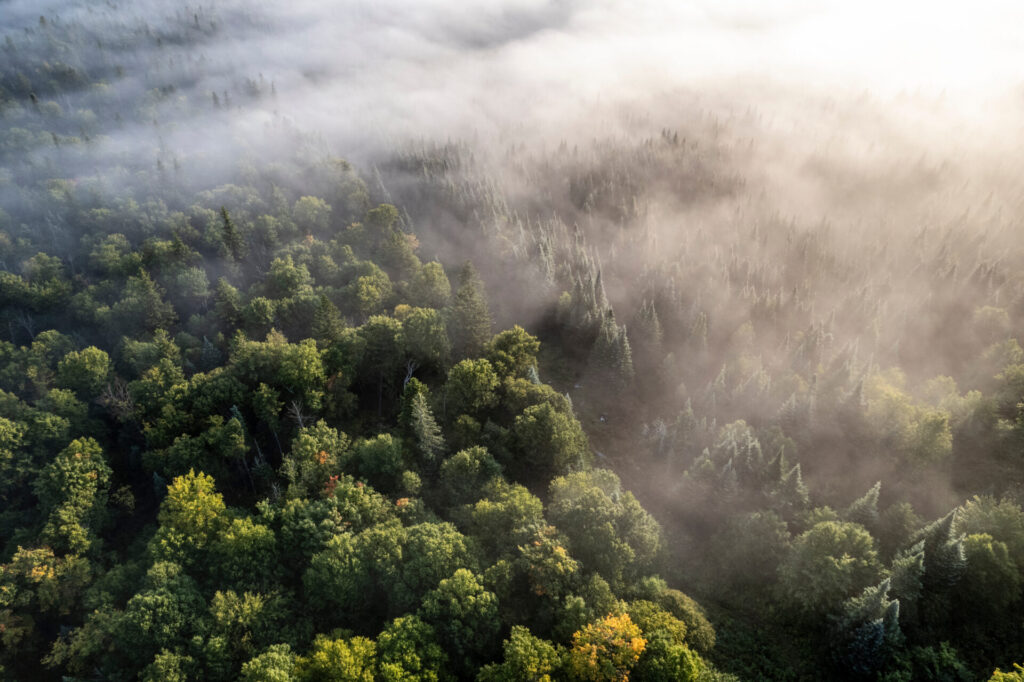
Scattered throughout northern Maine, old-growth forests that are home to unique assemblages of plants and animals store as much carbon as 5 million cars emit in a year. Until recently, most people had no idea they existed.
Maine is nearly 90 percent forested, but its old-growth forests were widely assumed to have been logged off long ago. What remained, the thinking went, were stands of young spruce, fir, and northern hardwoods recovering from and preparing for the next rotation of timber harvest. And, indeed, this constitutes most of the landscape. But in 2024, ecologist John Hagan and colleagues used Lidar technology to survey nearly 4 million hectares of Maine’s remote unorganized territories. What they found surprised everyone, including me: more than 165,000 hectares of late-successional and old-growth-like forest largely unknown to the conservation community. These forests have all the structural fingerprints of old growth: large trees, standing dead snags, and thick accumulations of fallen logs. They are the product of decades or centuries free from major disturbance.
Maine’s old forests are packed with carbon that took centuries to accumulate. A single commercial harvest, the kind that occurs on 4 to 6 percent of Maine’s private forestland every year, can release much of that stored carbon within a few years as the trees are converted to short-lived products like paper and biomass energy, the branches, roots, and slash decomposes, and any disturbed soil carbon is released to the atmosphere. Most of these old forests are not protected. They are owned by private commercial timber firms and are, in effect, merchantable timber awaiting a harvest decision. In fact, the same attributes that make them ecologically valuable – like their large trees – also make them economically valuable.
Unlike the old-growth forests of the Pacific Northwest – which are largely on federal public land and were the scene of disputes over protecting the spotted owl in the 1990s – Maine’s old forests sit predominantly on privately owned commercial timberlands. Roughly 95 percent of Maine’s forestland is privately held, much of it controlled by timber investment management organizations (TIMOs) and real estate investment trusts (REITs) – institutional investors whose management objectives are explicitly financial. These owners oversee most harvesting in the state.
So, what would it take to protect these forests and keep that carbon out of the atmosphere, where it would trap heat and contribute to climate change?
Working from Hagan’s maps, colleagues at Harvard Forest and I have estimated the cost of acquiring individual forest patches from their current owners on terms likely to appeal to them. The average price runs about $3,800 per hectare — high, because these forests contain substantial timber volume, the very quality that makes them both commercially attractive and ecologically valuable. Protecting every unprotected hectare through outright purchase would cost roughly $422 million.
But the carbon stored in those forests suggests one way to close that gap. Carbon markets give real monetary value to verified commitments to keep forests standing. Under a forest carbon project, sponsors estimate how much carbon would likely be released through harvest, commit to keeping more carbon stored in the forest over time, and sell verified credits (typically measured in metric tons of carbon dioxide) to buyers seeking to offset emissions elsewhere. Our analysis finds that revenue from those credits could cover a substantial share of acquisition costs for high-carbon forests under harvest pressure, depending on the market.
We present a tiered protection strategy that relies on diverse mechanisms to protect these forests over time. Rather than trying to protect everything at once, the goal is to concentrate resources on the largest, most ecologically intact, most carbon-rich patches that face the most immediate harvest risk. The ten largest unprotected patches cover nearly 4,000 hectares and could be acquired for roughly $16 million — a manageable target for a well-organized conservation campaign.
Maine’s situation is not unique. Across the eastern United States, old forests have been reduced to small, isolated patches. But if we look, we may find similar discoveries throughout the eastern forest. The challenge of protecting them on private land, without regulation, without coercion, and against the backdrop of commercial timber values, is one the conservation community has not yet reckoned with.
All perspectives expressed in the Harvard Climate Brief are those of the authors and not of Harvard University or the Salata Institute for Climate and Sustainability. Any errors are the authors’ own. The Harvard Climate Brief is edited by an interdisciplinary team of Harvard faculty.