Could a changing forest slow northern megafires?
In the far north, global warming begets more warming.
Wildfires in Canada and Alaska release carbon from trees and soils as greenhouse gases. Those gases trap heat, creating hotter, drier conditions that encourage yet more fires.
The Arctic is already heating three or four times as fast as the global average. As human emissions keep warming the planet, they risk triggering further releases of carbon that has been stored underground for millennia.
Taken together, “these high northern latitude feedbacks could amplify human-caused climate change by […] as much as 30 percent,” said Michelle Mack, professor of ecosystem ecology at Northern Arizona University.
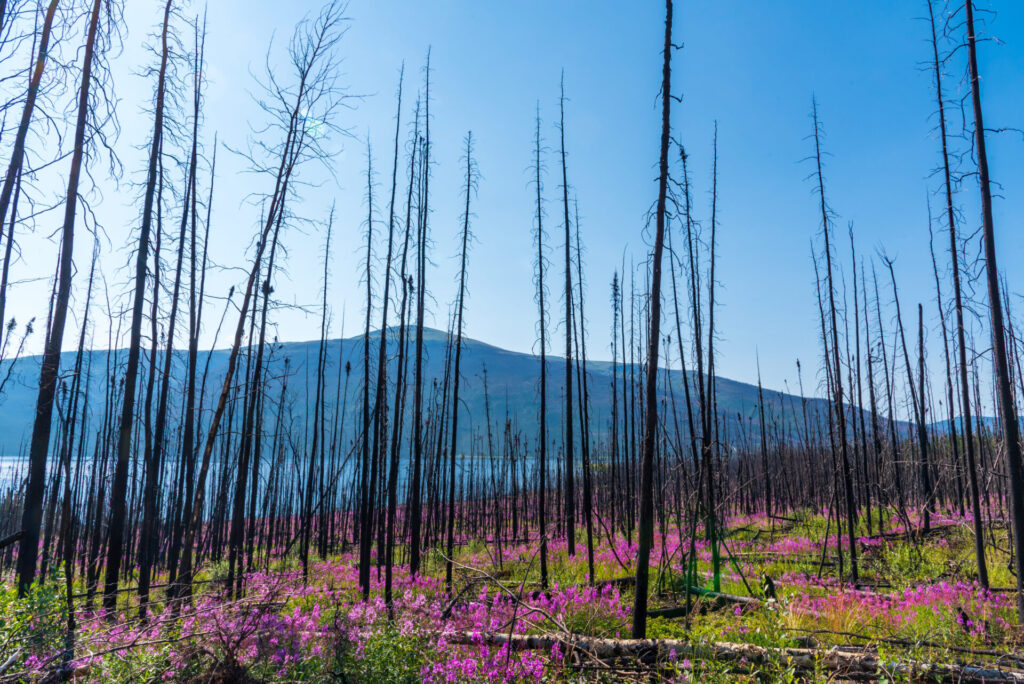
But the next forest need not burn like the last. In some scorched areas, flammable spruce is giving way to native aspen and birch. These broadleaf trees grow quickly, absorb more carbon, and burn less readily. Patches of them can even interrupt an advancing fire.
Mack is studying whether encouraging aspen and birch could protect communities and reduce carbon losses, and what that would mean for species that depend on spruce.
Why are these fires so damaging to the climate?
The boreal forests Mack studies are dominated by black spruce—a conifer with dry, waxy needles and combustible sap. A fire can move rapidly across thousands of hectares, killing nearly every tree.
Yet much of the released carbon comes from underground.
Plants absorb carbon from the air and leave it behind in dead leaves, roots, and wood. In cold, wet soils, these remains accumulate faster than they decay, forming thick layers over millennia. Those layers help insulate permafrost—ground that stays frozen for at least two consecutive years. Permafrost soils hold roughly ten times as much carbon as the trees.
Fire releases soil carbon directly by burning the organic layer. In the forests Mack’s team studied, this accounted for roughly 90 percent of the carbon emitted by fire. When soils dry out, fires can burn more deeply, consuming older carbon that survived previous fires. Burning this “legacy carbon” shows that forests are experiencing “more severe disturbance than they’ve experienced in the past,” Mack said.
Fire also removes the canopy and insulating soil, allowing more heat to reach the permafrost. As it thaws, microbes break down previously frozen plant remains, releasing carbon dioxide and methane. Those losses can continue long after the fire is out.
Why are aspen and birch replacing spruce?
When fire burns through the organic layer, it exposes deeper mineral soil that can retain moisture and provide a suitable seedbed for the tiny, windblown seeds of aspen and birch.
These deciduous trees can accumulate more carbon than spruce, and do so faster, storing much of it in their trunks. Their fallen leaves decay readily, returning nutrients to the soil that help the trees grow.
Also, their bark and foliage hold more moisture. They have few of the low branches and other fuels that help flames climb into the canopy. Alaskan firefighters already use these stands to position equipment and set controlled burns against approaching fires.
Aspen and birch can still burn. But, Mack said, “when they do burn, the fires are less intense and they emit less carbon.”
“We don’t want to replace spruce stands,” Mack said. “But if a forest burns, I think this is one of the next best outcomes for climate simply because of the difference in carbon accumulation.”
Why not just put the fires out?
Mack’s first choice, where feasible, is to keep carbon in the ground through targeted fire suppression. Better monitoring is helping crews detect fires and respond while they are still small.
“We know how to do it,” Mack said. “It becomes a policy and an economic question.”
But accessing fires across vast, remote areas is difficult. Even fires spotted early can be hard to stop. Mack described watching a 2025 blaze near Fairbanks that was reported within minutes. It still burned for weeks.
In the black spruce forests Mack studies, fires have historically returned about once a century. Preventing them can allow flammable vegetation to accumulate—that’s especially dangerous around communities.
Could a firebreak be a forest?
Around settlements and towns, forest service crews currently thin trees or grind them into wood chips to create fuel breaks. These give firefighters room to work, park vehicles and set controlled burns. But they substantially alter the forest and can be unpopular with residents. As spruce grows back, crews must clear it again.
Mack is studying whether aspen and birch could reduce the need for repeated clearing.
“What if we could harness these ecological characteristics of deciduous trees to create living fuel breaks?” she asked.
Around Whitehorse, in Canada’s Yukon, more than 100,000 aspens have been planted in fuel breaks, Mack said. If the aspens take hold, crews may have less spruce to clear.
What would be lost?
Spruce forests support mosses and lichens. Older stands also provide winter forage for caribou. When spruce stands convert to deciduous forest, “the biodiversity plummets,” Mack said.
Those losses are one reason Mack favors a patchwork. Areas of aspen and birch among the spruce could slow fires around communities, along with the carbon in their soils and the species that depend on them. Her team is studying how much deciduous forest would be needed to reduce the spread of megafires. Encouraging aspen and birch in some places might help keep spruce in others.