
One community, many polluters: States rethink how to confront the combined toll
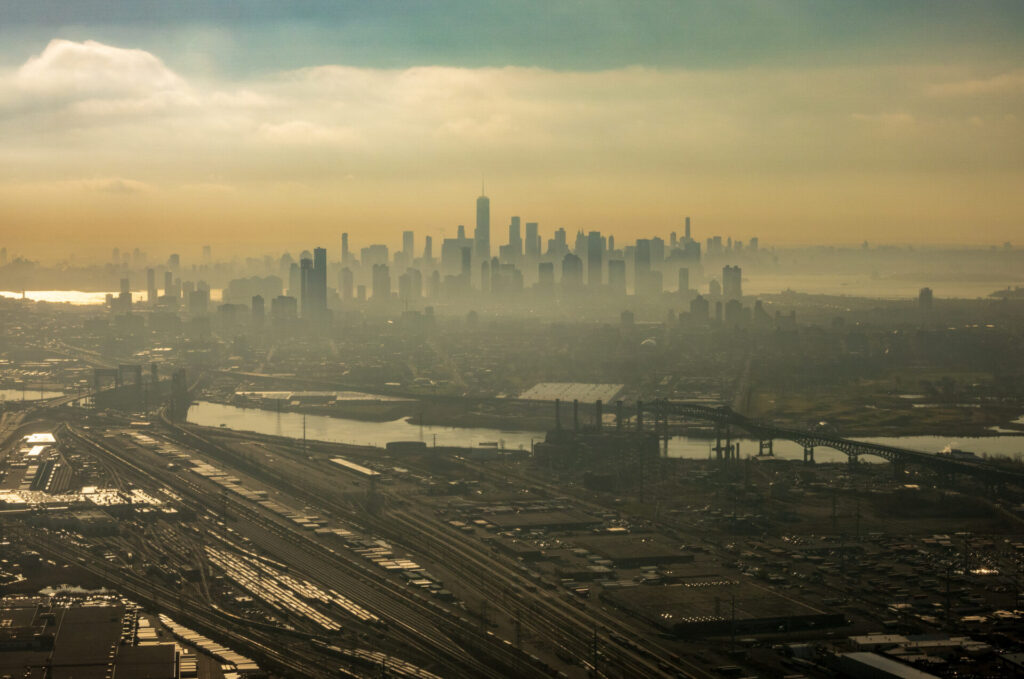
In Newark’s Ironbound neighborhood, pollution comes from almost every direction. The community of 50,000 is home to three power plants, New Jersey’s largest garbage incinerator, a major sewage-treatment facility, and more than 130 brownfield sites. Trucks serving the nearby port and airport grind through residential streets, adding diesel exhaust.
While these pollution sources are covered by thousands of environmental permits, regulators historically consider each source of pollution separately. A factory may meet every legal limit set on it, even in a neighborhood already burdened by bad air, truck traffic, and industry. But residents live with all of them at once, and environmental stressors are disproportionately concentrated in low-income communities and communities of color.
This mismatch is driving community advocates across the country to consider the tools states can use to comprehensively address these harms as part of their permitting process.
Ironbound is one such “environmentally overburdened community,” says Hannah Perls, a former senior staff attorney at Harvard’s Environmental & Energy Law Program. Pollution there combines with existing health and social stressors. Together, those burdens create cumulative impacts with devastating effects on people’s lives and livelihoods.
“We don’t experience soot, smog, noise, or a lack of green space separately,” Perls says. “All these stressors affect us simultaneously, and that cumulative effect can be far greater than if we just look at each stressor on its own.”
Some states now require regulators to consider those existing burdens together. They use cumulative impacts analysis to consider what a community already faces before deciding whether to approve an additional source of pollution.
Perls is one of the authors of a new guide from Harvard Law School’s EELP examining emerging programs in Connecticut, Massachusetts, Minnesota, New Jersey, and New York, and the choices facing lawmakers, regulators, and advocates as they design these programs.
The guide focuses on key decision points: Which communities deserve added protections? When should a cumulative impacts analysis be considered? Which health and environmental burdens should count? How much say should residents have? And when should regulators impose conditions or reject a permit?
Perls says cumulative impacts requirements have become more common at the state level over the past decade. The guide provides a legal overview of what those early states have done, and summarizes lessons learned for others now writing new statutes or regulations.
Sean Moriarty, a co-author, saw the need from inside the government. He led the development of New Jersey’s regulations – at the time, the first such rules in the nation – while serving as deputy commissioner and general counsel at the state Department of Environmental Protection.
“There was nothing like this guide available at the time,” Moriarty says. Officials often felt like they were “winging it.” Now, Moriarty hopes the guide will help people speak the same language. He says regulators, lawmakers and community groups often “talk past each other.” That can make already difficult negotiations harder.
One decision point for states: How much the legislature should determine, and how much it should leave to regulators.
A legislature can write a law using very detailed language. That gives regulators who must implement the law a clear mandate and can make protections harder to weaken. But detailed statutes can also become rigid while science, data, and conditions evolve. Leaving more to regulators offers flexibility and gives agencies more authority to decide how protective the program is. Finding the appropriate balance while also considering legal and political dynamics is a critical part of determining the ultimate effectiveness of these programs.
As an example, Perls points to New York’s use of “de minimis” (an amount too small to matter) to set various thresholds in the state’s cumulative impacts law. The law does not define the term, leaving regulators to decide what qualifies. That choice, she says, could determine how protective the program ultimately is. But writing a fixed numerical threshold into law creates the opposite risk. If the science changes, lawmakers may have to amend the statute.
A roadmap for the people in the room
Proposed laws and regulations can be hard to decipher, Perls says. The guide is meant to help simplify a complicated process and answer two questions: “How do I evaluate a proposed law or regulation to know what really matters? How do I evaluate the design options to create meaningful protections for overburdened communities?”
For Moriarty, the goal is simple: “healthier communities with cleaner air, cleaner water, less pollution.”
-As told to David Trilling