Will the AMOC slow? Collapse? Four ways scientists study the Atlantic current
The Atlantic current system that helps keep northern Europe mild has moved from climate models into national-security briefings. European officials warn that climate change could disrupt the Atlantic Meridional Overturning Circulation, or AMOC, threatening food and energy supplies.
Scientists often describe the AMOC as a conveyor belt, but that image is too simple. It is more like a circulatory system in the ocean: a network of currents that carries warm, salty water north near the surface. As that water cools, it becomes denser, sinks, and moves south again along the seafloor. The AMOC is part of the ocean and atmospheric machinery that distributes heat around the planet.
“If we didn’t have this system, we would be living on a planet that would be hotter in the equatorial tropics and colder in mid- and high latitudes, including where we are sitting today,” said Fiamma Straneo, a physical oceanographer who helps lead one major observing system in the North Atlantic.
Evidence suggests the AMOC may be slowing as the planet warms. The consequences could reach far beyond Europe: shifting rainfall patterns in Africa, Asia, and South America; stress on marine ecosystems and fisheries; changes in the ocean’s ability to absorb heat and carbon dioxide; and faster sea-level rise along the U.S. East Coast.
Much of the public discussion has focused on collapse, and on visions of an abrupt chill across the North Atlantic. Straneo says the word has been hollowed by overuse.
“It’s unclear what ‘collapse’ means; it’s not a well-defined scientific term. We should be talking about changes in the circulation and changes in how much heat the AMOC is delivering,” she said. Stressing uncertainty about tipping points or other non-linear change, she added, “We do have evidence that we should expect a slowdown.”
To examine the risks, scientists rely on four imperfect sources of evidence: paleoclimate records, direct observations from the modern ocean, climate models, and indirect “fingerprints” of past ocean behavior.
It will take decades of more data collecting to distinguish a clear long-term signal. But some of the monitoring needed to detect that signal may be at risk.
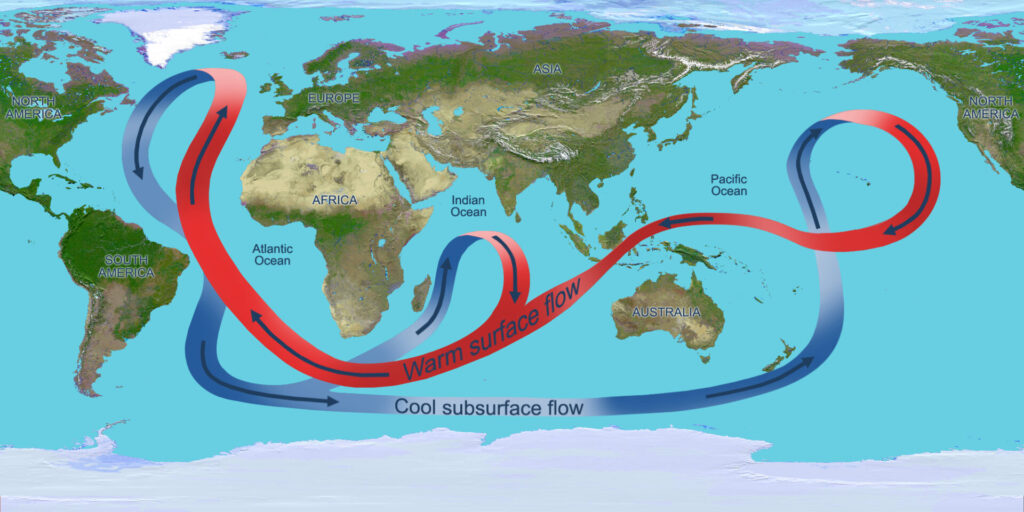
Changes in the distant past: The paleoclimatic record
The fear of a slowing is not fantasy. The Atlantic circulation appears to have weakened sharply before.
Scientists know this from chemical clues preserved in seabed sediments, in fossilized corals and the shells of tiny marine organisms. Carbon isotopes and nutrient levels can help reconstruct past changes in ocean temperature and salinity. In addition, the ratio of two radioactive isotopes may demonstrate ancient current strength. These paleoclimate records suggest that, as the planet emerged from past ice ages, the North Atlantic circulation sometimes reorganized. The deep, cold return flow appears to have become shallower and weaker.
But those upheavals happened in a very different world. Continent-spanning ice sheets were retreating, releasing huge pulses of icebergs and freshwater into the North Atlantic. Freshwater is lighter than salty water. In large enough amounts, it can sit near the surface like a lid, making it harder for the ocean to lose heat and for water to become dense enough to sink.
That is one reason Straneo is cautious about applying the most dramatic lessons from the past to the present. Greenland is melting, and that has enormous consequences for sea level. But today’s ice sheets are not the ice sheets of the last ice age. The world no longer has the same vast stores of icebergs or meltwater around places like Hudson Bay or the Arctic that could suddenly pour into the North Atlantic and disrupt the circulation.
“It’s unlikely that we will get such large freshwater forcing from the ice sheets in their current configuration as happened in the past when the ice sheets were a lot bigger,” Straneo said.
That does not mean the AMOC will not change. Warming can also weaken the circulation.
“As we warm the planet and we warm the atmosphere, it becomes harder to cool these waters and make them as dense,” Straneo said.
Modern observations: Young instruments in the Atlantic
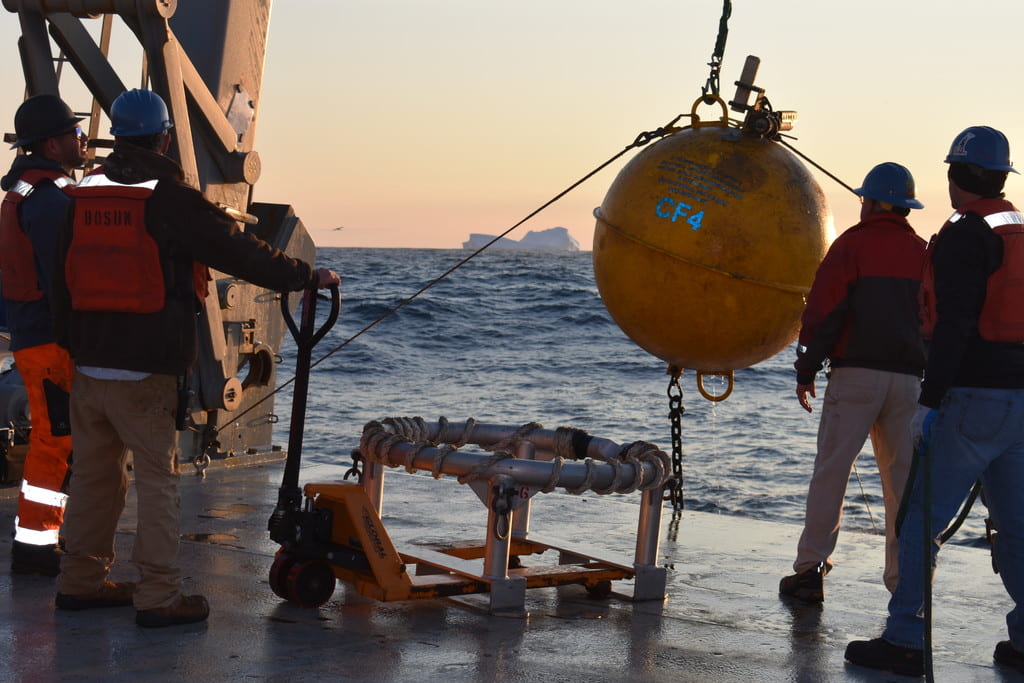
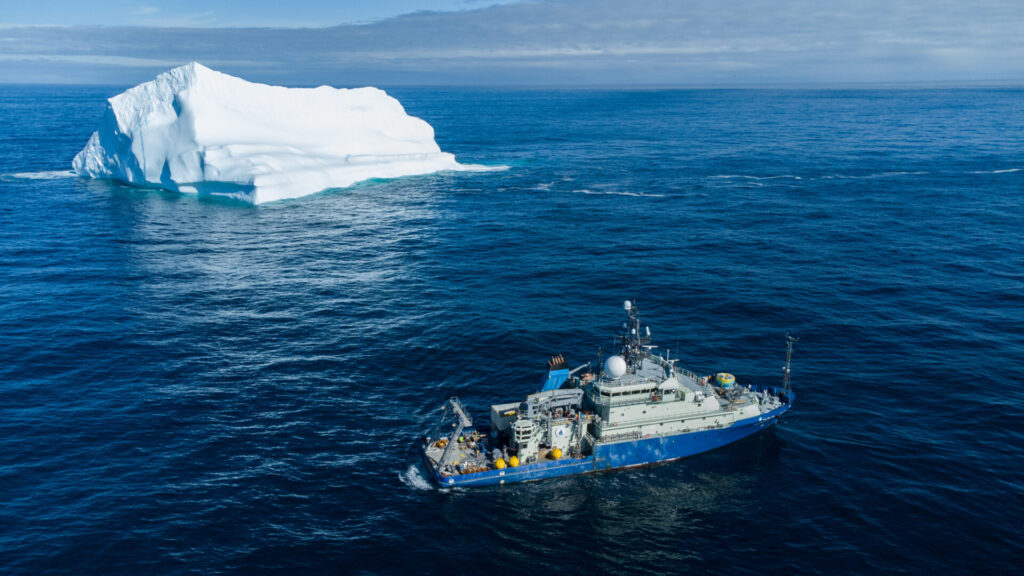
This summer, scientists from seven nations will spend months aboard reserch vessels in the north Atlantic hauling yellow metal spheres from the sea, each packed with two years of temperature data and other observations.
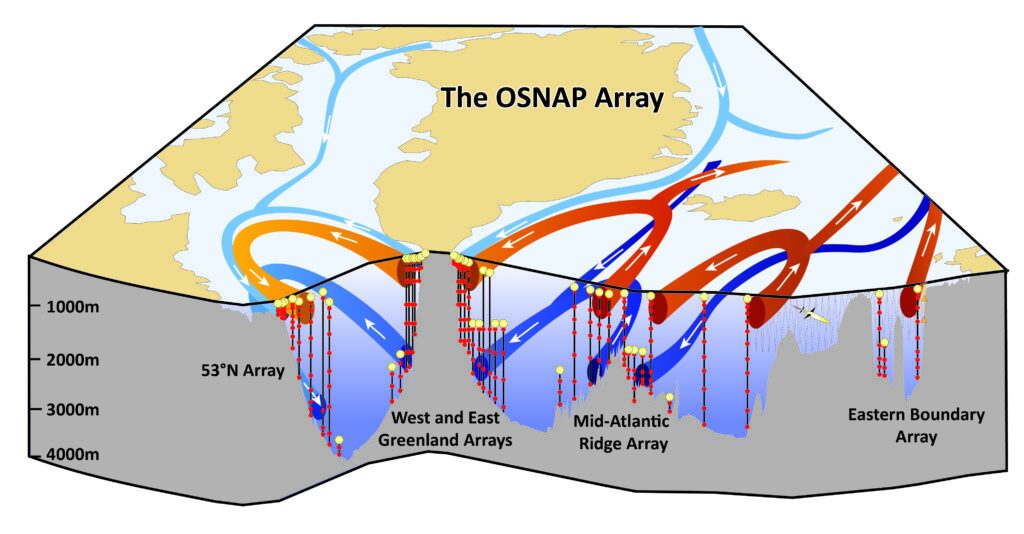
The moorings are part of OSNAP, the Overturning in the Subpolar North Atlantic Program, which has measured the AMOC since 2014 in the region where warm water cools, freshwater enters the system, and dense waters form. Farther south, the U.S.-British RAPID array has, since 2004, monitored the currents crossing latitude 26.5 degrees north between Florida and Western Sahara.
Together, they provide the best direct evidence scientists have. They are also very young records.
RAPID has shown a weak decline over roughly two decades, Straneo said. But the North Atlantic varies so much naturally that scientists cannot yet say whether that is a lasting shift or part of a longer cycle of the AMOC’s strength increasing and decreasing. OSNAP is too new to show a significant trend.
That is why the data need to keep coming. Yet the Trump administration recently tried to remove parts of a related system, the National Science Foundation-backed Ocean Observatories Initiative, which was designed to provide long-term observations at key ocean sites. Last month, the administration gave that project a reprieve after Senate pressure.
To separate a climate-driven slowdown from the ocean’s background variability, scientists need decades of continuous measurements. “These are our best tools,” Straneo said. “But the records we have are really short.”
“Climate models are predicting a slowdown”
Climate models, which test reams of real observational data against well-established physical processes to make predictions about the future, do not show the AMOC shutting down this century, Straneo said. They do show the circulation weakening as the planet warms, however, with warmer air making it harder for northern waters to cool, sink, and drive the deep-water overturning.
The models suggest that the slowdown would have been difficult to detect for much of the 20th century, becoming more apparent only in the early 21st century, Straneo said: in other words, soon.
“The climate models are predicting a slowdown, but no collapse,” she said. “You have to push the climate models very, very hard to get the system of currents to essentially stop transporting heat,” she said.
Reconstructing data
The least direct evidence comes from what scientists call fingerprints or proxies: model-derived clues in the ocean that may reflect the strength of the AMOC before modern instruments were in place.
One is the sea-surface temperature difference between the subpolar North Atlantic and the warmer subtropics or South Atlantic – a proxy that climate models suggest may be an indicator of AMOC change. A cooling of the north may signal that the AMOC has weakened.
Using these “fingerprints” and historical reconstructions of sea-surface temperature, some studies have concluded that the slowdown is underway. But fingerprints are not simple to interpret. They are model-dependent, and may not hold for different time periods. For example, temperature may be an incomplete description of AMOC changes because the AMOC depends on density, and density depends not just on temperature but on salinity. Salinity is much harder to reconstruct.
That leaves scientists with a vexing mix of evidence: Direct observations are too short; climate models point to a slowdown; paleoclimatic records show abrupt reorganizations in the past, as the planet emerged from ice-age conditions that are unlike today’s; model-derived fingerprints hint that change may already be visible, but they are imperfect.
What scientists need most is time
Straneo said it could take another 30 years of observations before researchers can be confident that they are seeing a long-term shift in the AMOC, rather than natural variability.
New technologies may eventually make that work cheaper and easier. But there is no substitute, she said, for sustained measurements in the ocean itself.
“We should be monitoring the ocean, just like we have weather balloons in the atmosphere,” she said. “We need to monitor the ocean, because it’s such a complex system that shapes our climate.”
The most likely outcome, Straneo said, is not a sudden collapse, but a slowdown with global consequences. “It will impact everything, because the AMOC is so intertwined in our climate system.”
-As told to David Trilling