get the brief in your inbox
Subscribe
The road to Belém
By hosting the 2025 UN Climate Change Conference (COP30) in Belém, Brazil has placed the talks inside the Amazon at a time when the hard-to-price value of the standing forest continues to weaken incentives to curb deforestation.
In promoting its choice, the government stated that COP30 would showcase the Amazon rainforest to the world. The statement is true in more than one way. Yes, the size, relevance, and beauty of the Amazon will be noted – it is inescapable. However, to economists, policymakers, and social scientists traveling to Belém from around the world, something else will become salient: the daunting complexity of redefining the relationship between people and forests.
Belém was founded in 1616 by the Portuguese to secure control of the mouth of the Amazon River and trade with and defend the region from the French and the Dutch. Over the following 300 years, it developed into an important trading center for Amazonian products, including cacao, spices, hardwoods, and, later, rubber. Belém’s fortunes peaked with the rubber boom from 1879 to 1921, when it became a rich, belle-époque cosmopolitan center.
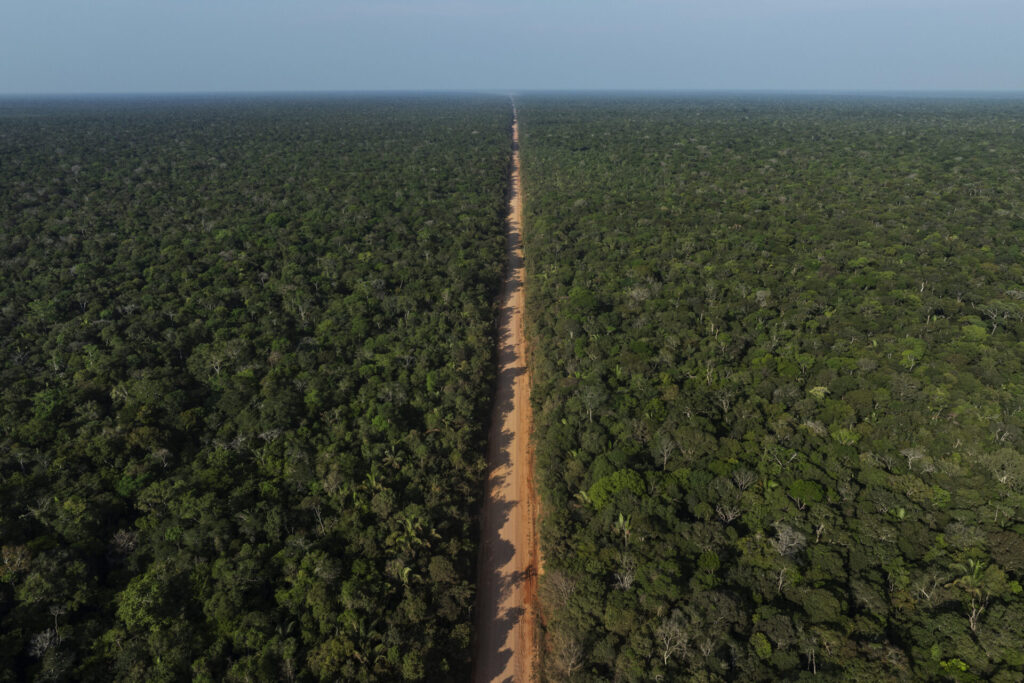
The economy stagnated with the collapse of the rubber economy in the early 20th century. Change came in 1956, with a national program to modernize Brazil and integrate its distant regions. Clearing forests and settling farmers was the new paradigm, and no other policy action made this clearer than the construction of the 1,240-mile Belém-Brasília road linking the city through the Amazon to the new capital.
In a theatrical display of progress, in 1960, President Juscelino Kubitschek mounted a tractor in the heart of the Amazon and drove it through the forest to unite the two halves of the Belém-Brasília road. The gesture marked not only the completion of an engineering feat but the birth of a national myth – that development meant clearing the forest. Paragominas, the town that emerged at the junction where the northern and southern construction teams met, became a symbol of this new frontier spirit. Fueled by government incentives, cheap credit, and official settlement programs, the Belém-Brásilia corridor soon turned into one of the most active axes of deforestation in Brazil. Between 1950 and 1990, millions of hectares of Amazon forest were cleared along its path, laying the foundation for the deforestation peaks that would follow in the decades to come. In the collective imagination, the road came to embody a larger national project – the conquest of the Amazon.
Cities, roads, and settlements in the biome were repurposed in the 1960s and 1970s. The forest was no longer an inexhaustible source of goods; it was the enemy. Clearing forests and promoting agriculture and ranching were the objectives. New cities created in the Amazon had their backs turned to the forest and their eyes fixed on a landscape that mimics the Mata Atlantica in southern Brazil, a region deforested centuries ago. In 1960, it is estimated that less than 2% of the Amazon forest had been cleared. Between 1960 and 2004, another 15% – or 650,000 square kilometers, an area the size of Texas – was cleared.
In 2004, there was a new paradigm shift. The Brazilian government, which had openly and actively incentivized deforestation in the 1960s and 1970s and had been ambivalent for most of the period between the 1980s and the early 2000s, launched the PPCDAm, an action plan to prevent and control deforestation. Within five years, deforestation fell more than 70% from the peak, demonstrating that clearing could be contained.
In addition, Congress approved a new forestry code in 2012 adding legal protections and, in 2017, launched Planaveg, a plan to restore 12 million hectares. Although political swings have made compliance and government action inconsistent, for the first time Brazil had a clear set of rules that, if enforced, could preserve and restore two of the most important tropical forests on the planet: the Amazon and the Atlantic forests.
An incentives gap
Decades of effort to conquer the Amazon have left their mark. In Brazil, the region is home to 28 million people, and its cities rank among those with the lowest levels of human development in the country. Today, poverty, land grabbing, illegal logging, and illegal mining drive most of the deforestation, as few economic opportunities arise from the value of the standing forest.
The unresolved relationship between economic development and nature is the defining feature of the Amazon. A report published this year by Amazonia 2030, an academic research initiative, showcases the complexity that resulted from four tumultuous centuries of resource extraction, settlement and adaptation.
COP30 will give participants a unique opportunity: to witness both the splendor of the Amazon and the complex, urgent challenge of forging a sustainable relationship between people and nature. This dual reality stands at the heart of why Belém was chosen and shapes Brazil’s message to the world.
This year, Harvard faculty and students will join some of the toughest conversations at COP30. Read more.
All perspectives expressed in the Harvard Climate Brief are those of the authors and not of Harvard University or the Salata Institute for Climate and Sustainability. Any errors are the authors’ own. The Harvard Climate Brief is edited by an interdisciplinary team of Harvard faculty.