get the brief in your inbox
Subscribe
Protecting nature to stabilize climate
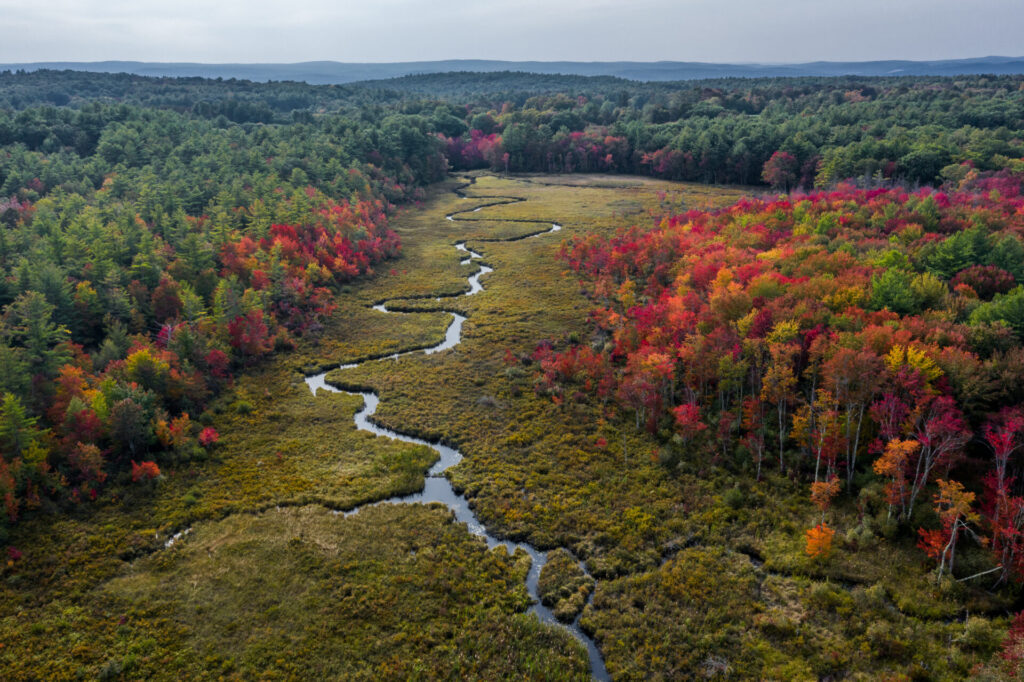
The hills of central Massachusetts are covered in thick, temperate forest: Oaks, pines, and maples have been growing back for over a century since large tracts of farmland were abandoned and the Midwest came to dominate American agriculture. Today, these forests are doing heavy lifting, actively absorbing carbon and cleaning the air. Yet, ironically, this same land is in high demand for solar farms.
This presents a difficult trade-off: Do we cut forests to install solar panels that clean up the energy grid and our atmosphere? Or do we preserve the forests to sequester carbon naturally and protect the intricate web of life that makes our planet habitable?
At COP30 in Brazil last month, some delegates acknowledged the need for integration. Humanity faces multiple grave dangers, yet we tend to treat them in isolation. Addressing biodiversity and climate change holistically will help us take advantage of synergistic solutions and avoid unintended consequences of treating them separately. The annual United Nations convention was held in Belém, in the Amazon, to emphasize the importance of biodiversity and maintaining our life-support systems as we tackle the transformation of our energy systems. The launch of the Tropical Forest Forever Facility with $6.7 billion is a concrete step toward this goal.
Synergies vs. trade-offs
Nature-based solutions to climate change, like protecting and restoring intact ecosystems – especially forests and rainforests – can simultaneously store more carbon, cool local climates, keep water flowing where it is needed, and help species migrate as conditions change. For instance, trees don’t just shade the ground; they release water vapor through their leaves (transpiration), which creates clouds and cools the atmosphere.
Yet green solutions to climate can backfire if they ignore ecological limits.
Consider the Amazon: Transpiration in the world’s most famous rainforest impacts rainfall from Argentina to Texas. It also provides the water flow for hydropower – the largest source of electricity in Brazil, the world’s 10th-largest economy – reducing the need for fossil fuel combustion.
And yet hydropower dams can block rivers, stopping fish from spawning and starving downstream ecosystems of nutrients – reducing the connectivity of ecosystems. If the forest degrades, the rains may fail, leading to less water in the rivers and a drop in hydropower production.
Similarly, replacing a native forest with a fast-growing monoculture (like a plantation of eucalyptus trees) might capture carbon quickly at first, but it creates a fragile system that supports little wildlife and is highly susceptible to disease and fire.
To avoid undermining the very life-support systems that give the planet resilience, decisions made in the name of decarbonization need to be biodiversity-aware. Species are disappearing faster than ever before: About 10.9 million hectares of forest are destroyed each year. The population of North American grassland birds has declined by 53 percent since 1970. With over 1 million species threatened, many scientists warn that we are pushing the planet toward a sixth mass extinction.
We rely on smaller creatures, too. About 75 percent of the world’s staple food crops, and one third of total agricultural production, depend on animal pollinators. Yet, the population of the American bumble bee has dropped dramatically in the last 20 years due to habitat loss, pesticide use, and climate change. If such a critical species collapses, our ability to grow food efficiently collapses as well.
The role of science and tech
At COP30, a panel I led – in collaboration with colleagues from the Science Panel for the Amazon and other Amazonian NGOs, the University of Zurich, the University of Twente, and the University of Pretoria – discussed the importance of data and monitoring for navigating these trade-offs and synergies. Long-term experiments, such as the global tree diversity trials by TreeDivNet, provide evidence that diverse mixtures of tree species grow more wood and store more carbon than single-species plantations. This happens because different species with contrasting forms, growth strategies, and rooting depths maximize the capture of light and soil resources. Biodiversity collections at institutions around the globe, like the Harvard University Herbaria and the National Institute of Amazonian Research (INPA) in Brazil, help provide the baseline knowledge telling us which species inhabit the Earth and how they are changing.
Further, new technologies allow us to see change at scale. Satellites generate imagery that can be used to map forest diversity, forest loss and regrowth, and habitat fragmentation in near real-time using AI models. These advances help track changes linked to global biodiversity targets. National mapping efforts, like Brazil’s MapBiomas, make it easier to determine if countries are meeting their pledges, such as the 30×30 target (protecting 30 percent of land and oceans by 2030).
As global negotiations on climate and biodiversity move forward – separately, on parallel tracks – both will benefit if they are guided by integrated science. If we focus only on climate and manage our ecosystems primarily for carbon, we will lose our life-support systems and our planet’s adaptive capacity. Only by seeing climate and biodiversity as one complex, coupled system shaped by human choices and institutions can societies design policies that avoid harmful trade-offs, strengthen ecosystem connectivity, and foster a more sustainable future.
All perspectives expressed in the Harvard Climate Brief are those of the authors and not of Harvard University or the Salata Institute for Climate and Sustainability. Any errors are the authors’ own. The Harvard Climate Brief is edited by an interdisciplinary team of Harvard faculty.