

New Harvard-MIT tool will help leaders navigate climate policy choices
Global trade policy is becoming increasingly complex as a patchwork of climate-related rules and standards emerges. A new open coalition of countries is exploring a harmonized approach to carbon markets that could deliver big emissions reductions and significant revenues to member countries. To help leaders understand the changing landscape and weigh joining or shaping the coalition, the Global Climate Policy Project at Harvard and MIT (GCPP) created an interactive decision-support tool.
What’s happening? A policy shift in Europe makes waves in climate and trade.
Some countries, seeking to green their economies, charge domestic industries for their greenhouse gas emissions. These countries incentivize a smaller carbon footprint by making emitters pay, usually through a carbon tax or a cap-and-trade system. To avoid putting those domestic producers at a disadvantage and discourage industries from simply moving to places with weaker climate rules, some countries are now introducing a policy tool called a border carbon adjustment. The European Union’s Carbon Border Adjustment Mechanism (CBAM) is the most advanced example of this kind of policy. The EU CBAM covers key heavy industries where emissions and global trade are significant. Imports into the EU now face a carbon adjustment fee except when the goods were already subject to a carbon price in the country of production.
Take an example: If a steel mill in Malaysia takes two tons of CO2 to make one ton of steel, they have to pay $150 per ton of steel for those two tons of CO2 when they export to the Europe Union. But, under CBAM, if they already paid a carbon price in Malaysia, they get credited for that price.
This policy has led to tremendous interest in carbon pricing around the world. This rising interest is good news for climate: In its 2025 flagship report, GCPP found that over 80% of global emissions associated with CBAM’s emissions intensive industries are already covered by carbon pricing policies (including by policies not-yet in force, like those in India or Brazil).
What next? A new coalition and big questions for policymakers.
While interest in carbon pricing is rising globally, so is recognition that coordination is crucial. If countries “go it alone,” they risk contributing to a patchwork of unilateral carbon measures that complicate trade, increase compliance costs and administrative burdens, and leave far-greater emissions reductions on the table. According to GCPP research, countries participating in a voluntary coalition around carbon would drive seven-fold emissions reductions and generate nearly $200 billion in revenue.
At COP30, recognizing the need for cooperation (and drawing on a framework proposed by GCPP), leaders from Brazil, the European Union, China, and others committed to establishing the Open Coalition on Compliance Carbon Markets, and officially launched the Open Coalition in Florence in May of this year.
Policymakers have questions.
As GCPP researchers continue to engage directly with governments and industry to shape the high-level discussions around the new coalition, they are fielding questions from policymakers around the world: How should my country respond to CBAM? Should my country coordinate with others to form a climate coalition? If my country introduces a carbon price, how will that impact our domestic production? How will that impact fiscal revenues? How will that impact my ability to meet my country’s climate goals under the Paris Agreement? How might emissions come down and how might this impact commodity prices?
To help policymakers navigate this new landscape for climate and trade, GCPP is developing the “CBAM Response and Coalition Navigator Tool.”
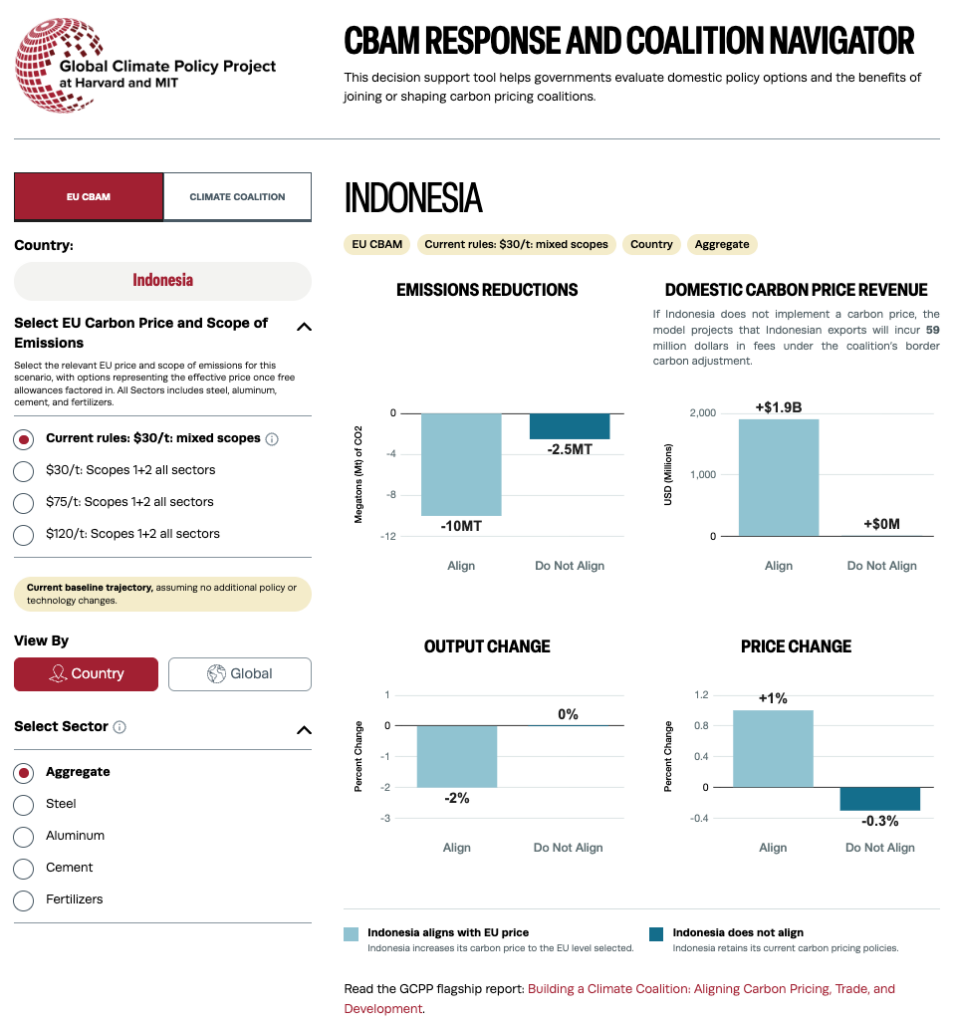
How it works
The tool allows users to see how different policy choices and scenarios might impact emissions reductions, carbon price revenues, output, and price in key high-emissions sectors. Researchers used economic research and granular, plant-level data to model how the market will evolve and how different scenarios or coalition designs will affect different key outcomes.
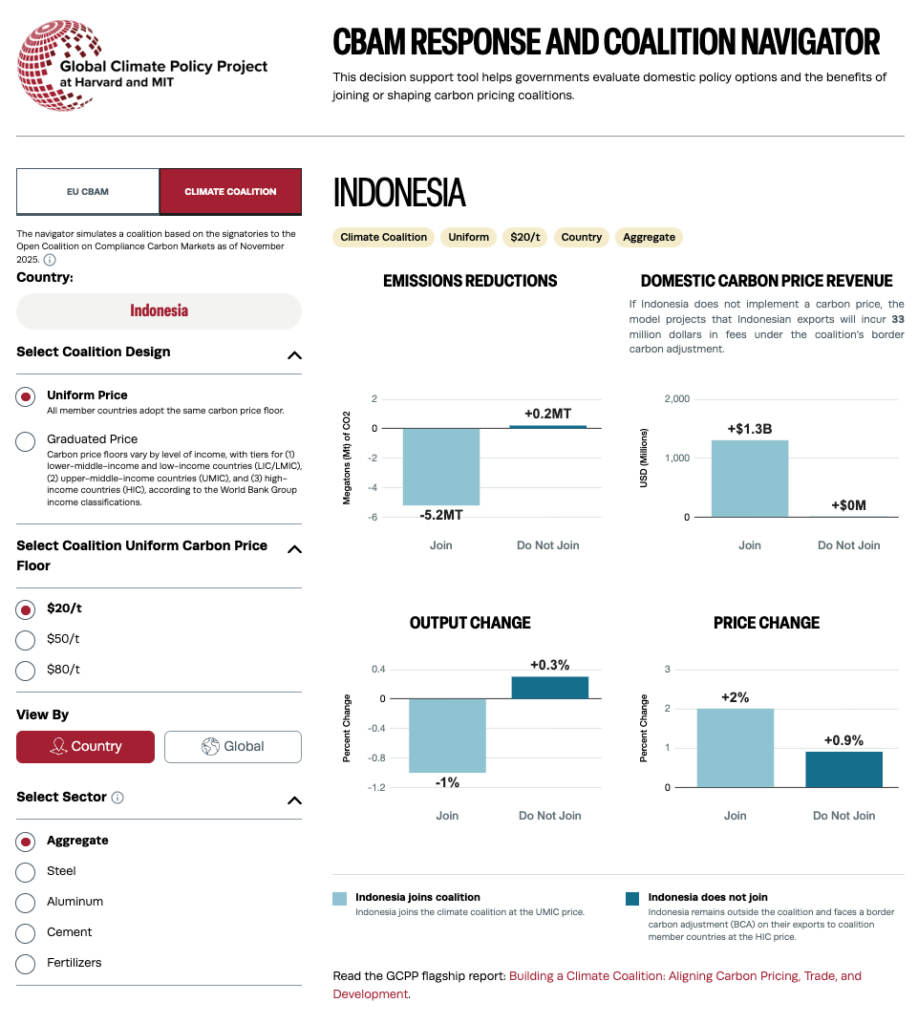
Take an example: You’re a decision-maker in Indonesia weighing whether to implement a $20 per ton carbon price on four sectors covered by CBAM: steel, aluminum, cement, and fertilizer. You want to know how much revenue this would generate for Indonesia. The tool predicts $1.3 billion in revenue and 5 MT emissions reductions:
Next stop, London: Advancing the climate coalition agenda
Next week, the GCPP team in collaboration with the MIT Climate Policy Center will host events at London Climate Action Week to continue the conversations that will help shape the next generation of climate governance.
Read more about GCPP’s plans for London Climate Action Week here.