Four words, one hour lost: Climate change is outpacing COP negotiations
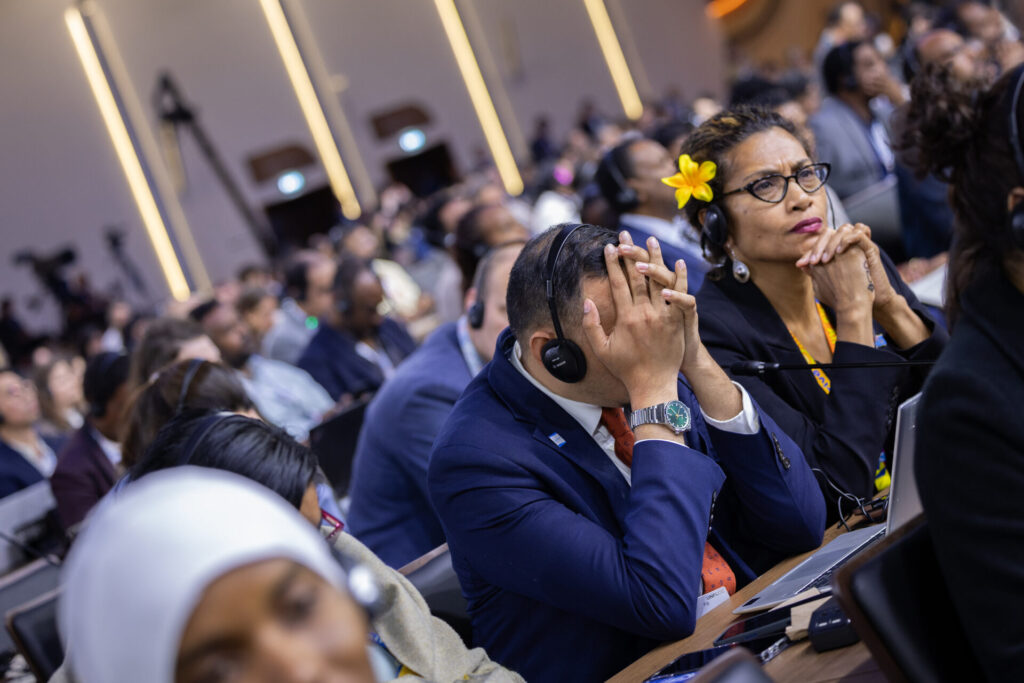
Earlier this month, I sat in a negotiating room in Antalya, Türkiye, and watched delegates spend about an hour on four words. The session was meant to advance the Global Goal on Adaptation, the UN process mandated by the 2015 Paris Agreement to define what it means to prepare for a hotter planet.
Instead, the room argued over whether a cover note should say a draft text “has no formal status”—they could not decide if the text were a working draft or binding. After back and forth between the Arab Group, the Alliance of Small Island States, the UK, Norway, and Canada, a decision about the unfinished draft’s status was postponed.
A few days later, the talks collapsed as oil producers blocked any mention of fossil fuels from a final communiqué.
I attended this year’s COP31 to follow global climate negotiations alongside many colleagues from the climate-health community, and to participate in an official side event about the health and economic benefits of a just transition. As an epidemiologist studying extreme heat and other climate stressors, I wanted to learn how global leaders plan to protect our health as temperatures rise.
What I learned is that the COP process is not keeping pace with the harms it is meant to address.
Heat risks are speeding up
While delegates debated procedure, heat has kept to its own schedule. This year, Europe experienced its deadliest summer on record, with 50,000 heat-related deaths across 854 cities; a Nature study in October attributed roughly 65% of them to climate change. The 2025 Lancet Countdown linked heat to about 546,000 global deaths a year. In 2024, our most vulnerable members of society, including infants and older adults, faced more than 20 heatwave days per person, roughly four times what they would have experienced 20 years ago.
My own research, covering more than 3.4 million emergency department visits by U.S. adults, found that visits for mental-health conditions rise about 8% on extreme-heat days, including visits for substance use, anxiety, mood disorders, and self-harm. The increase appeared across every adult age group.
COP is necessary, but not sufficient
UN climate decisions are made by consensus, so in practice any one of nearly 200 parties can object to and thereby delay a text. That design has purpose. A delegate from a Pacific island has the same power as one from a G20 economy—a critical protection that majority voting would not offer. But this also means progress tends to move at the speed of the most reluctant party, and fights over substance are often waged as fights over procedure.
None of this means COP should be abandoned. The annual Conference of the Parties is the one place where every country sits at the same table, and consensus is what gives the most vulnerable a voice. But a process that needs an hour to settle the status of a draft cannot be an engine of adaptation. It will not reach an 85-year-old in a boiling top-floor apartment in Paris, or the more than 266,000 people living unsheltered across the U.S., before the next heat season.
That work must happen alongside the negotiations, and it can start now, with health departments writing heat action plans, hospitals preparing for summer surges, cities opening cooling centers, and research teams testing faster deployment of health protections. COP can set the direction, but the pace must come from local leaders, public health officials, and researchers pushing for innovative solutions that match the speed of the climate crisis.
Accelerating adaptation with faster data
Here in the U.S., our research group is exploring how faster access to health data can help communities respond to extreme heat.
Many heat deaths and illnesses are preventable. But to target strategies like early warning systems, cooling centers, outdoor worker protections, and outreach to older adults living alone, local governments and public health agencies need to know who is being impacted and where. These data can take years to arrive.
We need a more agile response. Recent research I led with colleagues at Boston University and Truveta, a health-data analytics company, used anonymized electronic health records (EHR) to capture how heat waves impact emergency visits for all causes, heat-related illnesses, kidney diseases, and psychiatric conditions. EHRs are available within one week of an emergency room visit, providing data much more quickly than using insurance claims, the traditional data source. Faster data can show whether warning systems are working, where to target investments, and which populations need tailored protections.
These tailored protections can work, but only if people use them. Our research shows that some of the most vulnerable do not. On a single night in January 2025, 745,652 people in the U.S. were homeless, including 266,320 living unsheltered. In a forthcoming study, colleagues and I interviewed 30 people experiencing homelessness and mental health crises in Boston during summer 2024. Most reported symptoms of heat-related illness, yet few had heard of the city’s 16 cooling centers and only one had ever visited one. The heat alerts they received never mentioned these resources.
Measuring whether adaptation works
These local findings should also shape how climate negotiators measure progress: by whether the protections they fund reach people and reduce illness.
At COP, the debate over funding for climate adaptation focused on how much money would be provided and how to track it. It is just as important to know whether the people most at risk receive heat warnings and if they use the cooling centers that money pays for. Tracking spending alone cannot show whether those investments are preventing illness.
The negotiators will reconvene next November in Ethiopia. The heat will arrive first.
All perspectives expressed in the Harvard Climate Brief are those of the authors and not of Harvard University or the Salata Institute for Climate and Sustainability. Any errors are the authors’ own. The Harvard Climate Brief is edited by an interdisciplinary team of Harvard faculty.