get the brief in your inbox
Subscribe
When heat beats CO₂: Climate change will cut U.S. yields and raise world food prices
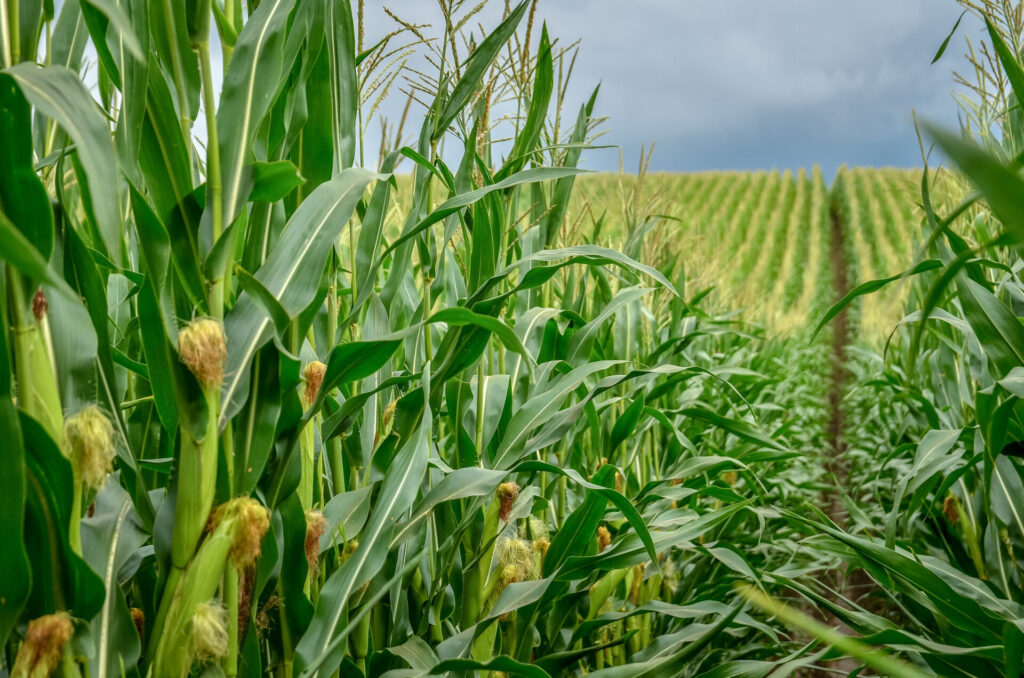
A recent Department of Energy report emphasized the supposed agricultural benefits of global warming. It pointed to CO₂ fertilization, the way that more carbon dioxide can accelerate plant growth. What it downplayed are the costs that arrive with climate change and higher concentrations of heat-trapping CO₂: hotter growing seasons that pull yields down.
Because the United States produces roughly a third of the world’s corn and soybeans, even small domestic shortfalls ripple through global markets.
Two forces pulling yields in opposite directions
Climate change affects agricultural production in two opposing ways.
First: heat and rain. In the U.S., corn and soybeans are grown predominantly in the Midwest where the common practice is dryland (non-irrigated) agriculture. Unlike crops grown in greenhouses or under highly irrigated conditions, these are directly exposed to fluctuations in temperature and precipitation. Heatwaves are projected to become more common with climate change, severely affecting yields. Investments in irrigation would decrease the sensitivity to heatwaves, but they come at significant cost.
A measure of extreme heat known as “degree days” – capturing both how much and for how long temperatures exceed crop-specific thresholds (84°F for corn and 86°F soybeans) – can explain year-to-year variability in yields. A 2009 model I developed with Michael Roberts, using data back to 1950, accurately anticipated the roughly 25% yield loss during the 2012 heatwave across the corn belt.
Second: CO₂ fertilization. Higher CO₂ can increase yields, with effects that vary by crop and setting. Both chamber studies and outdoor Free-Air CO₂ Enrichment (FACE) experiments find a modest boost. In a recent working paper, my colleague Charles Taylor and I link year-to-year fluctuations in CO₂ readings from satellites across U.S. counties to yield changes in farmed fields across the country.
When combining the negative effect of rising heat with the positive effect of CO₂ fertilization, reducing greenhouse gas emissions to limit global warming raises aggregate U.S. corn and soy production.
Moreover, warming doesn’t hit every region equally. The warmer southern U.S. loses more as cooler northern areas gain relative suitability. Some production will shift north within the U.S. and internationally, softening – but not erasing – overall shortfalls.
Small supply hits, outsized price moves
When discussing the effects of climate change on agriculture, it is important to distinguish between producers and consumers.
Prices for corn and soybeans are low in inflation-adjusted terms; coupled with increases in input costs, that strains farm finances. Historically, when policymakers wanted to help farm incomes, they used “set-aside” programs to tighten supply and lift prices. Climate-induced shortfalls work similarly.
Demand for staple crops adjusts only slightly in response to price changes – people still have to eat. Economists call this phenomenon “inelastic demand.” As a result, profits can increase even as the quantity produced falls. For each 1% reduction in corn or soybeans grown globally, prices would need to increase by 6-7 percent to restore market equilibrium – where the supply equals the demand.
Bottom line
As rising temperatures push production to shift north, and aggregate output slips, inelastic demand means even a 1% U.S. shortfall (which, given America’s global market share of roughly a third, equals a 0.3% shortfall in worldwide production) could nudge global prices up just over 2% – boosting farm profits while squeezing consumers.
Tighter markets can lift farm profits even as volumes fall. Consumers, however, face higher food bills. U.S. food prices rose by 23.6% from 2020 to 2024; further increases in basic commodity prices would add additional strain.
Climate-driven production losses thus have opposite effects on producers and consumers, with some farmers benefiting and many households paying more.
All perspectives expressed in the Harvard Climate Brief are those of the authors and not of Harvard University or the Salata Institute for Climate and Sustainability. Any errors are the authors’ own. The Harvard Climate Brief is edited by an interdisciplinary team of Harvard faculty.