

Field Study: Catching Cow Burps in Real Time
Methane is a short-lived but powerful greenhouse gas; cutting methane emissions can slow near-term warming and improve air quality by reducing harmful ground-level ozone. As ruminants digest feed, they release methane –– through burps. In fact, emissions from cattle are the largest source of human-caused methane emissions (roughly 25% of the total) – so reducing emissions from cattle is an important part of tackling climate change. Achieving these benefits, however, requires not only effective mitigation strategies but also reliable ways to measure methane under real farm conditions.
In June, members of Harvard’s cattle-methane-sensing team, Haritosh Patel, a postdoctoral fellow, and Nicholas Lee, a research intern, attended the State of the Science Summit: Reducing Methane from Animal Agriculture – at the University of California, Davis. The summit brought together researchers, government officials, industry leaders, and agricultural stakeholders to discuss emerging approaches to reducing livestock-methane emissions, including feed strategies, animal health, low-methane genetics, and measurement technologies.
Patel and Lee are researchers in Harvard Professor Joanna Aizenberg’s lab; Aizenberg is the Amy Smith Berylson Professor of Materials Science and Professor of Chemistry and Chemical Biology.
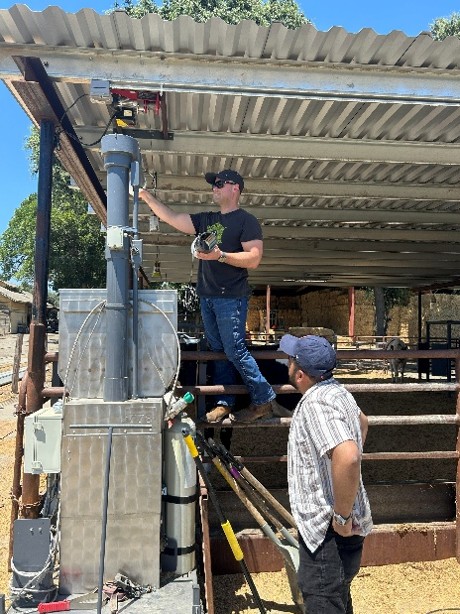
For the Harvard team, the trip marked an important step from laboratory development to field validation. In collaboration with UC Davis Professor Ermias Kebreab – a global expert on methane emissions from cattle – and his team, Patel and Lee began testing their methane sensor against the GreenFeed system, an industry-standard for measuring enteric methane emissions from cattle. (The Harvard sensor is known as a GRAZE-Tag – “Gas Recognition and Analysis using Zonal Ear Tag”.) Paulo de Meo Filho, a UC Davis postdoctoral scholar, and senior farm crew mechanics Mike Amato and Chris Beach helped install the Harvard sensors and set up the trial. The installation went smoothly, and early results were encouraging: the GRAZE-Tag detected its first cow burps in close agreement with GreenFeed.
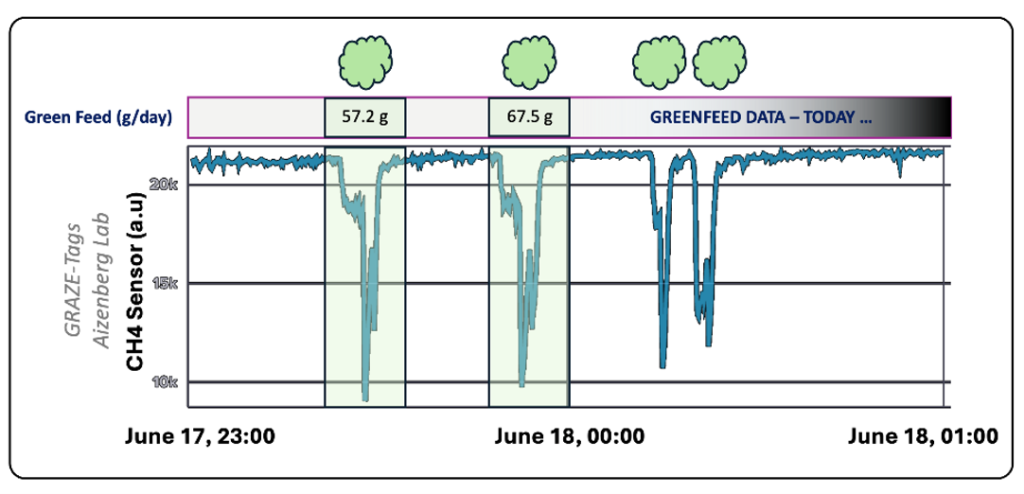
The field study is part of a broader effort to make methane measurement more practical, scalable, and compatible with typical farm operations. Existing systems such as GreenFeed provide high-quality data, but they can be expensive and difficult to deploy across large fields of grazing cows. The Harvard team’s methane detector is being developed as a low-cost alternative that could complement established systems while enabling broader, real-time monitoring across farms.
This is the second time the Harvard sensing team participated in the State of the Science Summit. See these articles on the project and the 2025 summit. Their project is supported by the Harvard Initiative on Reducing Global Methane Emissions, a research cluster of the Salata Institute for Climate and Sustainability.
The summit provided valuable insight into the research and technologies driving livestock methane mitigation. Feed strategies, animal genetics, engineering, policy, and producer collaboration are all important parts of this effort, and reliable methane detection will be essential for evaluating which approaches are most effective.
This early field study is only a first step, but it is a meaningful one. If compact methane sensors can be validated against proven systems like GreenFeed, they could help accelerate research on climate-smart livestock practices. The future is close: a low-cost, real-time, full-farm methane detection system may soon be within reach.