

How climate guided early migration
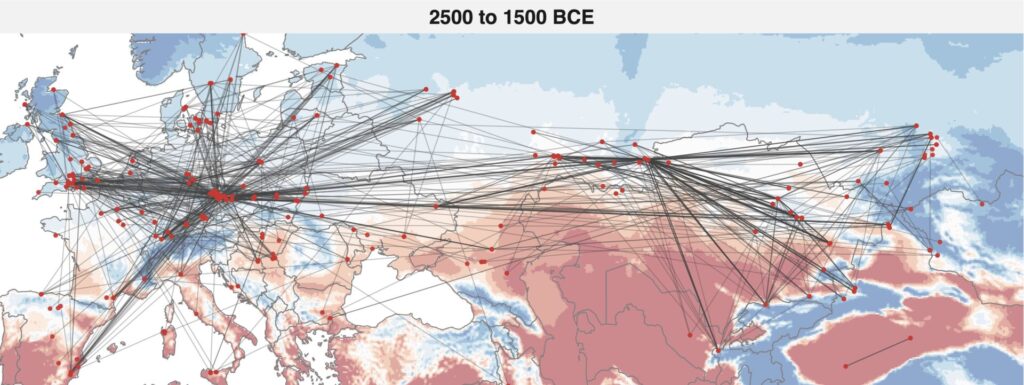
For much of human history, people moved. But they did not move at random. They carried practical knowledge with them about the rains, the soils, and the seasons.
A new working paper by scholars at Harvard and the University of Michigan treats that knowledge as a form of capital. Like any capital, it had limits. A farmer who knew one growing season could not simply transplant that knowledge anywhere. A herder used to one rainfall pattern could not assume the same skills would work in a different grassland. So prehistoric migration, the authors argue, often followed ecological fit. People tended to move toward places where what they knew still had value.
Using ancient DNA from people buried across Eurasia over the last 10,000 years to identify common ancestral lineages, the authors reconstruct prehistoric migration routes. They find that movement declined as differences in heat, rainfall, and soil increased.
The paper also treats climate change as a force that redrew opportunity, not just as a shock that drove people away. Warming after the last Ice Age made some new lands suitable for farming. Alternate periods of cooling expanded grasslands in places where pastoralists could move with their animals. In both cases, climate helped determine not only who left, but where they could go.
“Climate and Prehistoric Migration”
Peter Huybers, Marco Tabellini, Charles A. Taylor, Francesco Toti
National Bureau of Economic Research, June 2026