
Kampala’s minibuses waste hours in line. A new experiment asks why
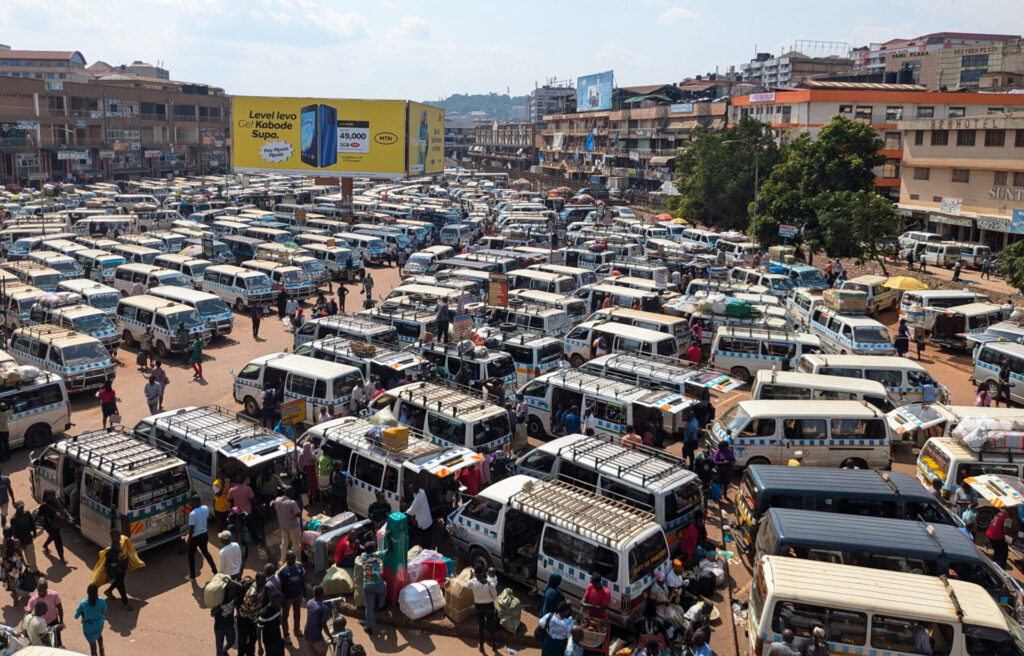
At minibus terminals in Kampala, Uganda’s capital of some five million, dozens of 14-seat matatus sit nose-to-tail, waiting their turn to load. Riders can spend 45 minutes before a departure as drivers hold out for fare-paying passengers to fill every seat; drivers spend hours inching toward the front of the line.
This is a typical scenario for hundreds of millions of commuters in low-income countries, where mass transit systems do not exist or have not kept up with rapid urbanization. It is a vicious cycle: Around the world, this unpredictability pushes people toward motorcycles and private cars – increasing congestion, air pollution, and planet-heating carbon emissions. In Uganda, emissions from the transport sector have climbed 300 percent in two decades; the United Nations says Kampala faces a “severe vehicle pollution crisis.”
Harvard economist Gabriel Kreindler is trying to understand why this system is so hard to improve, and what fixes could make it work better for people while cutting the climate costs.
The hidden logic of the queue
In greater Kampala, the minibus routes are organized by associations. These trade cooperatives “intend to act as monopolists,” explains Kreindler, by restricting access to newcomers, carving out territories, and setting fares. But they are limited in how much they can control drivers, who, despite grueling hours, “barely scrape by.”
“Half of the time, the average vehicle is not loading and not transporting people,” he says. “They’re just empty, waiting in the queue – sometimes for three or four hours.”
Despite these inefficiencies, driving can still pay. Kreindler estimates that fare revenue minus fuel and fees (to the bus owner, to the association) leaves around 30 percent for the driver. So, drivers are eager for the work. Across associations, the more profitable routes tend to have more drivers and longer queues.
The result is a grim equilibrium, says Kreindler: “It is worth the profit earned from a single trip to wait in the queue.”
Working with the associations, Kreindler and his team* are testing whether a small nudge can make the matatus move more regularly. Focusing on routes and times when demand is low enough that loading can take 45 minutes, they are paying drivers to depart 20 minutes after the last matatu. The payment covers the value of the empty seats – but only if the driver leaves immediately.
Last fall, they piloted the test for three weeks across 47 routes. Passengers were alerted with signs in the windshield promising “speedy departures.” On the simplest metric, it worked: The number of departures increased by almost a third. Drivers and passengers waited less time.
In theory, that should shorten queues over time.
But that’s not what the team found. Instead, preliminary data suggest, “the queues are just as long in treatment as in the control.” Kreindler’s interpretation is that the minibus system adjusts: Higher returns induce more drivers to line up. In other words, the system swallows the efficiency gain.
“The results suggest this system may be quite challenging to change. It may be quite fundamental to how these associations operate.”
For policymakers, that is a warning: An efficiency subsidy can be competed away if it attracts more vehicles. If you improve the returns to operating (by making each hour more “productive”), you may attract more participation and wind up back where you started: more vehicles competing for the same demand, more congestion near bus stations.
Seeking solutions
Kreindler notes that the associations, often seen as the obstacle, may be the only institutions with enough leverage to deliver reform at scale. They keep rosters and decide who operates where, making tools like quotas possible. One hard constraint is cash flow. Rotating drivers out can mean days with “no cash,” even as drivers still owe daily payments to bus owners.
Kampala’s minibus market sits between unregulated informality and fully planned transit. Kreindler’s work is a rare attempt to test interventions in that messy middle. It shows why a simple nudge may not be enough on its own.
The team is now exploring market-design options that reduce the incentive to queue: For example, a per-trip tax on passengers redistributed to association drivers, including those not driving that day. Or variants of “cap and trade” that impose an aggregate quota on the number of buses that may operate and auctioning off quota rights to generate revenue.
Change may be difficult, but the payoff large, Kreindler says: “If it’s possible to break this link, this could hold big promises for riders and the planet.”
-As told to David Trilling
*Members of the team include:
Jay Garg, doctoral candidate in economics, Harvard University; Tamara Kerzhner, assistant professor of urban and regional planning at Technion Israeli Institute of Technology; Judith Mababazi, doctoral candidate, Makerere University; Eu-Wayne Mok, doctoral candidate in economics, Harvard University; Prof. Carole Voulgaris, associate professor of urban planning; Harvard University’s Graduate School of Design.