Why Harvard should care about the Arctic
Because it is warming faster than any other region on Earth. Because it is home to one-third of the sub-soil carbon capable of escaping into the atmosphere. Because what happens in the Arctic doesn’t stay in the Arctic.
There was no shortage of answers when the Belfer Center’s Arctic Initiative asked the Harvard community why it cares about the Arctic at a September 15 networking breakfast to kick off Harvard Climate Action Week.
The Arctic, speakers agreed, is the frontier of climate change.
In a series of lightning presentations, participants shared Arctic-focused work from epidemiology to international law, including voices from Indigenous communities and defense. Across disciplines, they called for integrated approaches and urgent innovation to address accelerating climate change.
“Rapid warming in the Arctic … is a warning about what’s coming for us all if we fail to reduce greenhouse gas emissions,” said John Holdren, co-founder of the Arctic Initiative and former director of the White House Office of Science and Technology Policy. “Emissions from thawing permafrost are speeding up warming globally, and bigger Arctic wildfires under climate change are spilling toxic smoke into the mid-latitudes where most of us live.”
Scientists in the room pointed to many ways that the Arctic impacts global ecosystems.
The ocean food chain “depends on the invertebrates that bloom in these high latitudes. A bad year for whatever reason – the currents change, the nutrient inputs change – can make for a terrible year” across the global ecosystem, said Gonzalo Giribet, professor of Organismic and Evolutionary Biology and co-chair of Harvard’s new Biodiversity and Planetary Stewardship Committee.
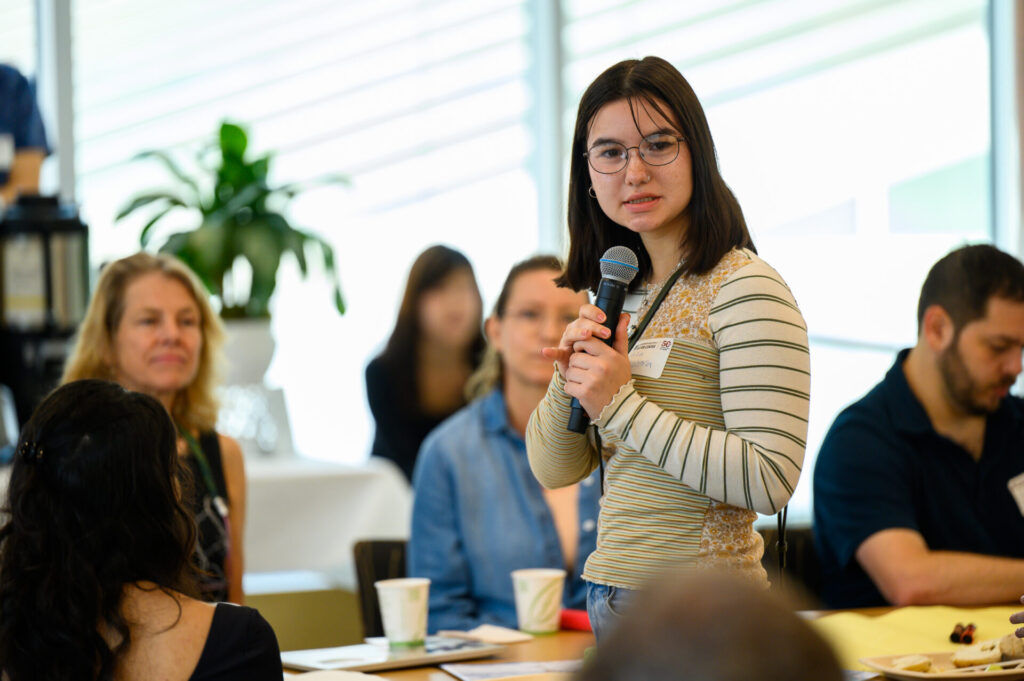
Indeed, one student, Talia Veldstra, a Harvard College freshman from northern Alaska, described how coastal erosion is changing animal habitats and directly impacting her community’s survival. “I’m Iñupiaq,” she said, “and the loss of sea ice is affecting our polar bears and our walruses, which is affecting our hunting and our food sources.”
How the Arctic story gets told
Several speakers discussed how information about the Arctic reaches different audiences.
News coverage is dominated by security issues and fossil-fuel extraction, not climate change, said Allison Agsten, director of the Center for Climate Journalism and Communication at the University of Southern California. Her team’s analysis of a decade’s worth of media coverage found mentions of the region increasing overall, though “political and business news about the Arctic received nearly five times more coverage than climate change.” The person most cited: Vladimir Putin.
Closer to home, Rebecca Arellano, the Green Jobs Specialist at City of Cambridge, said she attended the networking breakfast “to learn all about what you guys are doing. The Arctic matters. I’m here for ideas on how we can teach Cambridge K-12 students about the Arctic.”
Shared seas, shared solutions, shared leadership
Many participants pointed to the need for transboundary cooperation to address unique challenges in this vast region undergoing rapid change.
“As we lose Arctic sea ice, a new ocean is opening up, and new shipping routes, resource extraction and geopolitical conflicts are adding to these pressures,” said Margaret Williams, senior fellow at the Arctic Initiative. “Addressing these challenges requires a transboundary approach.”