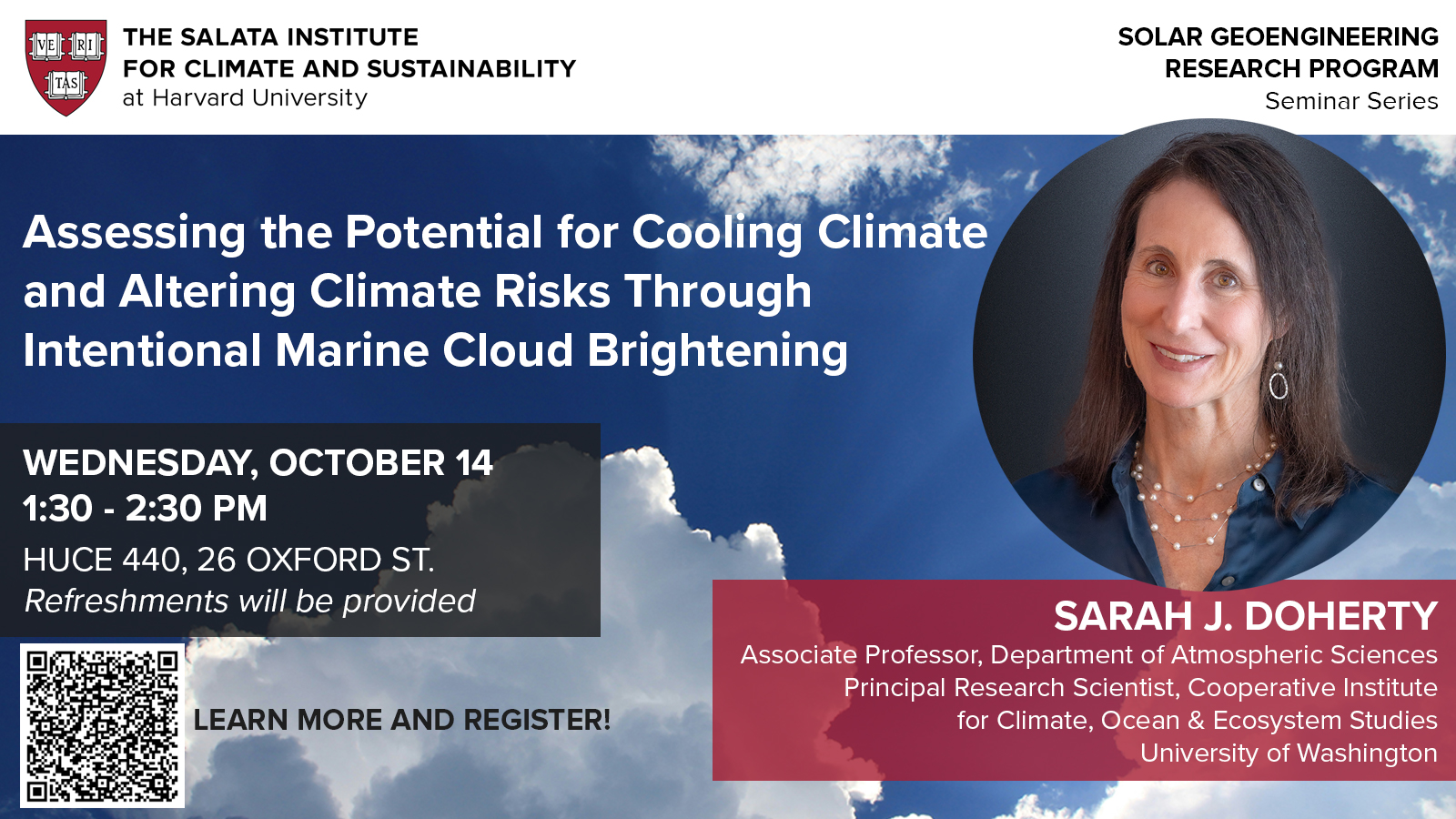
SGRP Seminar: Assessing the Potential for Cooling Climate and Altering Climate Risks Through Intentional Marine Cloud Brightening
Wednesday, Oct 14, 2026, 1:30 pm - 2:30 pm
Center for the Environment, Seminar Room 440, 26 Oxford Street Cambridge
Pollution aerosols are currently cooling the climate by ~0.5°C, offsetting about a third of climate warming by greenhouse gases. Most of this cooling effect comes from how pollution aerosols alter clouds — on net, making them more reflective. The idea behind marine cloud brightening (MCB) is to mimic this effect, using sea salt aerosols to brighten low clouds over the ocean. In this talk, Prof. Sarah Doherty (University of Washington) will discuss research to assess the potential for MCB to cool the climate and how different implementations of MCB would affect future climate change. She will also discuss the role of different modes of study (modeling, laboratory studies, observational analyses, field experiments), arguing that greater clarity and specificity is needed when discussing, in particular, what could be learned from different scales of field experiments and the potential risks of these experiments. While the talk will focus primarily on physical science research, Dr. Doherty will also discuss the link between the generation of robust scientific information and effective decision-making around whether and how to ever use solar geoengineering.
Dr. Sarah Doherty is a Principal Research Scientist at the Cooperative Institute for Climate, Ocean, and Ecosystem Studies and an Associate Professor in the Department of Atmospheric Sciences at the University of Washington. She is currently the Program Director for the University of Washington Marine Cloud Brightening Research Program. Dr. Doherty’s expertise is in atmospheric aerosols and their role in climate. She was previously the Executive Officer of the International Global Atmospheric Chemistry project (2003-2012), was one of four Coordinating Lead Authors on “Bounding the Role of Black Carbon in Climate” (Bond et al., 2013; one of JGR-Atmospheres' most-cited papers), was a lead author on the 2017 U.S. National Climate Assessment – Vol. I Climate Science Special Report, and was the Editor for the 2018 and 2022 Scientific Assessment of Ozone reports to the parties of the Montreal Protocol.
Register
Dr. Sarah Doherty is a Principal Research Scientist at the Cooperative Institute for Climate, Ocean, and Ecosystem Studies and an Associate Professor in the Department of Atmospheric Sciences at the University of Washington. She is currently the Program Director for the University of Washington Marine Cloud Brightening Research Program. Dr. Doherty’s expertise is in atmospheric aerosols and their role in climate. She was previously the Executive Officer of the International Global Atmospheric Chemistry project (2003-2012), was one of four Coordinating Lead Authors on “Bounding the Role of Black Carbon in Climate” (Bond et al., 2013; one of JGR-Atmospheres' most-cited papers), was a lead author on the 2017 U.S. National Climate Assessment – Vol. I Climate Science Special Report, and was the Editor for the 2018 and 2022 Scientific Assessment of Ozone reports to the parties of the Montreal Protocol.

ADD YOUR EVENT TO THE SALATA CALENDAR
Are you hosting a Harvard-affiliated event that is related to climate change and/or sustainability? Please submit your event to the Salata Institute event calendar using this quick form! We look forward to sharing your event with the Harvard community.
Submit Your Event