Sensor-Fusion Flight Test: A Case Study with Exploration Potential
Wednesday, Jan 07, 2026, 1:00 pm - 2:00 pm
Virtual
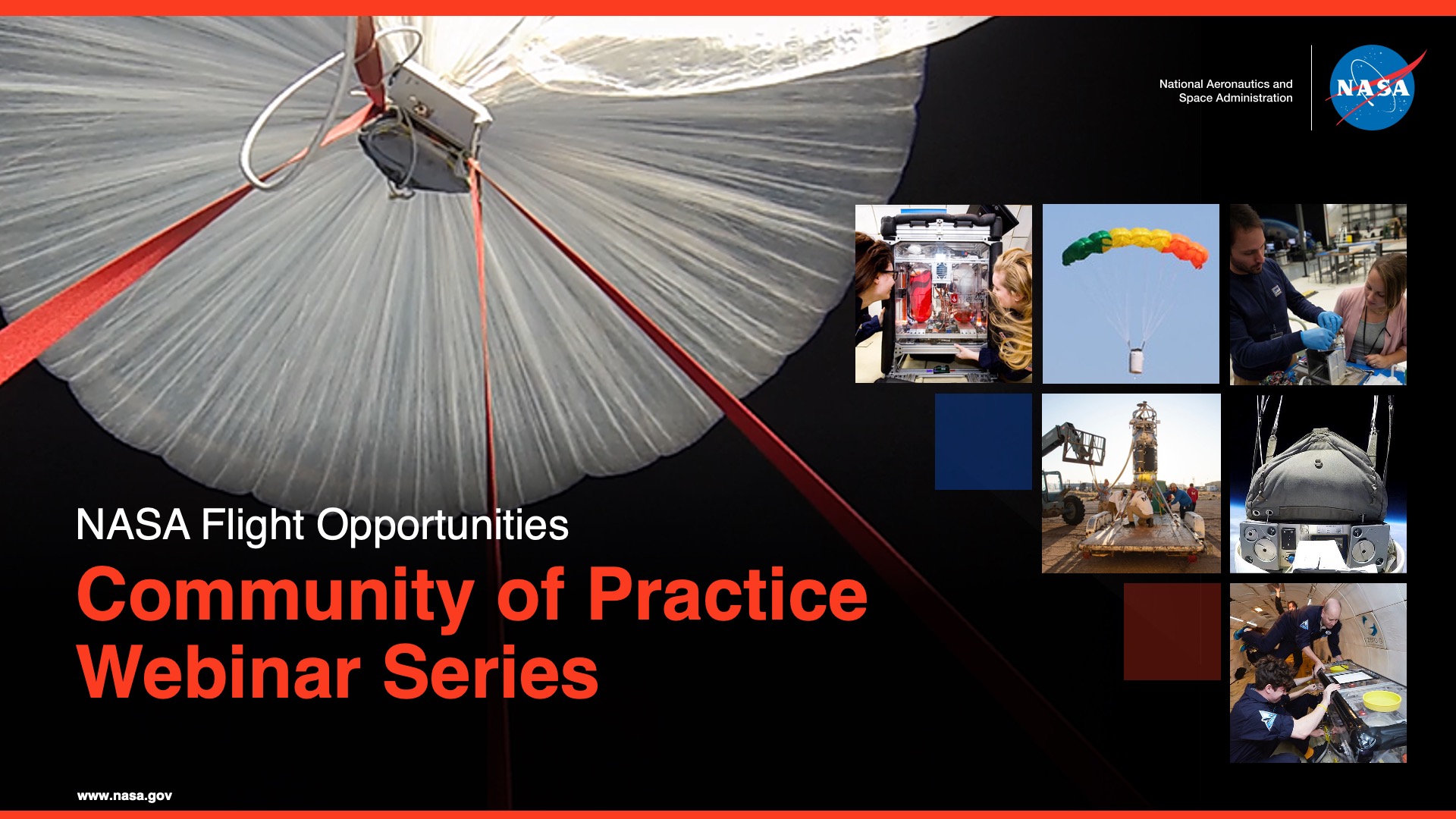
This NASA Flight Opportunities Community of Practice Webinar will explore the unique aspects of testing a suite of Earth observation sensors as well as how these technologies might be leveraged for planetary exploration. On April 23, 2025, a payload comprising three technologies designed to autonomously detect wildland fires from the stratosphere flew aboard an Aerostar International high-altitude balloon for eight hours over several contained and controlled burns.
Designed to fuse the observations of multiple sensors simultaneously, the payload combined:
Speakers
John Dykema, Ph.D., Project Scientist, Harvard University
Amanda Cook, Ph.D., Instrument Scientist and Project Engineer, NASA’s Ames Research Center
Joshua Frock, Program Manager, Aerostar
Anh Nguyen, Ph.D., Program Portfolio Integrator, NASA’s Flight Opportunities program
More Information
Designed to fuse the observations of multiple sensors simultaneously, the payload combined:
- A sensor developed by Harvard University that measures the quantity of smoke by particle size
- The Xiomas-developed multi-band thermal imager called TBIRD (Three Band Infrared Detector) that quantifies burning intensity and estimates the fire’s smoke-producing emissions
- The ASI (Atmospheric Structure Investigation) from NASA’s Ames Research Center, which includes the NephEx sensor to measure the smoke’s optical density in addition to a pressure probe, accelerometer, and other components designed to be used on a descent probe for future planetary studies
Speakers

ADD YOUR EVENT TO THE SALATA CALENDAR
Are you hosting a Harvard-affiliated event that is related to climate change and/or sustainability? Please submit your event to the Salata Institute event calendar using this quick form! We look forward to sharing your event with the Harvard community.
Submit Your Event