Reinventing Batteries for a Sustainable Future
Monday, Mar 09, 2026, 4:00 pm - 5:00 pm
Science and Engineering Complex (SEC), LL2.224, 150 Western Avenue, Boston
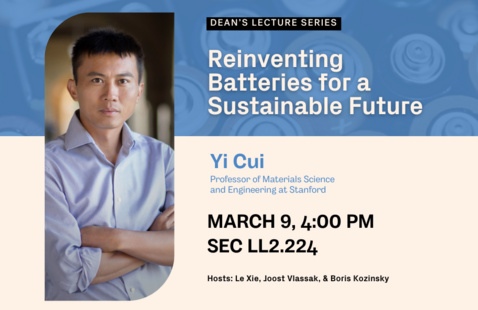
Abstract: Sustainable transportation, integration of renewable electricity into grids, and powering AI computing centers call for innovation of the next generation of batteries, which are energy-dense, durable, safe, and scalable. To address these opportunities, my lab has been conducting research over the past 20 years on reinventing batteries through nano and materials science innovation. Our progress on developing silicon anodes, lithium metal anodes, and sulfur cathodes could enable 2-4 times higher energy density than the existing lithium-ion batteries. Our development of aqueous electrolyte-based batteries offers potential game-changing solutions for stationary energy storage. To understand the fundamentals of batteries, we need new tools, and I will highlight our pioneering development of cryo-electron microscopy and cryo-XPS. I will also discuss the translation of lab innovations to markets.
Bio: Yi Cui is the Founding Faculty Director of Stanford Sustainability Accelerator, previous Director of the Precourt Institute for Energy, Fortinet Founders Professor of Materials Science and Engineering, Energy Science and Engineering at Stanford University. He earned his bachelor’s degree in chemistry in 1998 from the University of Science & Technology of China and his PhD in chemistry from Harvard University in 2002. He was a Miller Postdoctoral Fellow at the University of California, Berkeley from 2002 to 2005. Cui has published more than 600 studies and is one of the world’s most cited scientists with H-index 297. In 2014 he was ranked NO.1 worldwide in Materials Science by Thomas Reuters. He was an executive editor of Nano Letters. He is a co-director of the Battery 500 Consortium, Bay Area Photovoltaic Consortium, Stanford StorageX Initiative. He is the Director of Aqueous Battery Consortium (a $62.5M energy innovation hub funded by US Department of Energy). He has founded six companies to commercialize technologies from his lab: Amprius (listed in NYSE: AMPX), 4C Air, EEnotech, LifeLabs Design, EnerVenue and Zero Inc.
Cui is an elected member of the US National Academy of Sciences, fellow of the American Association for the Advancement of Science, fellow of the Materials Research Society, fellow of the Electrochemical Society, and fellow of the Royal Society of Chemistry. His selected honors include Global Energy Prize (2021), Ernest Orlando Lawrence Award (2021), Materials Research Society Medal (2020), Electrochemical Society Battery Technology Award (2019) and Blavatnik National Laureate (2017).
Learn More
Bio: Yi Cui is the Founding Faculty Director of Stanford Sustainability Accelerator, previous Director of the Precourt Institute for Energy, Fortinet Founders Professor of Materials Science and Engineering, Energy Science and Engineering at Stanford University. He earned his bachelor’s degree in chemistry in 1998 from the University of Science & Technology of China and his PhD in chemistry from Harvard University in 2002. He was a Miller Postdoctoral Fellow at the University of California, Berkeley from 2002 to 2005. Cui has published more than 600 studies and is one of the world’s most cited scientists with H-index 297. In 2014 he was ranked NO.1 worldwide in Materials Science by Thomas Reuters. He was an executive editor of Nano Letters. He is a co-director of the Battery 500 Consortium, Bay Area Photovoltaic Consortium, Stanford StorageX Initiative. He is the Director of Aqueous Battery Consortium (a $62.5M energy innovation hub funded by US Department of Energy). He has founded six companies to commercialize technologies from his lab: Amprius (listed in NYSE: AMPX), 4C Air, EEnotech, LifeLabs Design, EnerVenue and Zero Inc.
Cui is an elected member of the US National Academy of Sciences, fellow of the American Association for the Advancement of Science, fellow of the Materials Research Society, fellow of the Electrochemical Society, and fellow of the Royal Society of Chemistry. His selected honors include Global Energy Prize (2021), Ernest Orlando Lawrence Award (2021), Materials Research Society Medal (2020), Electrochemical Society Battery Technology Award (2019) and Blavatnik National Laureate (2017).

ADD YOUR EVENT TO THE SALATA CALENDAR
Are you hosting a Harvard-affiliated event that is related to climate change and/or sustainability? Please submit your event to the Salata Institute event calendar using this quick form! We look forward to sharing your event with the Harvard community.
Submit Your Event