

Trash Talk
Every morning, Americans across the country participate in a time-honored tradition: trash day. Like clockwork, carts and dumpsters full of waste are wheeled out from households and businesses, their contents never to be seen again. But what happens to that trash once it hits the curb? And why should we care? I went to find out at the inaugural Resource Conference (RCon), hosted by the Solid Waste Association of North America (SWANA) in Columbus, Ohio, in November 2025.
The answer, it turns out, matters enormously for the climate. Today, landfills are the third-largest source of U.S. methane emissions, accounting for roughly 14% of the national total per the EPA, and recent Harvard research suggests the true figure may be more than 50% higher than official EPA estimates. About half of all municipal solid waste generated in the U.S. ends up in a landfill, and a staggering share of what’s buried there doesn’t need to be.
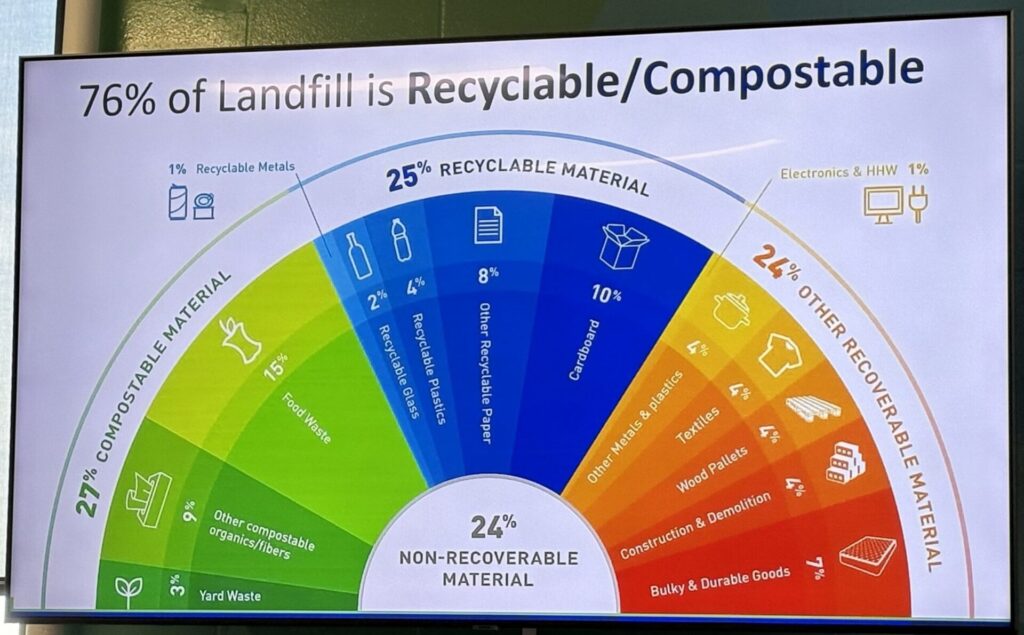
I saw this firsthand at the Franklin County Sanitary Landfill, a short 20-minute drive from downtown Columbus. Operated by the Solid Waste Authority of Central Ohio (SWACO), the facility serves 1.3 million people and receives over a million tons of solid waste per year. Yet according to SWACO’s own waste characterization data, 76% of the material arriving at the landfill could be recovered: 27% is compostable food, organic, and yard waste; 25% is recyclable cardboard, paper, plastic, and glass; and 24% is bulky goods, construction debris, wood pallets, and textiles that could be otherwise diverted.
In other words, only about a quarter of what enters the landfill truly belongs there. The climate implications of the rest are significant: food waste alone accounts for 58% of fugitive methane emissions from landfills, meaning the compostable material arriving at facilities like Franklin County isn’t just a missed recovery opportunity. It’s the primary driver of the problem.
That points to two levers for addressing waste methane: diverting organic material before it reaches the landfill, and mitigating emissions from the waste that’s already there.
On the diversion front, California has emerged as the national leader. In 2016, the state government passed SB 1383, which on its face is an organic waste diversion law but in practice represents one of the most ambitious methane mitigation regulations the country has ever seen, mandating a three-bin collection system, surplus food recovery, and a 75% reduction in organic waste disposal by 2025. Yet in much of the country, landfilling remains the default, driven by simple economics. In California, where space is scarce, landfill tipping fees average about $84 per ton statewide and can exceed $100 in coastal metros, incentivizing the search for alternatives. In Texas, where land is abundant, fees average roughly $43 per ton, meaning diversion programs struggle to clear even a basic economic hurdle.
For waste already at the landfill, landfill gas capture systems have proliferated over the past several decades. Many convert methane into electricity, while a growing number upgrade it to renewable natural gas (RNG) that, driven by federal and state clean fuel credits, can command prices far exceeding those of conventional natural gas. These systems have delivered real financial and environmental value. But they are an imperfect solution. Landfills are inherently porous, and the majority of methane emissions occur at the “working face,” the active area where fresh organic waste decomposes rapidly, even as dump trucks and heavy machinery roll across it. No gas collection system can fully capture what escapes in those chaotic early hours and days.
Later that day at RCon, I asked a landfill engineer why he joined the trash industry. His answer was immediate and earnest: “To save the world.” It’s a reminder that behind the unglamorous work of waste management are dedicated public servants tackling one of our most overlooked climate challenges, and that the 1,800 pounds of trash each of us produces every year deserves a lot more of our attention.