get the brief in your inbox
Subscribe
Sniffing out cow burps with an electronic nose
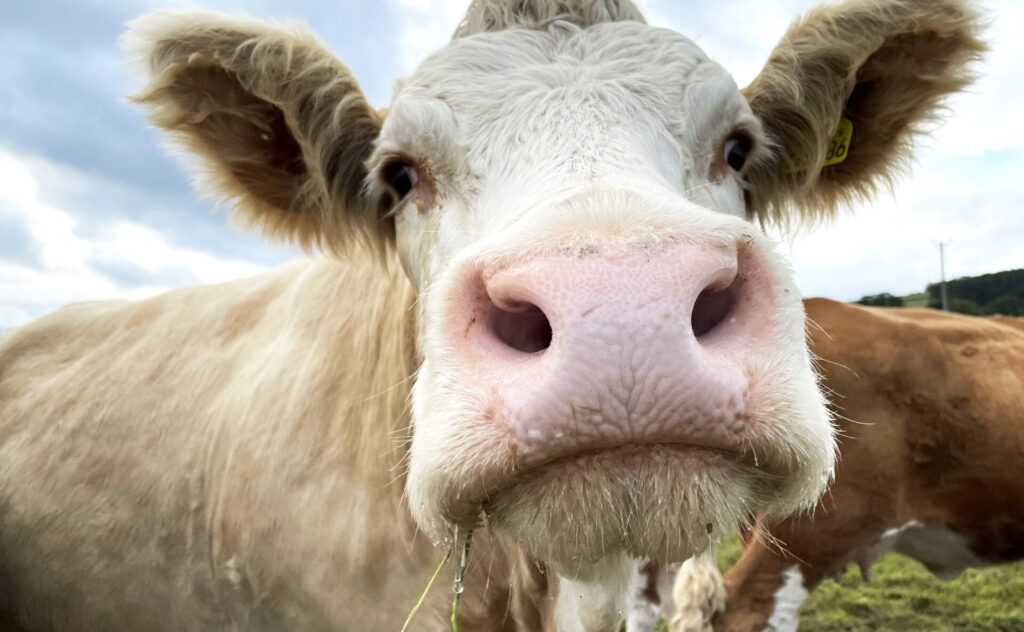
Cows are an important piece of the climate puzzle.
As cows digest their food, they belch methane – a greenhouse gas that traps over 100 times more heat than carbon dioxide in the decade or so that it remains in the atmosphere. Since the Industrial Revolution, methane has driven about 30 percent of global warming. Ruminants like cows, sheep, and buffalo account for more than a quarter of human-caused methane.
Reducing this enteric methane is essential to slowing climate change. And it is possible through changes in diet and breeding. But to test solutions, scientists and farmers first need a practical way to measure the burps.
Why measuring methane is so difficult
Farms are chemically noisy places. The air contains gases from manure, feed, cleaning products, vehicles, and the barn itself. Metal-oxide gas sensors can be small and cheap, but they are easily confused: They respond not only to methane but also to many volatile organic compounds (VOCs).
Existing methods can isolate cow burps, but they are expensive, slow and hard to scale. Respiratory chambers provide controlled measurements, yet they can alter a cow’s normal behavior, making the results less representative of real farm conditions. Other methods rely on tracer gases and careful sampling, but in practice measurements can still be thrown off by nearby gases that interfere with the sensors.
Filtering chemical noise
A group at Harvard SEAS is trying to close the measurement gap with a small tag that can be affixed to a cow’s ear. The “electronic nose,” as they call it, is designed to be cheap, compact, and accurate enough to run for long periods in real farm conditions.
In a new paper in Advanced Materials Technologies, the team, led by Haritosh Patel, argues that the simplest way to improve methane readings is to clean the air before it reaches the sensor. Their module pairs a common metal-oxide sensor with a two-layer filter made of activated carbon spheres and a fiber membrane. The filter is meant to block other VOCs while still letting methane through, reducing the chemical noise the sensor must interpret. Without that filtering, all VOCs can reach the sensor surface and interfere with the reactions used to detect methane, skewing the reading. Filtering upstream reduces that interference and stabilizes the methane response.
The approach is part of a broader idea the team calls GRAZE, short for “gas recognition analysis through zonal ear tags.” It is built on what Patel calls “a bubble of detection around each ear tag.” In other words, a single tag can pick up emissions in its immediate vicinity, not only from the cow wearing it.
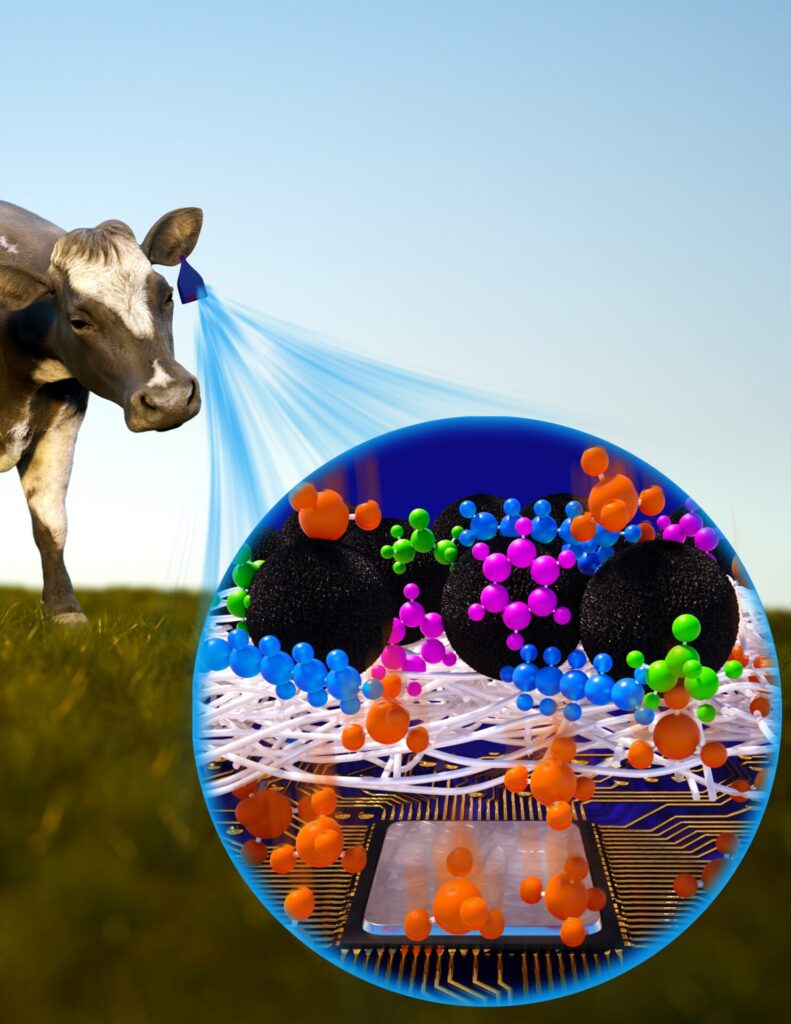
A conceptual rendering of the tag (Second Bay Studios)
In controlled experiments, the filtered sensor produced a strong signal relative to noise, detected low methane levels (down to around 8 parts per million, where a short burst of burps can raise local concentrations up to a few thousand ppm), and tracked methane in a nearly linear way across the tested range. The toughest challenge was interference: methane mixed with pentane, a VOC that disrupts unfiltered sensors. With the filter in place, the average error fell 100-fold.
A full ear tag system, not just a sensor
To help interpret the methane signal and rule out false positives, the system uses multiple channels: an environmental sensor for temperature and humidity, a carbon dioxide channel, and a sensor to reflect background VOC levels. Humidity, in particular, can weaken methane sensitivity, so the system needs to track conditions to correct for any loss in the methane signal.
The team also designed a protective casing meant to survive farm conditions while still allowing airflow, and estimated that the prototype ear tag could run for almost two weeks on a charge.
“These tags need to survive a lot of wear and tear. There’s a lot happening on a farm. A cow is going to put its face in whatever it wants. So, these sensors need to be robust,” says Patel, pointing out that they also help track the animal’s health – creating value for the farmer and increasing the likelihood of eventual adoption.
“One of the first indications of disease is a change in food intake, which is reflected in a cow’s enteric output. When monitoring methane output, it’s easy for farmers to monitor their health.”
What it won’t solve yet
If the approach works reliably on cattle in real settings, it could help turn a rough estimate into something that can be monitored over time, enabling larger studies and faster testing of diet and breeding strategies. Farmers could identify high-emitting animals, test feed additives, or monitor changes in housing and husbandry. Breeders could incorporate emissions into selection programs. Policymakers could build incentives.
“Oftentimes policy requires technology to progress,” says Patel. “While we are still far from any commercial activity, this work establishes a robust materials and sensing foundation for advancing such technologies going forward.”
For a problem as stubborn as livestock methane, this is a step forward.
-As told to David Trilling