Scaling “smart, low-carbon” buildings, from lab to millions of homes
At Harvard Climate Action Week, professors and industry leaders introduced a cross-disciplinary research cluster to move breakthroughs in material science, AI sensing, and grid-aware controls into real-world systems – while emphasizing that the hardest problem is scaling from academia to millions of buildings.
“Imagine you walk into your house and you ask it, ‘How are you doing?’” said Vijay Reddi, the Gordon McKay Professor of Electrical Engineering at the Harvard John A. Paulson School of Engineering and Applied Sciences.
“I’m not talking about a Nest [thermostat] – how hot or cold is my house,” he continued, describing the AI-driven “embedded intelligence” he is designing for the homes of the future that translate data from sensors into autonomous actions.
Those sensors will pair with “next-generation thermal materials” that actively or passively respond to their surroundings, said chemist Jarad Mason, the John L. Loeb Associate Professor of the Natural Sciences. “Imagine if the walls of your buildings could actually store thermal energy or heat, kind of like a battery: soak up a lot of that heat […] and then when it gets colder at night, release it,” he explained.
Some of those sensors and materials are inspired by living organisms, noted Joanna Aizenberg, a pioneer in bio-inspired, adaptive materials, who is the Amy Smith Berylson Professor of Materials Science. “As we develop new approaches for sensing, how can we take advantage of the way dogs sense?” she said, offering an example.
The technology is the easy part for engineers, Reddi maintained; his concern is the “incentive structure” required for broad adoption.
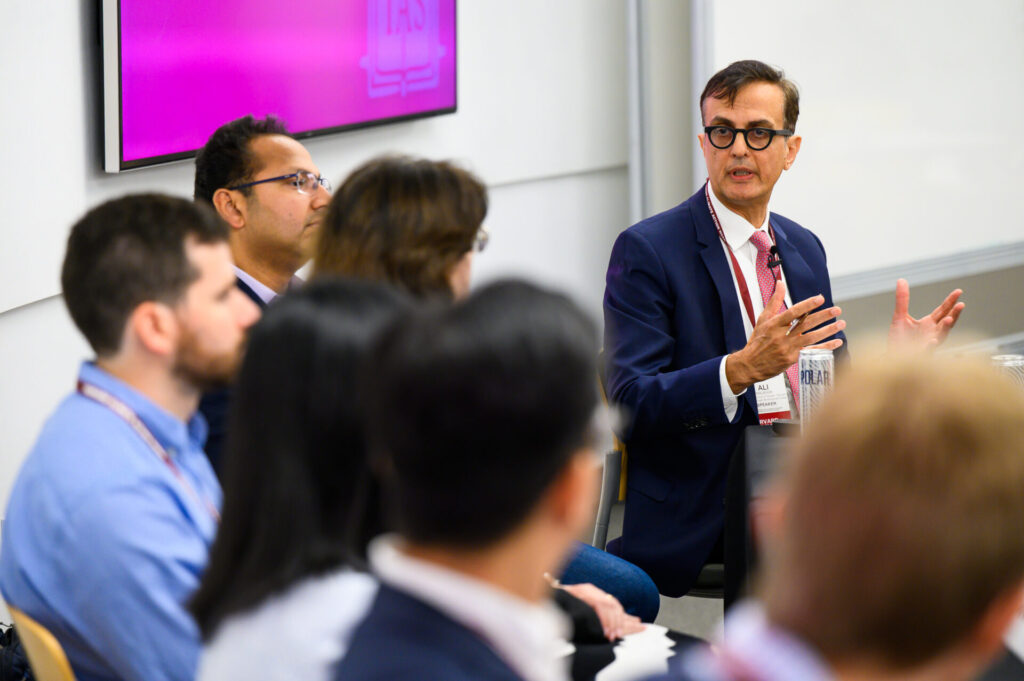
Cluster lead Ali Malkawi, Professor of Architectural Technology at the Harvard Graduate School of Design, said breaking academic silos and “razing barriers” to confront the housing and energy crises is why industry partners are embedded in this Salata Institute-sponsored research cluster from day one.
Indeed, industry participants underscored the urgency.
Michel Nasilowski of Saint-Gobain/NOVA called collaboration with academia and across disciplines “critical … to removing bottlenecks” in the housing “ecosystem” of the future.
“Smooth communication” will also be critical, Fei Sha, a research scientist at Google, reminded the research team: “The biggest challenge I see in interdisciplinary study is always communication barriers: the different terminology, different incentives, different ways of looking at problems – and how we break down these barriers.”