

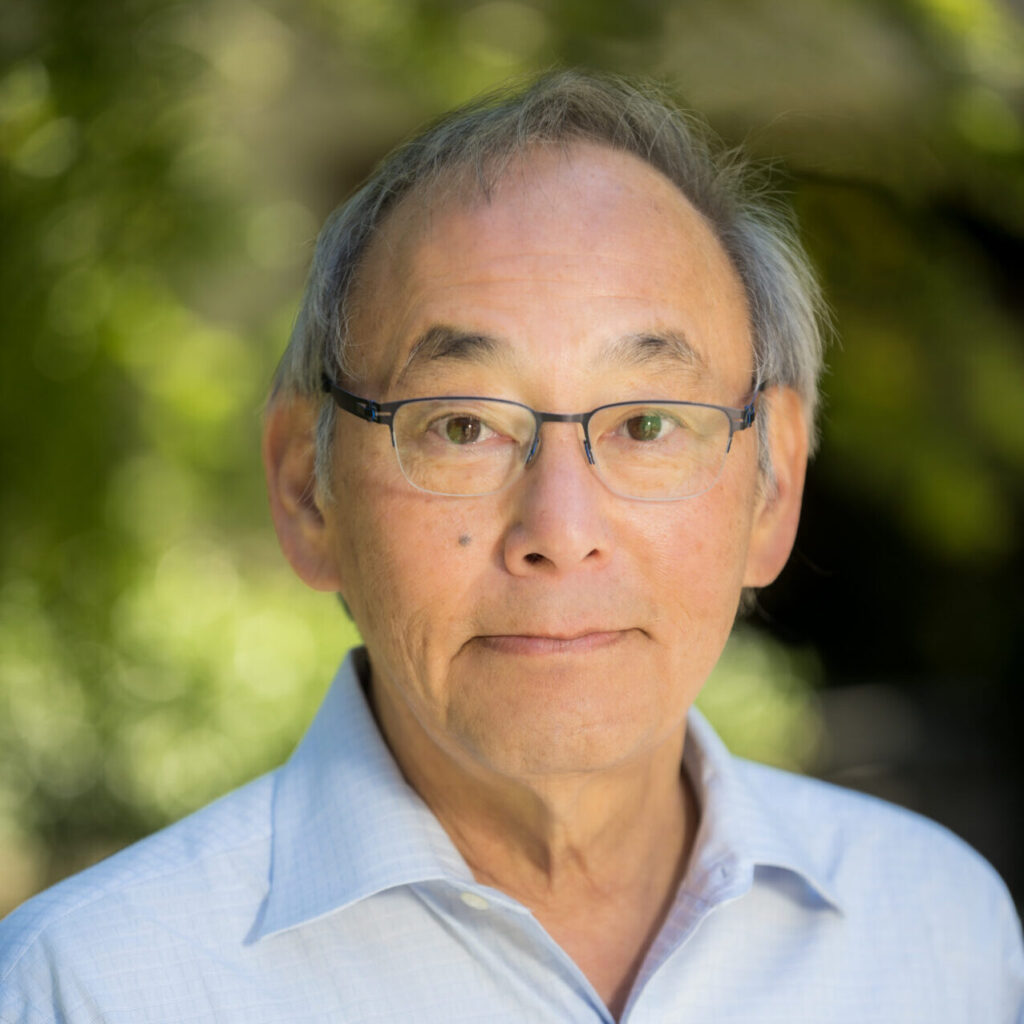
Steven Chu
Steven Chu, a professor at Stanford University, received the 1997 Nobel Prize in Physics for laser cooling and trapping of atoms. Other contributions include the first optical tweezers manipulation of biomolecules, precision atom interferometry based on optical pulses of light, and single molecule FRET of biomolecules. His current areas of study include molecular and cellular biology, non-linear ultrasound imaging, batteries and carbon capture.
Chu has a Ph.D. in physics from the University of California, Berkeley. After a postdoctoral fellowship at Berkeley, he joined Bell Laboratories as a member of the technical staff in 1978 and then department head in 1983. From January 2009 to April 2013, he was U.S. Secretary of Energy, where he began ARPA-E and the Energy Innovation Hubs. As the first scientist Cabinet member in U.S. history, he recruited dozens outstanding scientists and engineers to the Department of Energy, and was personally tasked by President Obama to help BP stop the Macondo Oil spill. Previously, he was Director of Lawrence Berkeley National Laboratory from 2004 to 2008. While Professor of Physics and Applied Physics at Stanford from 1978 – 2004, Chu helped initiate Bio-X, linking the physical and biological sciences with engineering and medicine, and the Kavali Institute for Particle Astrophysics and Cosmology.
He was past president of the American Association for the Advancement of Science, a Senior Advisor to the Directors of the NIH and the NNSA. In addition to his Nobel Prize, he is the recipient of three dozen other awards, has 35 honorary degrees, and is a member of the U.S. National Academy of Sciences, the American Academy of Arts and Sciences, the American Philosophical Society, National Academy of Inventors, is a foreign member of the Royal Society, Royal Academy of Engineering, the Chinese Academy of Sciences, the Korean Academy of Sciences and Technology, the Pontifical Academy of Sciences, and 3 other foreign academies of sciences.
The Salata Institute
The Salata Institute supports interdisciplinary research that leads to real-world action, including high-risk/high-reward projects by researchers already working in the climate area and new endeavors that make it easier for Harvard scholars, who have not worked on climate problems, to do so. Faculty interested in the Climate Research Clusters program should note an upcoming deadline for concepts on April 1, 2024.