

Governing a global crisis
“Let’s be candid,” said Joseph Aldy, the Teresa and John Heinz Professor of the Practice of Environmental Policy at the Harvard Kennedy School, as he kicked off the final session of Harvard Climate Action Week. “While we have made progress on international climate policy, it’s not enough to deal fully with the threats posed by climate change.”
The panel discussion brought together renowned architects of international climate policy weeks before the United Nations’ COP30 climate conference opens in Brazil to assess where multilateral climate agreements are succeeding, where they’re stagnating, and the challenges of implementing and enforcing these promises.
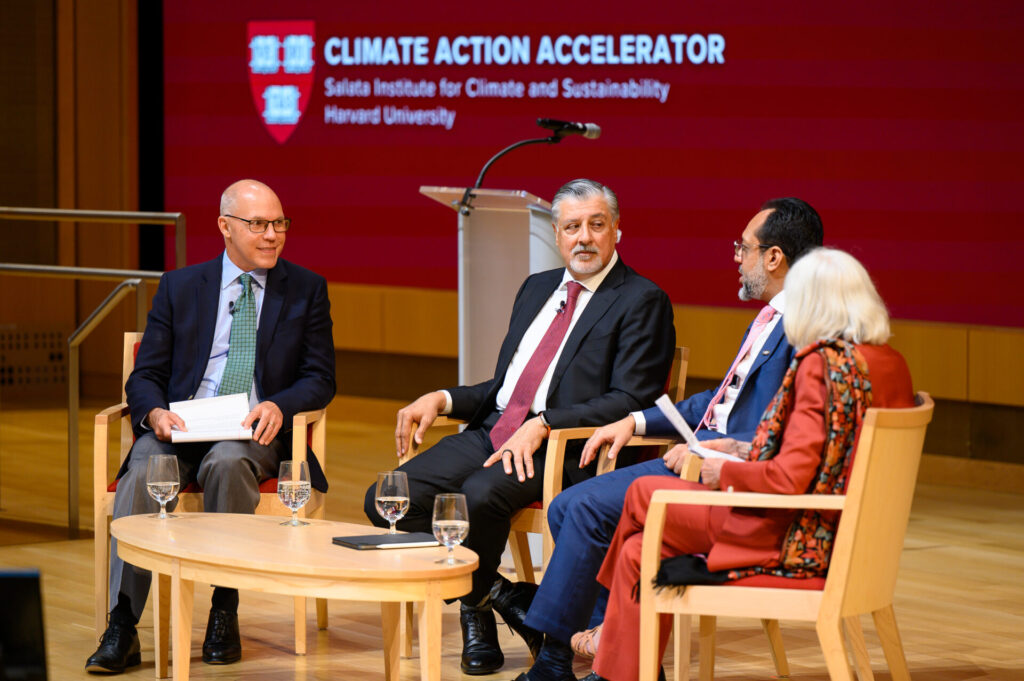
Laurence Tubiana, president and CEO of the European Climate Foundation, explained how the Paris Agreement in 2015 laid the foundation for climate governance today.
In addition to mobilizing nearly 200 nations and establishing a blueprint for tackling climate change, the Agreement also detailed ways that climate change will affect every aspect of global and local economies, created partnership frameworks between governments and between governments and non-state actors, and set concrete emissions-reduction targets to measure success.
“Before the Paris Agreement, we were pointing to a 4C” rise in global temperatures, Tubiana said. “It’s no more the case. […] We have delivered, at least, to curb the emissions trend. It was not fast enough, not strong enough, but it’s there.”
Tubiana credited the Paris Agreement with creating crucial legal infrastructure, but added that mechanisms for enforcement must be strengthened: “We have a lack of accountability.”

Bringing everyone to the table
Climate policy now revolves around holding countries to their promises.
Adnan Amin, chair-designate of the World Energy Council and CEO of COP28, was part of the first Global Stocktake, an international assessment conducted five years after the Paris Agreement that evaluated how much progress had been made. He said that COP28 negotiations on the next steps often hinged on ensuring that stakeholders were heard.
We found success “through inclusion, through creating the conditions for people to engage in a transparent process that gives them the right or the ability to feel that they are part of it, understanding what the different motivations are, and creating the framework,” he said.
“For the first time in any climate agreement ever, the words ‘transitioning away from fossil fuels’ were part of the agreement,” Amin said. “I think that is the most consequential part of this agreement.”
Going beyond governments
Arunabha Ghosh, founder and CEO of the Council on Energy, Environment, and Water, is a UN Secretary-General-appointed expert in climate accountability for non-state actors, which include corporations and NGOs. He emphasized the importance of evaluating these entities’ climate pledges, work that requires analyzing them for credibility and building accountability metrics, both internal and external.
“The easiest way to demonstrate that you’re not a sincere player is if your first action is actually to buy an offset somewhere else so that you don’t have to do something today,” he said. “You’ve got to demonstrate what is it that you can do within the scope of your business, and then what you can’t do.”
Emissions abatement, Ghosh said, also involves analyzing supply chains and pinpointing specific sectors that need reform the most.
“In India, steel, cement, fertilizer, and petrochemicals account for three-quarters of our industrial emissions. If you don’t solve for those, the rest really doesn’t matter,” he said.
As panelists previewed their work at and beyond the climate summit in November, Tubiana of the European Climate Foundation urged negotiators to include more people outside the halls of COP30.
“They are affected. It’s not tomorrow, it’s now. We have to have their voices represented very strongly,” Tubiana said. “People say climate policy is a policy of elite people. We have to demonstrate that it’s not.”