Fluid-filled smart windows cut heating and cooling costs
Buildings spend huge amounts of energy keeping indoor temperatures comfortable. A Harvard team has developed a fluid-filled “smart window” that could do some of that work passively.
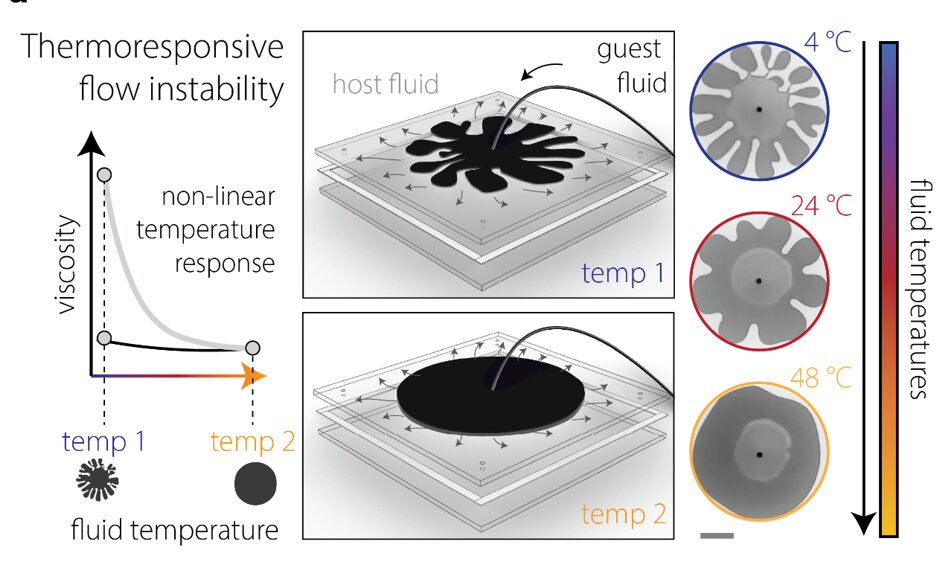
It is based on a phenomenon called viscous fingering: When a thinner fluid pushes into a thicker one in a narrow space, the boundary becomes unstable and forms branching patterns, much like flower petals.
Raphael Kay, Joanna Aizenberg, and colleagues at Harvard John A. Paulson School of Engineering and Applied Sciences have demonstrated in a new PNAS paper that these temperature-dependent fluid instabilities occurring within windowpanes can be harnessed to self-regulate indoor temperatures – saving energy and cutting planet-heating carbon emissions.
Their trick is to color the thinner fluid.
As ambient temperatures rise, dark liquid patterns spread to block sunlight; as temperatures fall, they branch apart to let more heat in.
“By choosing the types of liquids and designing the geometry of the container, we can control the patterns that emerge at different window temperatures,” explained first author Raphael Kay, a doctoral candidate in the Aizenberg Lab.
“In the cold, the colored liquid branches into petals, leaving gaps that let more sunlight through; in the heat, that same liquid spreads into smoother circles, covering more of the pane and blocking more sun. The result is a window that can help warm a room when it is cool and shade it when it is hot, without relying entirely on conventional heating or air conditioning.”