

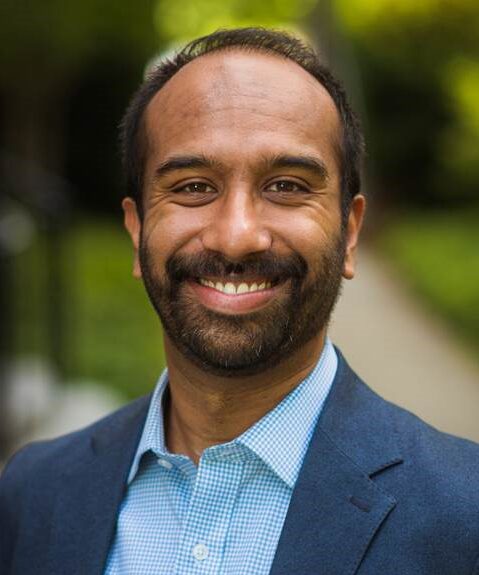
Gaurab Basu
Assistant Professor of Medicine, Division of Global Health Equity, Brigham & Women’s Hospital/Harvard Medical School
Assistant Professor of Global Health & Social Medicine, Harvard Medical School
Assistant Professor of Environmental Health, Harvard T.H. Chan School of Public Health
Assistant Professor of Global Health & Social Medicine, Harvard Medical School
Assistant Professor of Environmental Health, Harvard T.H. Chan School of Public Health
Profile
Outside professional activities
Profile
Gaurab Basu, MD, MPH is a physician and assistant professor of medicine in the Division of Global Health Equity at Brigham and Women’s Hospital, and assistant professor of global health & social medicine at Harvard Medical School (HMS). At Harvard T.H. Chan School of Public Health, he is an assistant professor of environmental health and core faculty at the Center for Climate, Health, and the Global Environment (Harvard Chan C-CHANGE). His work focuses on the intersection of climate change, global health equity, human rights, medical education, and public policy.
Dr. Basu has developed and evaluated numerous innovative health equity curricular programs. He received the inaugural HMS Equity, Social Justice, and Advocacy Faculty Award and the HMS Charles McCabe Faculty Prize in Excellence. He has been an HMS Curtis Prout Academy Fellow and a Harvard Macy Scholar.
In 2021, Dr. Basu was named to the Grist 50 list of national climate leaders. In 2018, the Robert Wood Johnson Foundation selected him to their Culture of Health Leadership fellowship. Dr. Basu served as an advisor to the Massachusetts Governor’s Executive Office of Energy and Environmental Affairs (EEA) as a member of the Implementation Advisory Committee and the Climate Science Advisory Panel. He was on the city of Cambridge Mayor’s Climate Crisis Working Group and its Net-Zero Climate Task Force. His work has been featured in the New York Times, NPR's All Things Considered, Boston Globe, CNN, Scientific American, BMJ, and Grist, among others.
Dr. Basu currently serves as an advisor to the Child in Need Institute and previously worked for the Gates Institute, Partners in Health, and Last Mile Health. He is on the Board of Directors of Environmental League of Massachusetts and the advisory council for the Medical Society Consortium on Climate and Health. He also serves on the National Academy of Medicine’s Action Collaborative on Decarbonizing the U.S. Health Sector and the Boston Green Ribbon Commission’s Healthcare Working Group.
He graduated magna cum laude from Brown University with a bachelor of arts in international relations. He received his medical degree from the Larner College of Medicine at UVM. Dr. Basu was a Sommer Scholar at the Johns Hopkins Bloomberg School of Public Health, where he studied human rights and received his master’s degree in public health. He completed his internal medicine residency training at Cambridge Health Alliance/Harvard Medical School.
Contact
Email: gbasu@bwh.harvard.edu
Phone: 617-525-4783
Additional Website: https://ghsm.hms.harvard.edu/faculty-staff/gaurab-basu
Expertise
Global health equity, Human rights
Outside professional activities
Outside Professional Activities
In the spirit of transparency and integrity, Salata Institute Faculty Associates disclose publicly their key professional activities outside of Harvard University. The activities disclosed below are for the most recent reporting period, as defined by University policy. Some of the activities may be paid, some may be unpaid, and others may be in exchange for expense reimbursement only.
Outside Professional Activities For Gaurab Basu
Organizations:
Relationships:
Environmental League of Massachusetts
Professional Services or Employment
Massachusetts Executive Office of Energy and Environmental Affairs
Professional Services or Employment
Medical Society Consortium on Climate and Health
Professional Services or Employment
The Salata institute
The Salata Institute supports interdisciplinary research that leads to real-world action, including high-risk/high-reward projects by researchers already working in the climate area and new endeavors that make it easier for Harvard scholars, who have not worked on climate problems, to do so.