

Climate disasters strain mental health in West Africa
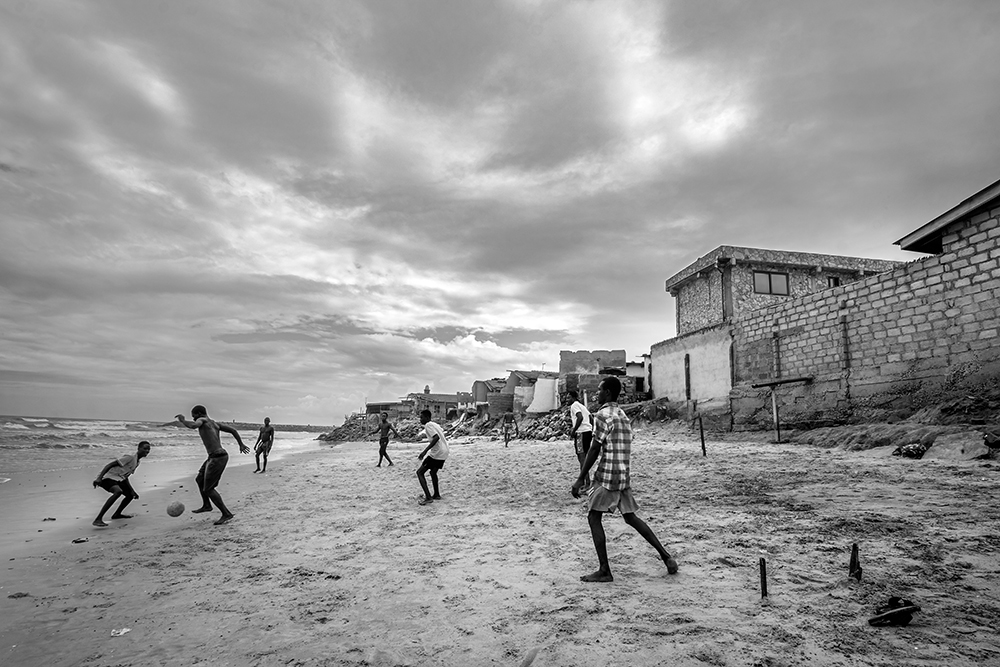
Climate change is driving a quiet mental health crisis along West Africa’s coast, researchers and clinicians warned at a recent panel examining how flooding, erosion and rising seas are reshaping daily life in the Gulf of Guinea.
Referencing a scoping review that examined more than 3,000 global studies on climate and mental health, during a recent Harvard University workshop psychiatric researcher Jennifer Ashilevi pointed out that “only 20 percent include research on the Global South” and, of those, there were “zero studies from Africa,” leaving policymakers to respond without data that reflect local realities.
“Global evidence on mental health relies heavily on high-income countries,” said Ashilevi, a collaborator with the Salata Institute’s Climate Adaptation in the Gulf of Guinea research cluster. “Imagine waking up every day not knowing when the ocean will take your home, and then being asked, ‘Why don’t you just move?’ It is not as simple as that.”
The cluster’s country teams have begun to fill that gap with a mental and emotional health survey of coastal communities in Ghana, Nigeria, and Côte d’Ivoire.”
According to preliminary results, in Ghana, over half of respondents reported feeling “afraid, as if something awful might happen,” and 77 percent linked their distress to “flooding, erosion, or other environmental changes.” Eighty-six percent of coastal Ghanaians screened positive for symptoms of post-traumatic stress disorder (PTSD) – the highest figure in the three countries.
“The problem is going to get worse, and there is no system that has been established to support what people are dealing with every day,” Ashilevi warned.
Despite high levels of distress, the data also show strong resilience, especially in Ghana, where over 90 percent of respondents described themselves as hopeful about the future (compared with 76 percent in Nigeria and 22 percent in Côte d’Ivoire). Panelists suggested that a mix of government intervention, social networks and faith communities may be sustaining that hope, even as homes and livelihoods are lost.
Samuel Adjorlolo of the University of Ghana argued that such resilience cannot be taken for granted in the face of escalating climate shocks.
“The severity of the exposure is directly proportional to the burden of mental health issues,” he said.
Adjorlolo called for “forward-looking strategies” to “deliberately strengthen evidence and data systems,” “strategically integrate mental health and psychosocial support systems into existing disaster management plans,” and “build institutional capacity to be able to respond to the mental needs of communities.” Most important, he added, is “to strengthen communities so that they are able to meet their own needs.”
Harvard historian Emmanuel Akyeampong, the research cluster’s principal investigator, said the mental health consequences of coastal erosion have been visible for years, even if they were not named.
“Before the language of climate change came up, we were seeing the facts that are now classified as climate change already unfolding. We just called it ‘environmental disaster, environmental change.’ Coastal erosion was happening before we connected it to sea-level rise,” he said.
‘An essential pillar of climate adaptation’
For psychiatrist Giuseppe Raviola of Harvard Medical School, the West African experience underscores that “climate-related mental health is not just a clinical problem. It’s a systems- and social-infrastructure challenge, and so the challenge cannot be met by clinical mental health responses alone.”
Drawing on the concept of allostatic load – the cumulative physical burden of chronic stress on the body – Raviola asked, “Isn’t the same thing happening with the environment? Is imbalance in the environment causing imbalance in humans?”
“Mental health becomes an essential pillar of climate adaptation,” he said. “The mental health burdens will grow, non-linearly, more quickly and more severely than traditional models assume. Climate disruption becomes a stress multiplier across generations. There is a need for organized, collective, community-led response systems.”
Raviola characterized the forthcoming survey as having global implications.
“Climate change is dismantling the physical and social foundations of life in West Africa,” he said. “Beyond psychological first aid, there are interventions that can be adapted to communities and delivered by non-specialists. The West African data presented here is not just important for the region, it’s a warning signal for the world.”