

Canada used to send clean, cool air. Harvard scientist explains the new reality of wildfire season
Wildfire smoke from Canada has once again cast a haze over wide swaths of the United States, upending a long-held summer pattern in which fresh, cool air from the north usually offered relief from heat and pollution.
Here in Cambridge, thousands of miles from the active fires in Saskatchewan and Manitoba, air quality indices have repeatedly warned in recent weeks that the air is unhealthy for sensitive groups.
In this Q&A, Harvard atmospheric scientist Loretta Mickley explains why the usual rules have changed and the questions researchers are asking about the global journey of wildfire plumes.
Mickley, a senior research fellow in chemistry-climate interactions at the John A. Paulson School of Engineering and Applied Sciences, uses advanced atmospheric modeling to track how wildfire smoke travels and affects regions far from the fire. Summer cold fronts, she says, are no longer offering the relief they used to.
In the 2000s, you and colleagues noted that Canadian cold fronts bring clean air to the Northeast United States in summer and found evidence that climate change was likely decreasing the frequency of these cold fronts. But now a cold front is bringing smoky air. What’s happened?
Yes, in the ensuing years, the research community has expended much effort on whether the frequency of these cold fronts would decrease or in fact increase with climate change. Current thinking seems to support our original contention.
With fewer cold fronts, warm stagnant air over the Northeast lingers, allowing local pollution to intensify. “The air just cooks,” I said in 2005.
What’s paradoxical now is that we’re getting cool air from Canada, but sometimes laden with smoke. When a high-pressure system develops and winds weaken, that smoke just sits here.
I think this phenomenon says more about how our usual avenues of relief in summer – clean, cool air from Canada breaking up the heatwaves in the Northeast – can no longer be counted on.
What is the role of climate change?
Climate change is likely prolonging droughts and hot weather in Canada, leading to more fire activity, which is something we predicted 10 years ago. Now, whether a cold front brings relief to the Northeast depends on where fires are burning and on the wind patterns on that particular day.
The cool air will come but may bring massive smoke along with it.
What does this mean for readers concerned about the future of wildfire smoke wafting into New England?
In the future, the frequency of the Canadian cold fronts may diminish, although, as I said, there is some debate about this issue. If the frequency of Canadian cold fronts does decrease, that would mean fewer influxes of smoke into the U.S. but also less relief from hot weather. So, it would be a mixed outcome.
How do cold fronts carry smoky air?
The tiniest smoke particles are very light and buoyant – less than 2.5 microns in diameter [less than 1/20th the width of a human hair]. Breathing elevated levels of smoke particles can set off systemic inflammation and may exacerbate existing diseases. Research has linked smoke exposure to asthma attacks, increased rates of wintertime influenza and COVID-19, adverse birth outcomes, and many other health effects. But we don’t have enough data yet to begin to gauge the effects of this particular smoke event in the Midwest and Northeast.
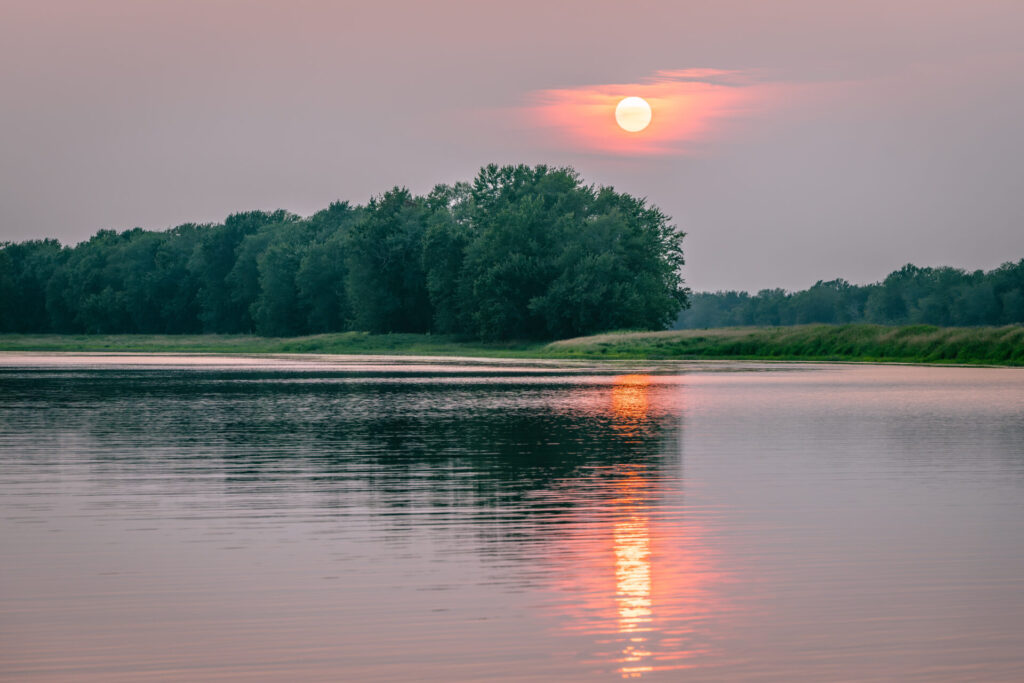
Because of their small size, PM2.5 particles don’t readily settle out of the atmosphere and can be carried by wind many miles. In this case, cold fronts are ferrying smoke particles across the Midwest and Northeast. There have been reports of this year’s smoke reaching Europe, but I think by the time the smoke has crossed the Atlantic it has probably been lofted up in the atmosphere and so is not affecting surface air quality. Aloft, however, the smoke can bring colorful sunrises and sunsets.
What is needed to better predict the movement of wildfire smoke?
What is needed for further research is better understanding of how climate change will affect patterns of air circulation, like mid-latitude cold fronts. What is needed politically is greater awareness that the Canadian wildfires are huge (currently, an area twice the size of Massachusetts is burning) and are likely yet another signal of climate change.
We still have a lot to learn about how the intense heat from fires and/or smoke particles can influence local and regional weather. We know that the heat and strong updrafts associated with fire can perturb local fire weather, involving lightning, towering clouds, and even fire tornados. And smoke particles can influence cloud formation and may lead to regional cooling by blocking sunlight.
Cold and warm fronts are part of the usual weather on earth: air masses moving in response to spatial differences in surface heating and cooling. Do fires and smoke influence the movement of airmasses? That is an open question.