

Deadlocks and breakthroughs at COP
From November 9 to 20, the 31st UN Climate Change Conference (COP31) will take place in Antalya, Türkiye. It will be a huge endeavor. Inside negotiation rooms, 20,000 delegates from over 190 countries—plus 300 ministers and 85 heads of state— will spend long days (and more than a few sleepless nights) hashing out the details of at least 40 issues. Outside the formal talks, a further 80,000 people from think tanks, nonprofits, businesses, and civil society groups are expected to showcase how climate pledges are being turned into action.
But while the scale may seem impenetrable—and the acronyms and alarming headlines, impersonal—the “deadlocks” and “breakthroughs” we read about coming from COPs can often be traced back to very specific, very human moments: a turn of a phrase, an impromptu storming of the stage or a planned walkout. These are the smaller stories during which COP’s monumental negotiations turn.
On the eve of COP31, we dive into five consequential moments from the past 15 COPs. Individually, they contextualize the successes and failures that led us here. Taken together, they also highlight the common threads that anyone studying, following, or planning a complex negotiation must constantly weave together: the substance of the issue, the relationships between the people deciding it, and the process shaping the decision. The ability to manage these dimensions, moment by moment, makes or breaks a COP.
I. Claudia Salerno’s Bloody Hand (COP15 Copenhagen, 2009)
Going into COP15 in Denmark, expectations ran so high that the conference was nicknamed “Hopenhagen”. The IPCC, the UN’s climate research body, had warned that the only way of keeping warming within 2°C of pre-industrial levels (and avoiding irreversible climate disaster) would be for emissions to start declining by 2015. But the first of the Kyoto Protocol’s legally binding emission targets were due to expire in 2012, and there was broad consensus that if an agreement could not be reached in Copenhagen, countries would run out of time to ratify a new treaty and we would enter a crucial period without any climate rules in force.
Trust was strained early. On the second day of the conference, The Guardian leaked the “Danish text”, a draft agreement by the COP15 Presidency and a small group of nations which not only bypassed formal processes, but according to developing countries, saddled them with new obligations, despite rich countries being responsible for the bulk of historical emissions as stated by developing countries.
However, even after a five-hour walkout by the G77 bloc of developing countries, and the eventual resignation of COP President Connie Hedegaard, the Presidency underestimated the vitality of transparent process and equitable substance.
At 3am on the final night of COP15, Danish Prime Minister Lars Løkke Rasmussen announced that a group of unnamed heads of state had produced an Accord and, with the support of few countries, asked the conference to adopt it. Mass protest erupted; the delegate from Sudan called the text “a suicide pact for Africa”; but when Claudia Salerno, lead negotiator for Venezuela and an influential voice within the G77, raised a point of order (which would have immediately given her the floor), Rasmussen refused to give her the floor and instead tried to gavel the summit closed.
Salerno, in turn, banged her country’s nameplate on the table again and again, cutting her hand on the metal until she was recognized by the chair. Holding her bloodied palm to the room, Salerno asked whether this was what a sovereign nation had to do in order to be heard. “The hand, which is bleeding now, wants to speak,” she said, “and it has the same right as any of those which you call a representative group of leaders.”
The Accord was “noted” but never adopted, and although it contained real progress, not all countries which were invited to “associate” themselves with it after the conference actually did. The bloody hand of Claudia Salerno, and the broken trust it represented, loomed too large.
Copenhagen became shorthand for failure in climate diplomacy, and presidencies ever since have been wary of procedural missteps like using secret texts, closed-door deals, and gaveling past objections in the pursuit of a false summit.
II. The Durban Huddle (COP17 Durban, 2011)
Even after the skillful work of Mexico’s COP16 President Patricia Espinosa to “exorcise the ghost of Copenhagen”, it was far from a fait accompli that the world would (or could) keep working together on climate. The Kyoto Protocol (from 14 years earlier) built a divide between rich countries, which were required to cut emissions, and developing ones—even giant and fast-growing economies like China and India—with no binding targets. COP17 in Durban, South Africa, was set to be not only a test on how to bridge that divide, but also a referendum on the health of the multilateral climate regime itself.
As Durban ran almost 36 hours past its scheduled close—the longest COP on record at the time—with negotiators missing flights home to work through consecutive nights, the results of that referendum seemed dire.
At the eye of the storm was the choice of whether the text should be called a “legal outcome,” a “protocol,” or something else—each label meaning something different for how binding the deal would be and for whom. The debate was most heated between the European Union, which argued that after years of patience, it was not too much to ask for all countries to be bound to a target, and India, whose representatives felt they could not sign away the rights of 1.2 billion people, many of them living in poverty. The summit was on the verge of collapse.
And then COP President Maite Nkoana-Mashabane took the unusual step of calling an impromptu huddle in the middle of the hall. Around a dozen negotiators from the main parties, including the EU, India, the U.S., China and Brazil, gathered shoulder to shoulder as the room watched on. In this small oasis, they spoke directly without speeches or microphones, and about 15 minutes later, emerged with wording that all parties were willing to accept.
That huddle (famously known since then as the ‘Durban Huddle’) on the plenary floor exemplified some core tenets of negotiation: digging underneath other parties’ positions to discover their interests; giving people space to share their anger before moving forward productively; using deliberately ambiguous language (which in this case was firm enough for the EU and flexible enough for India) to help delegates tell the right stories to their constituents at home. Rather than delivering a win-win, it meant nobody had to be seen to lose.
The package adopted that final evening extended the Kyoto Protocol and launched a wide-ranging negotiation that four years later would become the Paris Agreement.
Other COPs have since deployed their own versions of the Durban Huddle, using a change of setting to open up space and exploiting ambiguity to deliver treaties that have legally binding processes and flexible targets. In so doing, they have kept the idea of shared climate action alive.
III. The Moral Weight of Pakistan’s Floods (COP27 Sharm El-Sheikh, 2022)
In the summer of 2022, unprecedented rainfall left a third of Pakistan underwater. Alongside the terrible devastation and loss of life, the World Bank estimated $30 billion in economic damages. Historically, taking climate action had meant either cutting emissions to reduce the speed or impact of climate change (mitigation) or helping countries prepare for that change (adaptation), but the floods raised the stakes at COP27 for a conversation about a third component: “loss and damage” (L&D).
L&D focuses on compensating countries for the economic, environmental, social, and cultural costs they suffer from climate change. An L&D fund—paid for by the largest historical emitters—had long been requested by developing countries and long resisted by developed ones worried about legal liability for past emissions and claims running into the hundreds of billions.
In Sharm El-Sheikh, Egypt, Pakistan had the opportunity to use the emotional impact of the floods to focus attention on L&D. This had been tried at previous COPs, including COP19 a decade earlier when countries agreed to create an L&D mechanism days after Typhoon Haiyan smashed into the Philippines, but the pushback from rich nations made attaching money difficult. What made 2022 different was that Pakistan was able to use emotional support alongside formal influence, having also assumed the rotating chairmanship of the G77 bloc of developing countries.
Their first win was getting L&D on the formal agenda. The 134 members of the G77 unanimously demanded that L&D be properly discussed at the highest levels rather than relegated to a series of technical workshops.
Pakistan’s second win was keeping that coalition together. The G77’s membership spans from small islands and the world’s poorest countries to oil producers and emerging powers like China and India, making it possible for “spoilers” to turn factions against each other. But Pakistan’s climate minister, Sherry Rehman, held fast to the idea that her country was on the frontline and would keep loss and damage at the core of its negotiations. Through clever concessions and moral weight, Pakistan mobilized the G77 as a single negotiating bloc for the first time since 2009.
Their efforts worked. In the early hours of COP27’s penultimate day, EU climate chief Frans Timmermans announced a proposal for an L&D fund. He spoke of Pakistan’s floods and East Africa’s drought, and how it broke his heart to hear about them. After some haggling, the idea for the fund was agreed. Initial pledges reached about $770 million and were made operational on the very first day of COP28 in Dubai (the first time a COP has ever adopted a decision on day 1).
It may no longer be possible to achieve such broad consensus (as we have argued in a previous article), but Pakistan’s ability to seize its day and salvage some promise from the wreckage was admirable. As Rehman told her fellow delegates, developing countries had struggled for 30 years and this was the first positive milestone. At last, she said, COP had responded to the voices of the vulnerable.
IV. Arm in Arm in Paris (COP21 Paris, 2015)
In Durban for COP17, countries had agreed to negotiate a new deal “applicable to all” by 2015. COP21 in Paris was that deadline. But the memory of “Hopenhagen” lingered, and the question on people’s lips was whether it was possible to get 195 countries with wildly different capacities and responsibilities to commit to a single agreement.
Ahead of the summit, the French Presidency spent years studying what went wrong in Copenhagen and designing COP21 to avoid those mistakes. It committed publicly to three principles: all parties are included; transparency is upheld throughout; nothing is agreed until everything is agreed.
Instead of handing down targets from the top, France built political buy-in by asking each country to bring its own pledges. By the time talks began, 146 Intended Nationally Determined Contributions (INDCs) had been submitted, covering 173 countries (including major players like the EU, China, and the U.S., and many of the world’s most climate vulnerable countries).
When, during the second week of COP, the Presidency created the Comité de Paris(a single open body to steer the final negotiations), it ensured the committee reported back on its many consultations with countries and broadcast its proceedings on screens across the venue. As positions started to harden, the Presidency convened an “Indaba of Solutions”—a format adapted from Durban—where countries were given equal opportunity to speak and asked to offer compromises instead of restating positions. Observers noted no sign of the distrust in the Presidency that had killed Copenhagen.
This served France well, because not long after they entered the final plenary to an ovation, the U.S. delegation found a problem in the consensus text. Article 4.4 stated that developed countries “shall” take the lead with economy-wide emission reduction targets, whereas earlier drafts had said that they “should” take the lead. In legal terms, the latter is a recommendation while the former is an enforceable obligation, and U.S. delegates knew the Senate would never ratify a treaty that was legally binding. With the talks hanging in the balance, the French Presidency declared “shall” was a typo caused by lack of sleep, the Secretariat read out “should” as a “technical correction,” and not long after, COP President Laurent Fabius brought down the gavel and the Paris Agreement was adopted.
UN climate chief Christiana Figueres, Secretary-General Ban Ki-moon, Fabius, and President François Hollande cheered together from the dais.
The substance of the deal combined legally binding commitments with each country able to set its own targets, and was designed to gain buy-in from the bottom and make it easier for delegates to justify their actions when they returned home. More than that, because countries had watched the process come together in the open—many recognizing their own input in the final agreement—there was enough mutual goodwill that a last-minute fix could pass without the room exploding.
Figueres called COP21 the most tightly run climate conference ever. As a result, every country took on climate commitments under a single agreement for the first time; that agreement pursued efforts to limit warming to 1.5°C (a target that had almost been banished from serious discussion before Paris), and, remarkably, the agreement entered into force less than a year later.
V. Tears at Glasgow (COP26 Glasgow, 2021)
The first major test of the Paris Agreement was COP26 in Glasgow. It was the first COP after Paris where countries were due to present stronger national climate plans, and the UK Presidency planned to put coal—the single biggest source of emissions—on the table for the first time.
It seemed that the biggest obstacle would be India. Coal made up 74% of India’s power generation in 2021, and it was already a big deal that Prime Minister Modi had surprised the summit with a net zero target of 2070, the first time India had ever committed to a timeline. But by the final day of the conference, the draft agreement called for accelerating the “phase out” of unabated coal power and COP President Alok Sharma told delegates the text was final. If so, it would represent a mammoth achievement.
Unfortunately, the chances of success had been influenced long before the summit started—in conversations between two unlikely partners: China’s Xie Zhenhua and U.S. envoy John Kerry, who had known each other since the 2000s and whose teams had met 30 times in the year to Glasgow. Towards the end of COP26, this culminated in a surprise joint declaration that the countries would work together on climate action this decade—and that use of coal would not be “phased out”, but “phased down”.
This language reemerged on the final day; India wanted to avoid singling out coal, China didn’t want to commit to a phase out, and both said they would not agree unless the wording were changed. Kerry and the EU’s Frans Timmermans agreed the change was worth making to save the deal, and Sharma, who had wanted to “consign coal to history”, was faced with accepting this ultimatum or not getting agreement at all.
Nonetheless, he refused to slip the change in as a presidency text, insisting instead that it be shared in open plenary so others had the chance to object. India’s environment minister Bhupender Yadav read out the new wording to much consternation (especially from island nations), but eventually it passed. Sharma fought back tears as he made his last announcement to the conference, saying he was deeply sorry for the way the negotiations had turned out in those final hours.
In many ways, the UK ran a strong Presidency. It used huddles to air tensions, as South Africa had at COP17, and insisted that objections be made openly in plenary, a lesson from Denmark’s closed-door COP15. Coal made it into a COP decision for the first time, and India took most of the public criticism for the surrounding wording being weakened.
But the final outcome was shaped by a relationship the Presidency could not control. The Kerry-Xie relationship injected momentum into a stalling summit and pre-agreed language that ultimately filtered into the agreement. Instead of relying on good process, the UK needed to engage countries with the power to shape outcomes (like India) earlier, more closely, and continuously.
Framework for planning successful negotiations: Substance, Process and Relationships
The stories above span last 15 COPs—all with their own context, priorities, and politics. But underneath the jargon-laden documents and complex diplomacy are human moments, and these can be analyzed through a three-part framework borrowed from negotiations scholarship: one that covers substance, process, and relationships.
This framework provides a practical tool that decision makers can bring into their planning and strategy meetings ahead of COP31 and future climate negotiations.
- Substance: What are we negotiating about? What does each party need, beneath what it is saying? What are the constraints parties are working with? What happens to each party if there’s no deal?
- Process: How do we move through the negotiation? What are the means and rules for transitioning from drafts to decisions? Does the process seem fair to all involved?
- Relationships: Who is involved, and what is the relationship between them? Who needs to trust whom, and on what? Who influences the people at the table? Who needs to be onboarded to move forward?
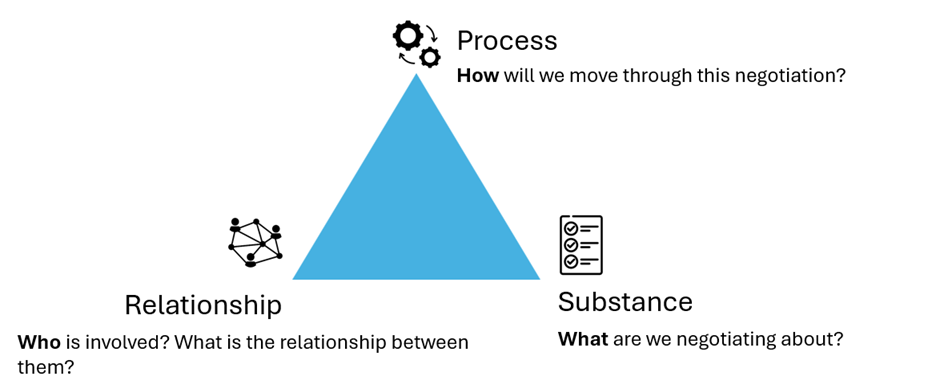
While attending past COPs, we have often seen presidencies and negotiating parties over-indexing on substance. Lots of preparation goes into outlining negotiation positions, defining red lines, and polishing the wording of draft text. Relationships get some attention, mostly as individuals work to strengthen their own coalitions and negotiating blocs, but truly grappling with animosity or ambiguity is rare. And very often underappreciated is the power of process—how the rooms and agenda are designed (or not) for generating ideas, surfacing disagreements productively, and suggesting ways to bridge them on the path from draft to a final decision.
The COP moments above show what happens when all three components come together—or fail to. The Copenhagen Accord brought real progress on substance, but broken processes weakened its uptake and delayed a global climate deal by six years. The Durban Huddle showed how innovative process choices could create space for relationships to recover and alternative wording to land. In Paris, transparency and trust helped the Presidency weather last-minute differences for an ambitious outcome, while in Glasgow, we saw how relationships developed long before COP can also force last-minute decisions that bring Presidencies to tears—even as they land victories on substance. At Sharm el-Sheikh, a coalition of 134 countries—exploiting processes, held together through relationships, and mobilized by disaster—made progress on an issue that had been stuck for 30 years.
Looking ahead to COP31, and to future COPs and climate negotiations, we recommend presidencies, group heads, and other stakeholders spend concerted time finding the answers to questions of substance, but also relationship and process. It might make a difference in the moment. And any moment might make the difference.
Authors:

Aditya Bhayana is a Fellow at the Harvard Kennedy School, where he teaches, and coaches diplomats, business leaders, and civil society professionals in negotiation strategy and leadership for better decision-making. His work focuses on equipping leaders from diverse sectors, capacities, and cultures with the skills needed to navigate complex, multi-stakeholder negotiations. He also leads Turn the Tide, an interuniversity collaboration that helps practitioners and students refine their negotiation skills to advance global climate action.
Earlier in his career, Aditya supported the government of India’s negotiations on climate, sustainable development, and international cooperation issues. He holds a master’s degree in public administration from Harvard Kennedy School and is a Young India Fellow from Ashoka University.
Ben Marshall is a Fellow at Dartmouth College, working on social impact and leadership development. He has spent his career helping organizations navigate complex public challenges. In the UK, he launched an NHS unit supporting global health collaborations, shaped government-to-government partnership mechanisms, and helped develop infrastructure decarbonization policies. He has run healthcare organization design projects and served as a leadership coach at Harvard, for UK health system leaders, and for community leaders in lower-income countries. Ben holds a BA from Oxford, an MBA from Dartmouth’s Tuck School, where he was a McGowan Fellow, and an MPA from Harvard Kennedy School.