

E.O. Wilson and a scientific friendship that lasted half a century
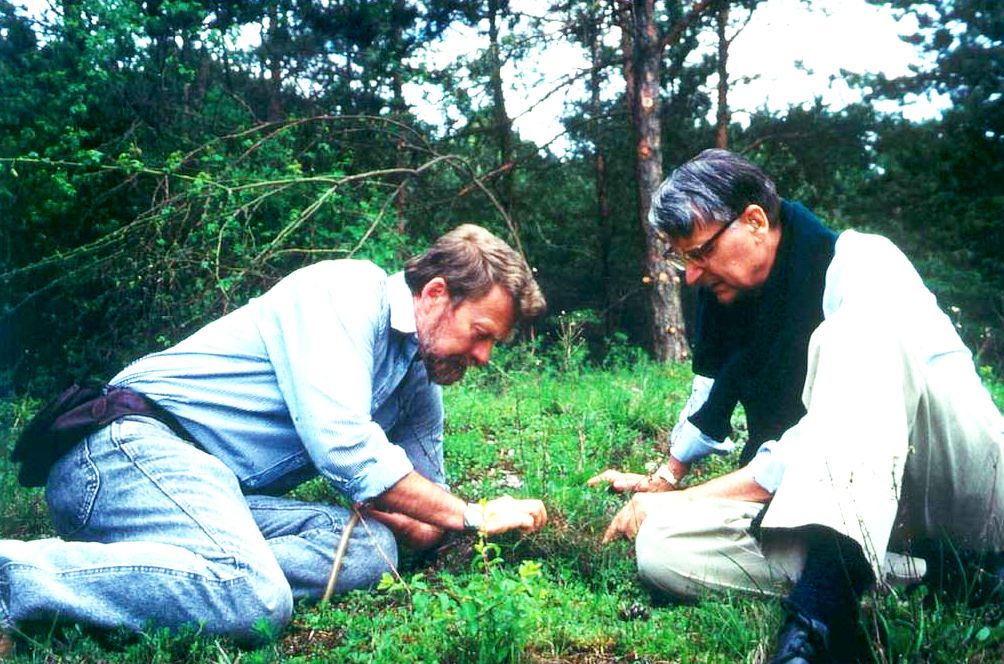
For more than 50 years, Bert Hölldobler and Edward O. Wilson shared a fascination with ants—and a friendship that helped transform scientists’ understanding of how insect societies work.
Wilson (1929–2021), a longtime Harvard biologist and two-time Pulitzer Prize winner, was one of the world’s leading authorities on biodiversity. He became an influential advocate for protecting life on Earth, proposing that humanity set aside half the planet’s land and seas for nature.
Hölldobler, an internationally renowned evolutionary biologist and pioneer in the study of insect behavior and communication, brought a different set of skills to their partnership. Where Wilson excelled at drawing broad conclusions about evolution and the natural world, Hölldobler focused on experiments that revealed how ants communicate, cooperate, and organize their colonies. Together, they wrote numerous scientific papers and books, including The Ants, which won the Pulitzer in 1991, and The Superorganism.
Their partnership was not without conflict. The two scientists sometimes disagreed sharply about how insect societies evolved. But their friendship survived, along with a shared conviction that understanding the natural world was essential to protecting it.
To mark Half-Earth Day, Jeannine Cavender-Bares, director of the Harvard University Herbaria and Wilson’s former teaching fellow, spoke with Hölldobler about their collaboration, the man behind Wilson’s public reputation, and what Wilson might make of the state of conservation today.
Tell us about yourself and how you came to know Ed. Can you explain a bit about your journey as a myrmecologist—or ant biologist?
From boyhood, I was interested in insects. I collected beetles and butterflies and cultured ant colonies which I raised from founding queens I collected after nuptial flights. My father was a medical doctor, but he also had studied zoology and published papers in myrmecology, so he was an early inspiration, and my mother was very patient and even helped catching flies to feed my frogs. Although in my advanced university studies I first began to specialize in forest entomology for my first thesis (which is about equivalent to a master thesis), I soon realized that my real interest is ethology and behavioral physiology. Of course, ants play a significant role in forest ecosystems, so I had already started working with ants, although with an applied entomological perspective. But I was fascinated by the diversity of their social organizations and wanted to better understand how insect societies work. So, I became a behavioral physiologist and experimental sociobiologist.
My main academic mentor was Martin Lindauer, who did pioneering work on honeybees at the University of Frankfurt, undoubtedly the most successful student of the Nobel laureate Karl von Frisch. I got my so-called habilitation degree under his mentorship and after that I was promoted to a position perhaps equivalent to associate professor without tenure.
You and Ed Wilson famously studied ants together and wrote many scientific articles over five decades and several important books over the course of your careers together, including the Pulitzer-winning The Ants, published in 1990. How did you first meet Ed? What do you remember about him as a young man? What sparked your collaboration and friendship?
After my habilitation I was entitled to take a sabbatical and with a stipend from the Max Kade Foundation, I was invited to be a visiting scholar at Harvard and Ed Wilson was my host. So, I arrived the first time in Boston in the fall 1969. My stay at Harvard was extended for another year to 1971. It was a most productive and, for me, formative time. Although Ed was working on his first magnum opus, The Insect Societies, and therefore was mostly secluded in his office, he was always there when I needed his support. I returned to Frankfurt to a tenured professorship in zoology, but after one year I resigned from this position because I received offers from Cornell and Harvard in 1972.
Our close friendship developed gradually after I had returned to Harvard as professor of biology in spring 1973. We both moved into the fourth floor of the new Museum of Comparative Zoology (MCZ) Laboratories, and we decided to have joint rooms—such as the insectary and environmental rooms, seminar room, and graduate student labs. It turned out to be a superb arrangement for both of us and for our graduate students, because our scientific backgrounds and talents were truly complementary.
Though we had our separate research groups and programs, on many occasions we joined our talents and formed a two-person team.
This two-person team conducted several research trips to Costa Rica. On such occasions I experienced Ed’s enormous enthusiasm for the diversity of life, his tremendous knowledge of natural history and his unending drive as a collector. This can best be illustrated by telling you a brief story which occurred on one of our trips to Costa Rica.
After having spent two weeks or so in the La Selva Rainforest, we returned to San Jose. On the evening before our departure back to Boston, Ed invited me to a restaurant, located behind a little city park close to our hotel. At the entrance of the park Ed spotted a trail of a Pheidole ant colony—the ant genus he was currently revising. Within seconds he was down on his knees and hands, and with his aspirator in his mouth he followed the trail picking up Pheidole workers, like an anteater. But Ed was not so much interested in the ant workers; for his taxonomic work he needed Pheidole soldiers, which he could not find along the trail. So, he crawled along the trail to get to the nest entrance, and to the absolute bewilderment of the park visitors, Ed obliviously approached a young passionately embracing couple standing behind the bush where the Pheidole nest entrance was located.
The behavior of this fanatic myrmecologist was so suspicious that the police appeared on the scene to inquire about our strange activities. That evening Ed had discovered seven new Pheidole species in this little city park of San Jose.
Needless to say, we never made it to the restaurant which Ed had recommended to me with mouthwatering superlatives.
Tell us about the nature of your collaborative work together. What did you each bring that the other couldn’t? What did he give you that you couldn’t have found elsewhere? Sometimes when scientists work together, there is a tendency to compete. Collaborations break down over perceived inequities in credit, resources, or other issues. Why did your collaboration work so well?
Ed and I did not compete with one another. It was very obvious to us that our different approaches to science, and our talents, were complementary. We both were interested in social insects, particularly the multitude of social organizations in the thousands of ant species, their evolution and ecological significance.
My background and strength was the experimental analysis of behavioral mechanisms, generally labelled behavioral physiology and experimental behavioral ecology and experimental sociobiology. I was interested in understanding complex social behavior in ants, and how so many solitary arthropods have succeeded during their evolution to break the communication codes of their host ant species and thereby exploit the “social acquisitions” of the ants.
Ed, although fascinated by this kind of research, himself came from population biology. An insect colony is treated like a population.
This is especially important for understanding the evolution of division of labor systems, the evolution of workers and worker-sub-castes, the analysis of adaptive demography and application of optimization models. These are areas where Ed Wilson made major discoveries and syntheses.
In addition, Ed’s background was evolutionary systematics and biogeography, where I am pretty ignorant.
Ed was the paramount synthesizer, whereas I am more of an analytical scientist. I love the experimental analysis and only after I passed the age of 50, I began to be interested in scientific synthesis within the frame of my expertise. We both had a good understanding of each other’s strengths and talents.
The combination of both of us was scientifically powerful and, I dare to say, also very beneficial for our graduate students on the fourth floor of the MCZ Laboratories.
We know E.O Wilson for explaining biodiversity to the world and championing it over the course of his life, for island biogeography, which became the basis for the half-Earth concept, for biophilia about our innate love of nature. What might we not know about E.O. Wilson and his work?
I remember when Ed finished the manuscript of his book Biophilia (1984), some of his colleagues, and I was one of them, urged Ed to choose another title. We had the impression the title may not catch the interest of the potential readership. We were obviously wrong!
When I first read Ed’s Biophilia, I did not see it as a scientific work, but as a beautifully written, somewhat autobiographic testimony of Ed’s love of nature and nature exploration, and his strong belief that our body and mind are adapted for life in the biosphere. In this context, I began to understand his use of the term biophilia.
To my knowledge Gordon Orians was among the first to come closest to Ed’s vision of scientific studies of innate dispositions in humans to nature. Orians’ paper “Habitat Selection: General Theory and Application to Human Behavior” (in the volume “The Evolution of Human Social Behavior” edited by Joan Lockard), 1980, is a pioneering scholarly work. The scientific treatment of biophilia finally found a solid base with the publication of the edited volume The Biophilia Hypothesis by Stephen R. Keller and E.O. Wilson, 1993, and a second volume The Biophilia Hypothesis II, co-edited by Ed Wilson, was published in 1997, and all these served as one of the bases for the revolutionary Half-Earth concept.
(The term biodiversity was coined by Walter G. Rosen, an Officer at the National Research Council of the National Academy of Sciences while helping plan the National Forum on Biodiversity, which was held in Washington, D.C., in 1986. Subsequently Ed Wilson very successfully popularized the term by using it as the title of the 1988 book of a collection of papers from the forum which he edited, and in turn he wrote the beautiful book The Diversity of Life, published in 1992.)
This characterizes Ed Wilson’s unique approach to public involvement. He made sure that these scientific publications did not remain only an academic enterprise; he invested much energy and charisma to make them public and shake the public conscience.
When I first met Ed Wilson in 1969, he was not an extrovert, flamboyant person who thrives when standing in the limelight of public attention. Just the contrary, he was a scientist and scholar, most happy in his library, or at the desk in his study, or in the tropical rainforest cutting up rotting wood searching for little known ant species that specialize in hunting mites. But during his decades of scientific work, Ed Wilson witnessed the man-made habitat destruction and mass extinction of life forms which finally drove him to become a chief advocate for the new field of conservation biology and the study of biodiversity, and some of his pioneering work provided the intellectual foundation for this advance.
What happened when you disagreed on aspects of the science you were doing collaboratively? You publicly and professionally agreed to disagree on kin selection versus group selection. What was the sticking point and how did you deal with it?
I assume you refer to our dispute concerning the evolution of eusociality, when we wrote the book Superorganism.
It was a difficult time and it is difficult to answer in short paragraphs. Although we agreed on the major concepts of colony-level selection, I could not follow Ed’s new ideas concerning the evolution of eusociality. It dawned on me too late that Ed had returned to Wynne-Edwardsian group selection. For Ed any ant colony, even those of “primitive eusocial” species in which each member has full reproductive potential, and therefore reproductive competition within societies is high, he considered a superorganism. He also claimed close family genetic relatedness is not needed for the evolution of eusociality. He failed to make a clear distinction between a eusocial society and a cooperative group.
My understanding, and I believe most experts agree with me, is that only those societies of highly derived eusocial status can (at least from an evolutionary point of view) be considered fully functional superorganism, and can represent an operational target of selection. In so-called primitive eusocial systems, we find high within-colony competition and almost no between-colony competition, whereas in highly derived eusocial systems there is no within-colony competition, but high between-colony competition and selection. Needless to say, we find all sorts of transitions between these two extremes. Hence, we speak of a multilevel selection process. But this is no argument against the kin-selection model.
I collaborated with a mathematical evolutionary biologist at Cornell. We clearly showed that a multilevel selection model can easily be transformed to kin-selection model and we could show that true superorganisms can function as a “vehicle of genes” (to use a metaphor of Richard Dawkins).
Needless to say, Ed did not agree. Some experts claim that Ed has always been a group selectionist, and indeed there is some truth to this, because in his earlier books (Insect Societies and Sociobiology) he considered kin selection a kind of group-selection.
Ed became really hostile toward the late William Hamilton, which also is mirrored in a Nature article, which caused a massive protest letter signed by 137 experts in the field. They also asked me to sign, but totally understood that I declined. Ed knew my view, I did not need to sign this letter, which also had some flaws, but mainly I felt too close to Ed to sign this letter.
These disagreements held up publication of our book for about two years. In summer 2007 I flew to Boston and I was determined we find a solution, because I did not want to repeat the mistake made in a PNAS perspective paper where I thought we could merge of our views. In retrospect that was, from my point of view, a disaster. Sure, the paper had some good points. But mostly it became confusing and contradictory. I wanted to make sure this was not repeated in our upcoming book.
To make the story short: Ed, who was assigned the evolution chapter, agreed that I take over and rewrite the chapter. I tried to also present his view, but our editor understandably did not like this because he felt the reader would get confused. So, the chapter heavily leans toward my view. Ed agreed, but requested to insert here and there some footnotes or change some emphasis of paragraphs. I could live with that and we finally sent off the manuscript to our editor. Ed’s final comment was: “Bert, there is one thing we agree on 100 percent, and that is, my co-author is wrong!”
Ed and I disagreed sometimes on academic issues, but our friendship remained as strong as ever. He called me once in his autobiography “his younger brother he never had” and for me he was like my older brother I never had.
What do you think Ed would make of where conservation science stands today—and what would he say needs to happen next?
I am afraid Ed would be much concerned and worried, because conservation science more than ever needs public understanding and support. The majority political attitude worldwide is that much of the basic research needed for conservation science has no relevance for society and therefore no public funds should be wasted for this kind of “useless” science. We have gone through these kinds of public mood swings before. This is why private foundations are so very much important, and also in this respect Ed Wilson was exemplary in creating such foundations and scholarships. As I know Ed, for him it would not matter whether these foundations or scholarships carry his name, but it should be a sign of our gratitude and our tribute to Ed to retain the name of this great man. I say this, because worldwide it currently appears to be politically correct to remove the names of scientists, on whose shoulders we all stand, from foundations, scholarships, buildings and streets, yet some politicians are eagerly decorating public buildings with their names.
Is there anything else you would like to share?
Greg Carr called Ed once a good man and a great man. I full-heartedly second this statement.
Ed was a great man because he was not afraid to ask big questions, questions about religion, philosophy, creative art, life sciences, and generally human existence.
He was the most eloquent advocate for saving the diversity of life on our planet and he was a master of the word.
Ed Wilson was a good man, because of his compassion, his genuine modesty and honesty; he cared!
Let me add a few sentences of a remarkable obituary for Ed written by Richard Dawkins, whose bitingly sharp critique of Ed’s book Social Conquest of Earth enticed Ed to label Dawkins a science journalist whose opinion he did not weigh seriously. This was certainly not fair and not correct, but it shows that despite all greatness Ed could react emotionally. After Ed’s passing Richard wrote a very fair and touching obituary remembering Ed. And here are a few sentences from his essay.
“Edward O. Wilson was a gentleman—a humane, humanist gentleman. He was also human, capable of being wrong, as we all are. … Edward O. Wilson was a biologist of immense distinction … a great scientist and a great man.”