

Is biodiversity valuable? At Harvard, Boston Climate Week ponders why
Think of a place in nature that makes you happy. A forest you visited in childhood, perhaps. A wetland. A beach. Someplace that feels more like memory than scenery – a part of yourself.
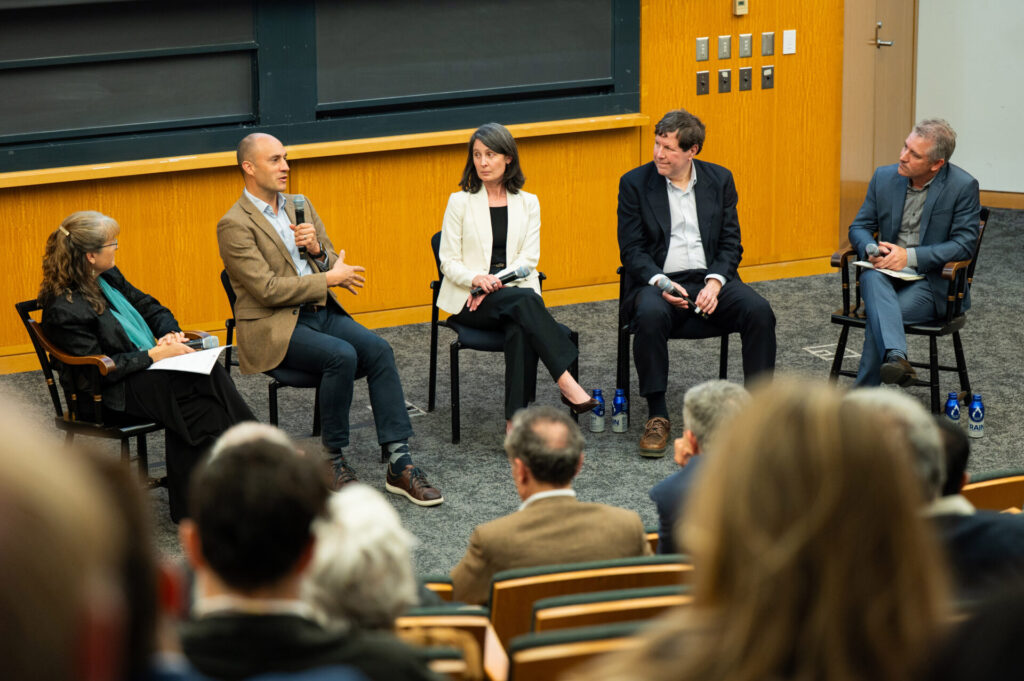
The prompt was part of an exercise at a Harvard panel during Boston Climate Week asking why – as species and ecosystems disappear at accelerating rates around the world – biodiversity matters.
“Perspectives really differ,” said Jeannine Cavender-Bares, co-chair of the new Harvard University Biodiversity Initiative for Planetary Stewardship, opening the panel by asking three scholars to argue one of three cases: Biodiversity matters for its own sake. It matters because humans belong to nature, as creatures of biodiversity. Or it matters for what people get from it – food, natural resources, and economic benefits.
While the three-part framing of biodiversity’s value – intrinsic, relational, and utilitarian – gave the panel structure, the speakers’ explanations converged; each saw biodiversity as valuable for overlapping reasons.
A diverse portfolio
“Healthy ecosystems are adaptive and resilient because they are complex networks,” said Rachel Gallery, a professor of microbial ecology at the University of Arizona, who took up the relational perspective – the idea that people belong to nature – framing the Earth not as a resource bank, but as home.
Ecosystems depend on the interactions and relationships between many species. Their “redundancy buffers against change” – much like a diverse financial portfolio protects an investor against market setbacks – and helps ecosystems resist invasion, disruption, and collapse, she said.
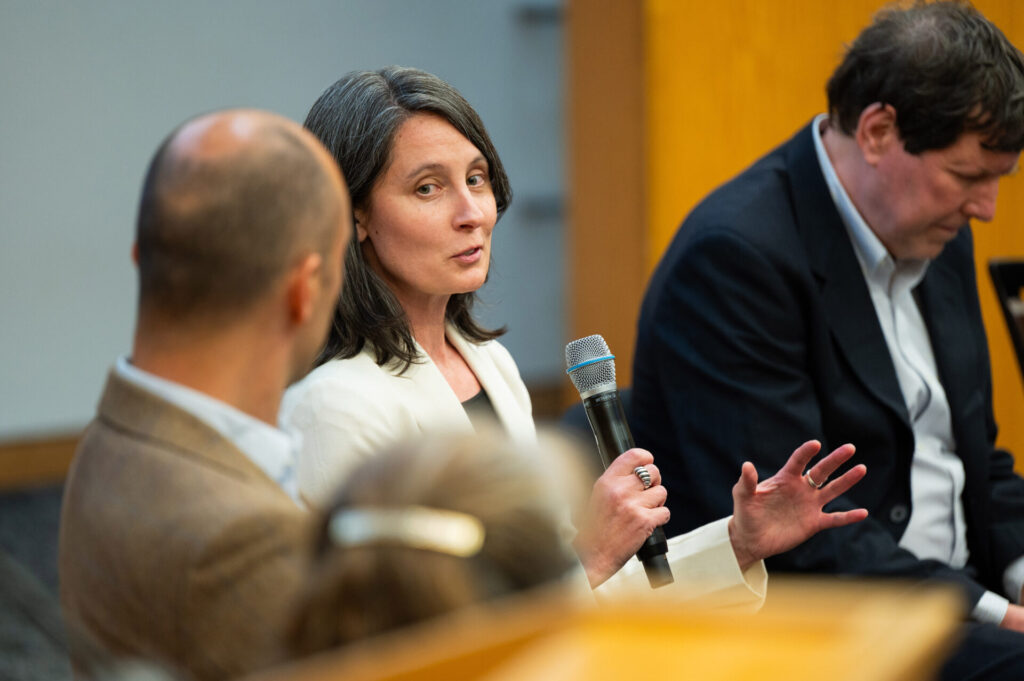
Human societies and economies depend on the planet’s “natural infrastructure,” she said, yet “the economic forces to extract from nature and reduce biodiversity are currently stronger than the forces in play to sustain it.”
Indeed, current market incentives often reward damage, said University of Minnesota environmental economist Stephen Polasky, who was assigned the utilitarian case.
Nature’s contributions to the modern economy are wide-ranging, Polasky said: providing food and building supplies, cleaning air and water, and regulating the climate.
Yet a failure to value nature is part of the problem.
Companies are often paid for extraction or production, but not for protecting water, air, or habitats. Polasky pointed to carbon pricing, zoning, biodiversity credits, and other tools as ways to better align profit with public and ecological value.
“Economic activity is what’s driving changes that are having negative consequences on biodiversity,” he said, raising the question of “what role does business have to play in turning this around?”
Rights of nature
Now let’s return to the thought experiment at the top: What is a natural place that matters to you, to your very being? Alexandre Antonelli, executive director of science at the Royal Botanic Gardens, Kew, posed the question as part of his case for intrinsic value – the idea that nature matters for its own sake.
For Antonelli, the place is the Atlantic rainforests of eastern Brazil, where he spent time as a child collecting seeds, snails, and anything else he could find. Most of those places are gone now, he told the audience, converted to farmland.
That loss, he argued, cannot be measured only in terms of what people no longer get from nature. Species and ecosystems were not made for humans. Many have existed for millions of years. They matter because they exist.
“And that’s why now there’s a movement called the rights of nature,” Antonelli said, “that nature itself has its intrinsic value and the right to exist.”
“I think intrinsic value is something that we have to speak much more about” in conservation, he said. “It is a tragedy for us to lose species in the branches of the tree of life. We know we have the means to reverse that, and therefore we should.”
Managing our home
The assigned perspectives converged because all three speakers saw biodiversity as critical infrastructure for life on Earth. Dividing the argument into intrinsic, relational, and utilitarian value was useful as a narrative device, but also limiting. Biodiversity matters, the three agreed, because life has value in itself, because people belong to nature, and because human well-being and economic activity depend on functioning ecosystems.
Antonelli pushed back on the idea that biodiversity simply means the number of species on Earth. Species matter, he said, but so do genetic diversity, ecological functions, evolutionary lineages, and ecosystems. He pointed to “all the different kinds of apples you get in the supermarket,” and to “the genetic universe” that makes some species more resilient to future climate change than others. Biodiversity is not only what people can see. It is the variation that lets life adapt and endure.
Cautioning against reducing nature to quantifiable terms, Polasky stressed that some of nature’s contributions are “nonmaterial services,” including “a sense of place” – values that are “less tangible than a material service, but often vitally important.” He also noted the limits of pricing the Earth system itself, recalling one economist’s response to an estimate of global ecosystem services as “a serious underestimate of infinity.” As Polasky put it: “You wipe out the earth, you wipe out us.”
Gallery tied the economic and ecological arguments together, highlighting the words’ Greek root – oikos, for house or household. We cannot choose between nature and the economy, she said, but must understand that both are tied to the same home: “Ecology is the study of the house. Economics is the management of the house. And we can’t manage what we don’t understand.”