

Harvard at Boston Climate Week
The first Boston Climate Week is set for May 3-10, featuring talks, runs, fresks, networking events, research workshops, and more. Harvard, through the Salata Institute, will host a series of events designed to leverage Boston’s strengths as a hub for academic research and climate innovation.
Public Talk: finding common ground on nature
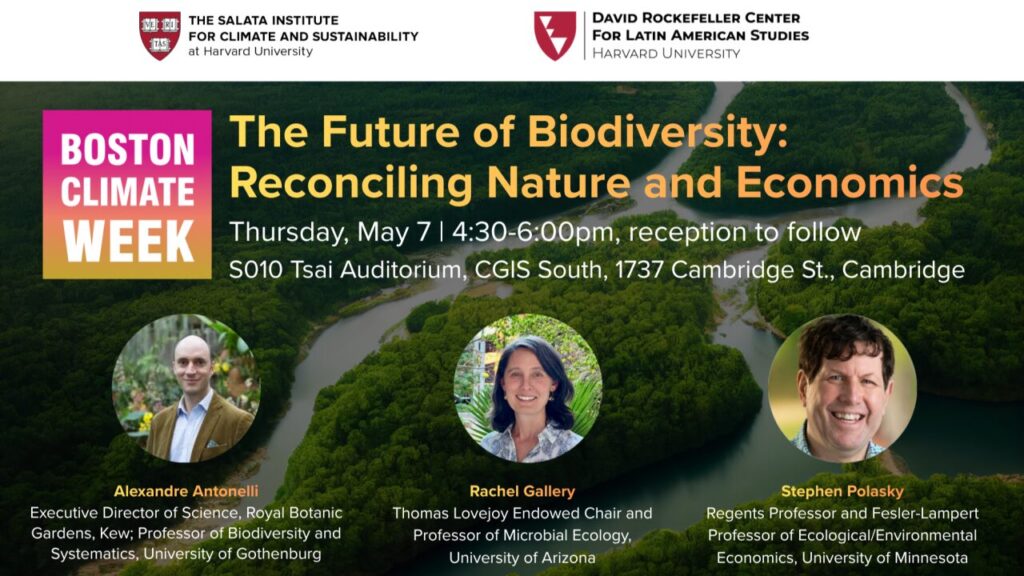
Biodiversity underpins our planet’s life support systems, yet views differ on why biodiversity matters. For some, nature matters because it supports the well-being of people, primarily through natural capital (the “utilitarian” perspective). For others, the diversity of nature has an intrinsic value, given its 3.9 billion years of evolutionary history, most of that in the absence of humans (the “nature for nature” perspective).
A Salata Institute panel on May 7th at 4:30 PM ET will explore these contrasting perspectives and how they can be reconciled. The expert panel will examine the roles and responsibilities humans bring to the table, whether it is protecting pristine environments, enjoying wildlife, or utilizing nature for its ecosystem services.
Register for the panel, “The future of biodiversity: reconciling nature and economics” here. This event is co-sponsored by the David Rockefeller Center for Latin American Studies.
Hands-on training: preparing city officials to confront extreme heat
Cities are increasingly being forced to adapt to hotter summers and more frequent, severe heat waves. The public officials tasked with protecting communities from dangerous heat often face constrained and uncertain resources. A two-day event at Boston Climate Week will bring together officials from across the country to learn life-saving strategies from cutting-edge research and each other.
This simulation design is unique in its use of hundreds of hours of archival news footage from recent heatwaves in Phoenix, Arizona. Hands-on breakout discussions are followed by short info sessions on topics ranging from thermal physiology to mortality estimations to impacts on the energy grid. The simulation is designed to elicit best practices and challenges faced by city officials and to promote inter-city knowledge exchange.
Learnings from the simulation and three panels focused on health, habitat, and labor will be consolidated to produce a new resource, Letters to a New Heat Officer. In this compendium, experienced officials will document the hard-won lessons, early warnings, and decision heuristics that they would have found useful at the outset of their careers in heat response and planning.
This event is hosted by the Salata Institute in collaboration with the Harvard Urban Health Initiative, the Harvard Global Health Institute Scholarly Working Group on Heat and Worker Protections, and CrisisReady at Harvard Data Science Initiative.
Read more about previous heat simulations here. Are you a city official, policy maker, or academic interested in a future heat simulation? Let us know!
Working sessions: charting what’s next for methane and carbon offsets
On the sidelines of Boston Climate Week’s many public events, leading researchers and practitioners will gather to press forward on two critical climate questions: methane and carbon offsets.
In a workshop focused on the role of entrepreneurship in reducing methane emissions, researchers and practitioners will explore barriers to deploying methane emissions-reducing technologies and opportunities for new business models, technologies, and coordinated action to unlock commercial and climate impact.
In a convening on carbon offsets, researchers will explore pressing and difficult questions: What is the state of the underlying science? What is the social value of offsets? How are their impacts measured? How are they financed? What are effective offset market designs? (And more). Through two days of in-depth presentation and discussion, scholars and practitioners will advance this urgent research.
Sparking careers: ClimaTech networking after dark
On Tuesday, May 5th, Harvard students and alumni are welcome to apply to join a career-building evening of networking with climate tech startups and luminaries. ClimaTech After Dark, supported in part by the Salata Institute, will feature opportunities to connect with potential mentors, a resumé drop – plus a live DJ and good food.