

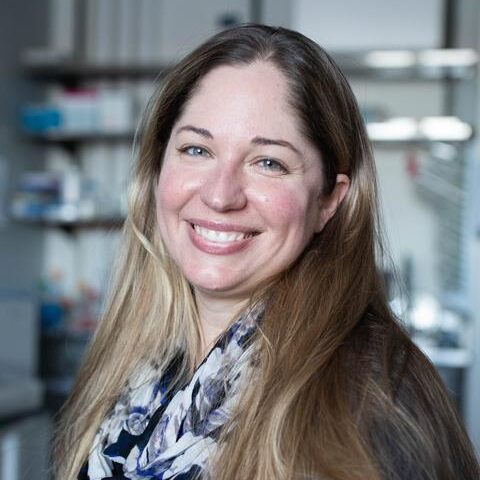
Carrie Albertin
The Albertin lab investigates the evolutionary and developmental bases of biological novelty using soft-bodied cephalopods (squid and octopus) as model systems. To enable this work, Carrie and her group have built new tools to study cephalopod biology, including sequencing, assembling, and annotating genomes, developing husbandry approaches, and establishing genome editing in these animals. Building on these tools, the Albertin lab is currently exploring how the anteroposterior, dorsoventral, and proximodistal axes are established and patterned during development, and how the cephalopod nervous system, which is the largest amongst invertebrates, forms during and after embryogenesis.
Carrie Albertin received a B.A. in Biological Sciences and French from Mount Holyoke College and a Masters in Molecular and Cellular Biology from Université Pierre et Marie Curie and École Normale Supérieure in Paris, France. She then received her Ph.D. from the University of Chicago, where she worked with Dr. Cliff Ragsdale on cephalopod genomics, transcriptomics, and embryology. Before joining OEB, Carrie started her lab as a Hibbitt Early Career Fellow at the Marine Biological Laboratory.
The Salata Institute
The Salata Institute supports interdisciplinary research that leads to real-world action, including high-risk/high-reward projects by researchers already working in the climate area and new endeavors that make it easier for Harvard scholars, who have not worked on climate problems, to do so. Faculty interested in the Climate Research Clusters program should note an upcoming deadline for concepts on April 1, 2024.