Is Politically Feasible and Morally Responsible Geoengineering Possible?
Tuesday, Mar 31, 2026, 12:00 pm - 1:30 pm
Malkin Penthouse, Harvard Kennedy School, 79 John F. Kennedy Street, Cambridge
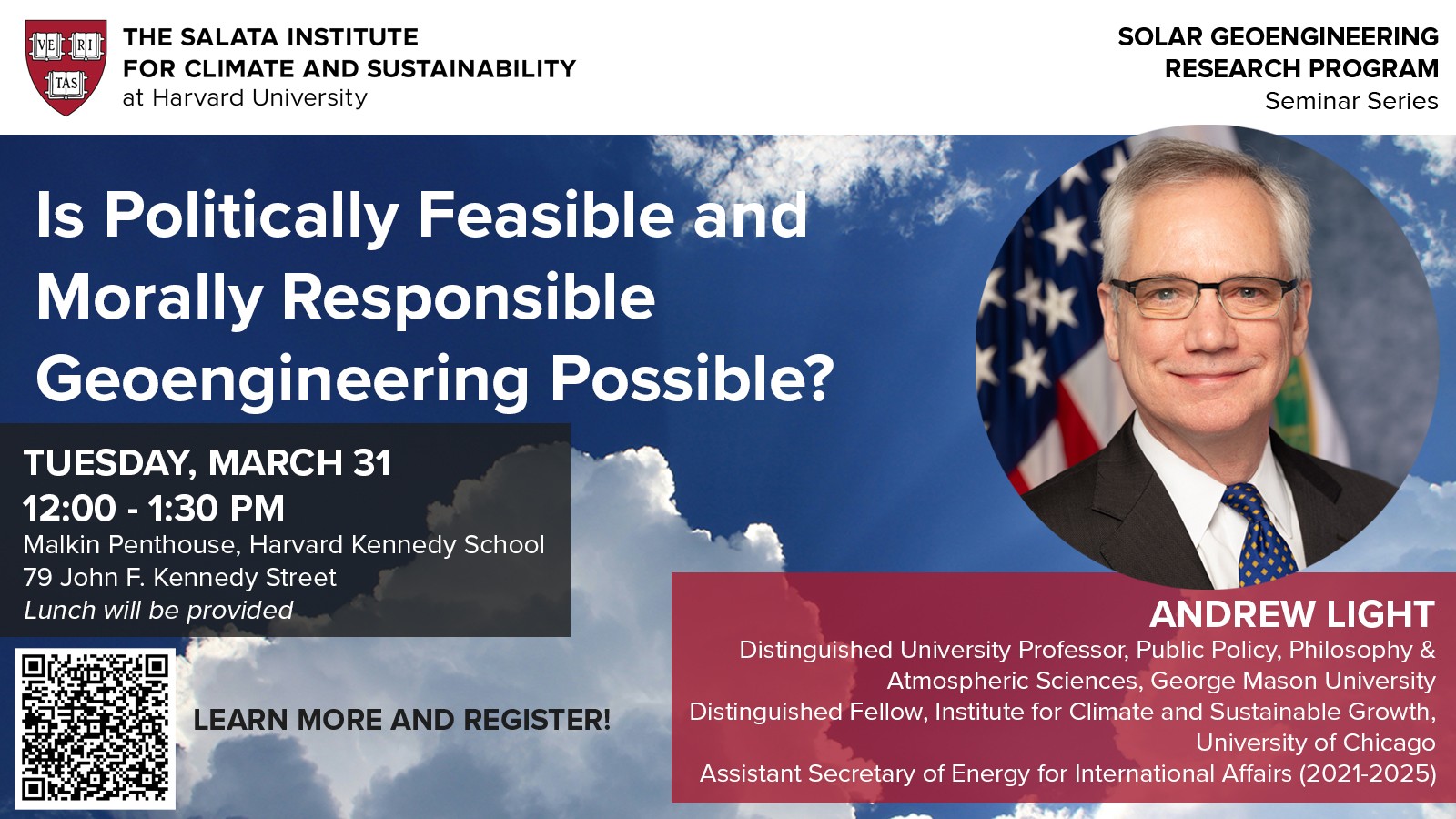
Public and private research on solar geoengineering is on the rise. Nearly all proposals for large-scale research or deployment envision that, given the scale and scope of interventions like stratospheric aerosol injection, some level of international cooperation or coordination is necessary for both success and moral license. Geoengineering more broadly faces the challenge by many opponents that even research, particularly large-scale outdoor experiments, risk “mitigation deterrence” — a moral hazard slowing the commitment to reduce anthropogenic greenhouse gases both by particular countries and under accepted international regimes. Along with the rise in research on geoengineering, there has been a flurry of proposed resolutions and well-organized campaigns in multilateral forums to limit all deployment and some research on solar geoengineering, most prominently advocacy for a global Non-Use Agreement. In this talk, Andrew Light will explore the current landscape of international debates on climate engineering and then try to address the question of whether it is feasible to get sufficient international coordination to attempt some form of climate engineering, and the conditions that would be necessary for some measure of international acceptance of it, as well as the broader problem of how to address the ethical, even existential, challenges to large-scale research or deployment.
Andrew Light has held a variety of leadership positions in government, NGOs, and universities. From 2021-2025, he served as United States Assistant Secretary of Energy for International Affairs, directing a team of over 100 civil servants and political appointees to help accelerate a global clean energy transition while ensuring energy security. Starting in February 2022, he also became one of the leaders in the U.S. government fighting the global energy war initiated by Russia as part of the invasion of Ukraine. From 2013-2016, he served as Senior Adviser and India Counselor to the U.S. Special Envoy on Climate Change, as well as a staff member for climate in the Secretary of State's Office of Policy Planning, working on the Paris Agreement and other platforms for climate cooperation. At NGOs, he has been a Distinguished Senior Fellow at the World Resources Institute, where he led some of the highest non-governmental bilateral dialogues on climate and energy cooperation between the U.S. and China, India, and the EU, and Senior Fellow and Director of International Climate and Energy Policy at the Center for American Progress. Andrew is currently a Distinguished Fellow at the Institute for Climate and Sustainable Growth at The University of Chicago, and Distinguished University Professor of Public Policy, Philosophy, and Atmospheric Sciences at George Mason University. Andrew is the author of over 100 articles and book chapters on climate change, restoration ecology, and urban sustainability, has authored and edited 19 books, and co-authored over 20 major policy reports. He is currently writing a book on India’s clean energy transition and working with select countries on the creation of global governance norms for climate engineering.
Register
Andrew Light has held a variety of leadership positions in government, NGOs, and universities. From 2021-2025, he served as United States Assistant Secretary of Energy for International Affairs, directing a team of over 100 civil servants and political appointees to help accelerate a global clean energy transition while ensuring energy security. Starting in February 2022, he also became one of the leaders in the U.S. government fighting the global energy war initiated by Russia as part of the invasion of Ukraine. From 2013-2016, he served as Senior Adviser and India Counselor to the U.S. Special Envoy on Climate Change, as well as a staff member for climate in the Secretary of State's Office of Policy Planning, working on the Paris Agreement and other platforms for climate cooperation. At NGOs, he has been a Distinguished Senior Fellow at the World Resources Institute, where he led some of the highest non-governmental bilateral dialogues on climate and energy cooperation between the U.S. and China, India, and the EU, and Senior Fellow and Director of International Climate and Energy Policy at the Center for American Progress. Andrew is currently a Distinguished Fellow at the Institute for Climate and Sustainable Growth at The University of Chicago, and Distinguished University Professor of Public Policy, Philosophy, and Atmospheric Sciences at George Mason University. Andrew is the author of over 100 articles and book chapters on climate change, restoration ecology, and urban sustainability, has authored and edited 19 books, and co-authored over 20 major policy reports. He is currently writing a book on India’s clean energy transition and working with select countries on the creation of global governance norms for climate engineering.

ADD YOUR EVENT TO THE SALATA CALENDAR
Are you hosting a Harvard-affiliated event that is related to climate change and/or sustainability? Please submit your event to the Salata Institute event calendar using this quick form! We look forward to sharing your event with the Harvard community.
Submit Your Event