

From New York to Belém: Building student engagement in multilateral climate governance
For me, 2025 was the year climate governance stopped feeling theoretical. While attending high-level international climate meetings in New York and Brazil, I found that the real challenge to progress addressing climate change is no longer country commitments – it is access, financing, and delivery.
Moreover, young people like myself play increasingly visible roles in negotiations, but procedural barriers and closed doors still keep future leaders on the margins, making our participation largely symbolic.
The access gap
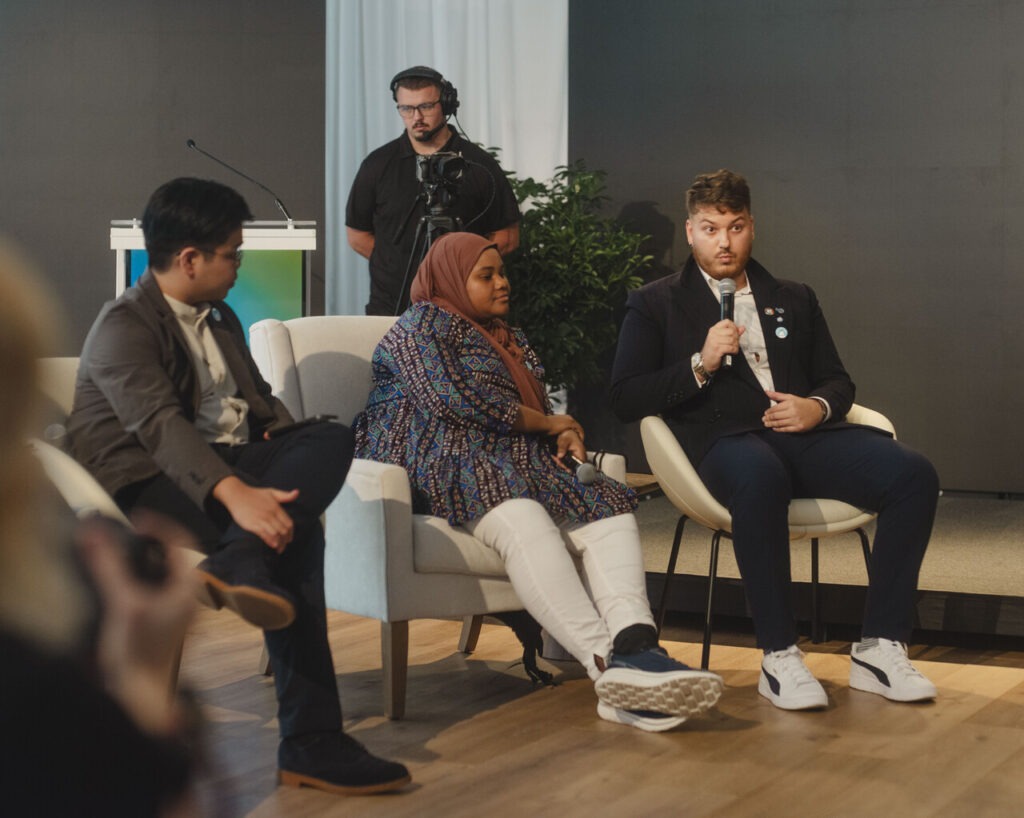
At the UN General Assembly and New York Climate Week in September, youth leaders were easy to spot and hard to hear. Getting into plenaries where the Secretary-General was present meant navigating layered petitioning processes with civil society sponsors, often for only seconds at the microphone.
Yet high-profile institutional reports argue that youth influence is rising. The UN’s 2025 Youth2030: A Global Progress Report, for example, points to improving “green scores” for youth engagement across UN entities. On the ground, though, the gap between representation and influence is still stark. Youth were fêted at the 30th anniversary of the World Program of Action for Youth, including what was billed as the first high-level meeting on youth during UNGA. But with the Youth2030 “green score” target of 80% still unmet, the pattern is clear: Youth are increasingly welcomed into these convenings, but not consistently empowered to lead – or to shape policy outcomes.
COP30 in Belém – the ambition gap meets closed doors
That same friction followed me to Belém for COP30. Even with an official Harvard University observer badge supplied by the Salata Institute, many negotiation rooms were still off-limits. Sometimes that was simply a function of capacity and process. But the effect was the same: Access even for accredited observers depended less on formal credentials than on informal, sometimes subjective connections.
Inside those high-stakes spaces, the tone skewed toward polished success stories. There was far less room for candid discussion of the ambition gap: the reality that, according to the UN’s 2024 Sustainable Development Goals Report, the world is currently on track to meet only 18% of the Sustainable Development Goals.
Outside the Blue Zone – local resolve and practical delivery
The disconnect between high-level policy and local reality was most visible in the streets of Belém. Outside the restricted Blue Zone, the city was alive with the resolve of Indigenous leaders and local NGOs. Here, I saw a more human side of climate action: community educators leading sessions in Portuguese and Spanish on protecting Amazonian lands.
At the same time, back inside, the technical work kept moving. Through the Council of Engineers for the Energy Transition (CEET) and ASEAN Green Future, I spoke with experts focused on Brazil’s power-system resilience. We dug into practical decarbonization options – grid hardening, nature-based solutions, and strategies that strengthen energy sovereignty.
The throughline was clear: climate finance can unlock momentum, but it cannot substitute for delivery. However framed, funding only works if it is paired with on-the-ground engineering and implementation – and if that work is guided by, and accountable to, local and Indigenous communities.
Turning exposure into sustained engagement
Harvard can play a different role in this ecosystem by building a durable bridge between global convenings and sustained work. With the right institutional infrastructure, student exposure can translate into ongoing participation and, over time, more formalized pathways to youth decision-making power.
The Salata Institute is one practical mechanism for making that bridge real. Through its student programs, 10 students (including me) attended COP30 with funding support. When we returned home, the Harvard Brazilian Association of Students and Scholars (HBASS), together with the Institute, hosted a debrief to translate what we saw into concrete lessons for the broader Harvard community.
As a Salata Student Ambassador, I have seen how that kind of ecosystem can function as a campus “nerve center” – connecting policy insights and technical solutions from individual students and schools to the wider research community. The point is not attendance for its own sake; it is building continuity, sharpening implementation capacity, and creating sustained leverage beyond a single convening.
We have also seen how easily meaningful influence can be postponed, even as opportunities for observation, networking, and knowledge-sharing expand. Closing the access gap will require moving beyond dialogue-centered engagement toward structured, participatory decision-making mechanisms – where youth participation is not symbolic, but expected.
That is the work ahead: turning presence into power, and turning exposure into implementation.