

Financing fairly: Development-optimal climate finance
Renewables are now the cheapest form of energy in many parts of the world. And once a solar or wind farm is built, its operational costs are negligible – the sun and the wind are free – unlike a coal-fired power plant that must keep sourcing coal indefinitely. But the upfront costs can be greater.
In emerging markets and developing economies, financing costs remain so high that fossil fuels are often the optimal choice from a banker’s perspective: A coal plant may look cheaper than a wind farm simply because capital is scarce and expensive, even if the lifetime costs are higher and the coal plant locks in decades of climate-heating emissions.
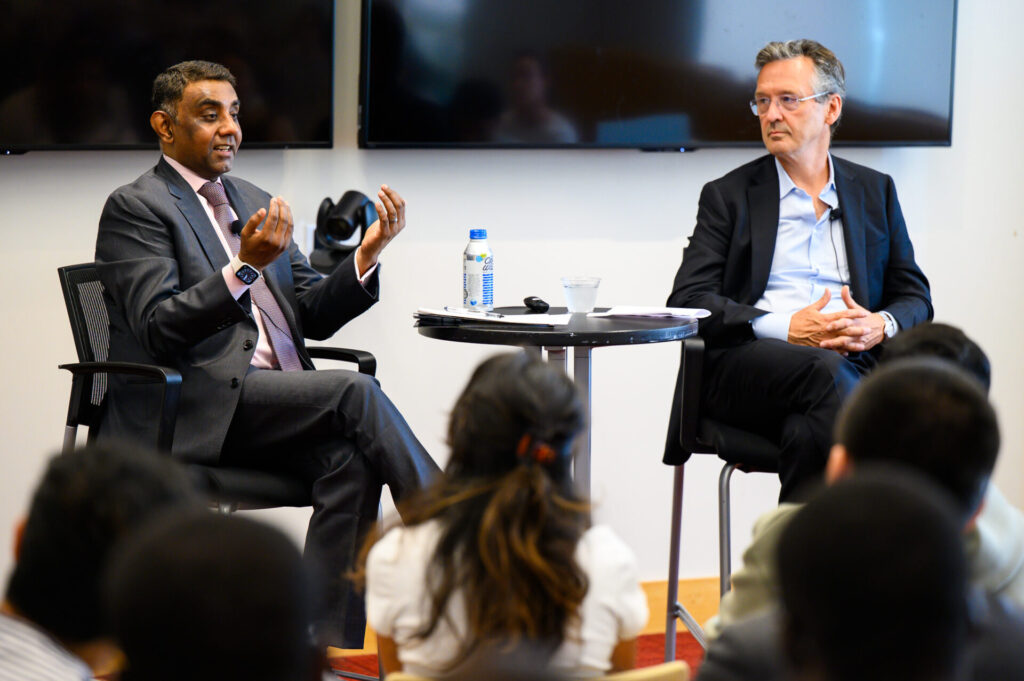
That dilemma framed a Harvard Climate Action Week seminar on September 18 hosted by the Belfer Center. Akash Deep, Senior Lecturer in Public Policy at Harvard Kennedy School, discussed his research on development-optimal climate finance, a framework to distinguish the benefits, costs, and risks of development from those of climate action. He was joined by Nick O’Donohoe, Senior Fellow at the Mossavar-Rahmani Center for Business and Government and former CEO of British International Investment.
Development vs. climate
Deep argued that while development and climate finance are deeply intertwined – and international lenders often try to meet the needs of both in one project – the risks and benefits are not.
The rewards of development are local: jobs, electricity, infrastructure. Caring for the climate, by contrast, benefits everyone; it is a global public good. The risks diverge too: Development finance faces currency, regulatory, and political exposure, while climate finance hinges on technology performance and carbon prices.
“Bundling these together blurs priorities and leads to misallocation,” Deep said. “To be effective and fair, financing has to reflect the differences.”
He proposes that international lenders separate how they approach the two, clarifying both the mission and who pays. Development resources should not be consumed by climate goals, and climate finance should not be stretched to deliver core development needs.
The Green Swap
Consider a country like India, which has announced plans to build dozens of new coal plants in the next five years. Coal is often the cheapest way to meet soaring power demand – the development-optimal choice.
A new financial instrument designed by Deep and colleagues, the Green Swap, uses that counterfactual – the unbuilt coal-fired power plants – as a benchmark. Here, climate investors provide the additional “greening” capital to build renewable plants instead. The risks are split: Development investors (in this case, the government of India or a public-private partnership) carry construction, credit, and political risks, while climate investors take on technology risks and any risk monetizing avoided emissions through carbon credits.
“Think of it as a swap,” Deep explained. “You long the green plant, short the brown plant, and net out the development risks.”
By structuring investments this way, the cost of capital can fall to affordable levels in developing countries. Crucially, Deep added, multilateral development banks (MDBs) like the Asian Development Bank or the World Bank can play a vital role in certifying the counterfactual. By vouching that the coal plant was indeed the development-optimal choice, MDBs provide the credibility investors need that the avoided emissions are real.

The framework has implications for development aid. Deep pointed to data showing that while total bilateral aid from donor nations has grown in the last decade, almost all the increase has gone to climate-specific or crisis-related spending. Traditional development has stagnated in real terms, squeezed by what he called the “triple mandate” of aid: development, climate, and crisis response.
Disentangling these mandates, he argued, is essential to ensuring resources flow where they are most effective. Without clearer distinctions, climate and humanitarian demands risk absorbing funds intended for long-term development.
Trade-offs in practice
O’Donohoe brought the perspective of a practitioner who has grappled with these trade-offs. British International Investment, the UK’s development finance arm, provided scarce capital to the private sector in low-income countries for decades. That started changing after the Copenhagen COP in 2009, when donor governments leaned on development banks to deliver climate finance.
“Suddenly we had two targets,” O’Donohoe recalled: one for overall investment and another for climate. The effect was immediate. “Teams naturally gravitate toward bigger, lower-risk transactions in middle-income markets,” he said. “That creates some cannibalization of traditional development finance.”
Addressing wary private capital
To meet the growing financing needs of the climate and energy transition, most of the capital will need to come from private sources. But private investors require commercial, risk-adjusted returns. That is difficult in countries where macroeconomic and political crises frequently lead to currency devaluations. “Until we start creating investment climates more conducive to pension funds and long-term investors, it will be hard to mobilize private capital at scale,” O’Donohoe cautioned.
Deep argued that development-optimal climate finance can help bridge that gap. By separating development and climate risks, and by having MDBs vouch for credible baselines, climate investors can be offered a clearer, less risky proposition. That, in turn, could draw in institutional capital without overwhelming scarce public budgets.
Both agreed the stakes are high. Development finance institutions risk drifting toward easier deals, while aid budgets are stretched across competing mandates. Without new instruments like the Green Swap, emerging economies may remain locked into fossil infrastructure, undermining global climate goals.
“The goal is not to choose between climate and development,” Deep said. “It is to finance both fairly.”