EPS Colloquia: What we talk about when we talk about enhanced weathering
Monday, Sep 22, 2025, 12:00 pm - 1:00 pm
Geological Museum 102 (Haller Hall), 26 Oxford St., Cambridge
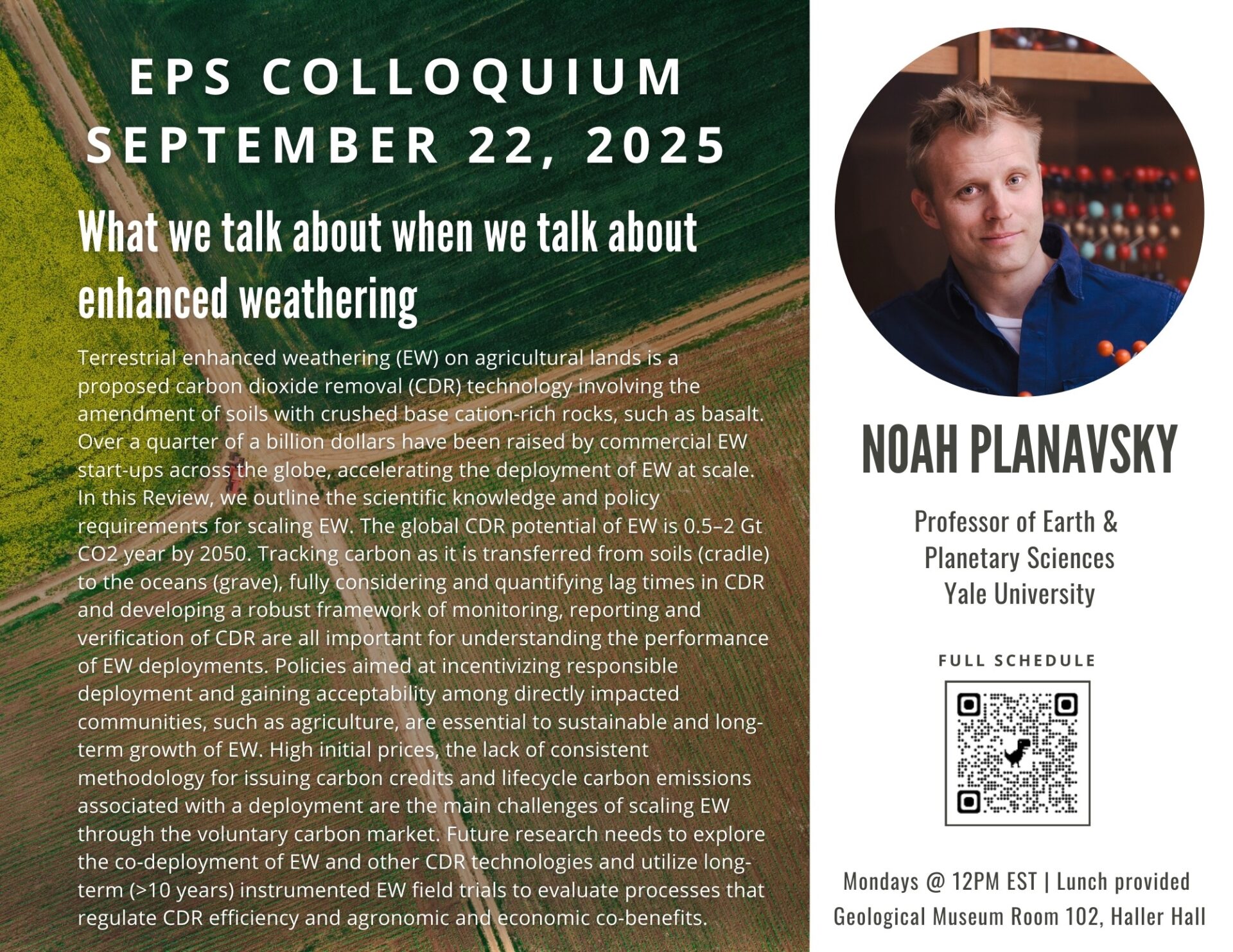
ABSTRACT:
Terrestrial enhanced weathering (EW) on agricultural lands is a proposed carbon dioxide removal (CDR) technology involving the amendment of soils with crushed base cation-rich rocks, such as basalt. Over a quarter of a billion dollars have been raised by commercial EW start-ups across the globe, accelerating the deployment of EW at scale. In this Review, we outline the scientific knowledge and policy requirements for scaling EW. The global CDR potential of EW is 0.5–2 Gt CO2 year by 2050. Tracking carbon as it is transferred from soils (cradle) to the oceans (grave), fully considering and quantifying lag times in CDR and developing a robust framework of monitoring, reporting and verification of CDR are all important for understanding the performance of EW deployments. Policies aimed at incentivizing responsible deployment and gaining acceptability among directly impacted communities, such as agriculture, are essential to sustainable and long-term growth of EW. High initial prices, the lack of consistent methodology for issuing carbon credits and lifecycle carbon emissions associated with a deployment are the main challenges of scaling EW through the voluntary carbon market. Future research needs to explore the co-deployment of EW and other CDR technologies and utilize long-term (>10 years) instrumented EW field trials to evaluate processes that regulate CDR efficiency and agronomic and economic co-benefits.
Noah Planavsky, Professor of Earth & Planetary Sciences, Yale University is an isotope geochemist that works on environmental change in Earth’s past, present, and future. His work combines field studies, analytical chemistry, novel isotope systems, and geochemical modeling. He has worked extensively on atmospheric evolution—particularly on changes in oxygen and carbon dioxide concentrations. Current projects focus on changes in ocean oxygen levels, tracking how primary productivity has changed through time, and on the potential for carbon capture through enhanced mineral weathering in marine and terrestrial environments.
Learn More
Terrestrial enhanced weathering (EW) on agricultural lands is a proposed carbon dioxide removal (CDR) technology involving the amendment of soils with crushed base cation-rich rocks, such as basalt. Over a quarter of a billion dollars have been raised by commercial EW start-ups across the globe, accelerating the deployment of EW at scale. In this Review, we outline the scientific knowledge and policy requirements for scaling EW. The global CDR potential of EW is 0.5–2 Gt CO2 year by 2050. Tracking carbon as it is transferred from soils (cradle) to the oceans (grave), fully considering and quantifying lag times in CDR and developing a robust framework of monitoring, reporting and verification of CDR are all important for understanding the performance of EW deployments. Policies aimed at incentivizing responsible deployment and gaining acceptability among directly impacted communities, such as agriculture, are essential to sustainable and long-term growth of EW. High initial prices, the lack of consistent methodology for issuing carbon credits and lifecycle carbon emissions associated with a deployment are the main challenges of scaling EW through the voluntary carbon market. Future research needs to explore the co-deployment of EW and other CDR technologies and utilize long-term (>10 years) instrumented EW field trials to evaluate processes that regulate CDR efficiency and agronomic and economic co-benefits.
Noah Planavsky, Professor of Earth & Planetary Sciences, Yale University is an isotope geochemist that works on environmental change in Earth’s past, present, and future. His work combines field studies, analytical chemistry, novel isotope systems, and geochemical modeling. He has worked extensively on atmospheric evolution—particularly on changes in oxygen and carbon dioxide concentrations. Current projects focus on changes in ocean oxygen levels, tracking how primary productivity has changed through time, and on the potential for carbon capture through enhanced mineral weathering in marine and terrestrial environments.

ADD YOUR EVENT TO THE SALATA CALENDAR
Are you hosting a Harvard-affiliated event that is related to climate change and/or sustainability? Please submit your event to the Salata Institute event calendar using this quick form! We look forward to sharing your event with the Harvard community.
Submit Your Event