

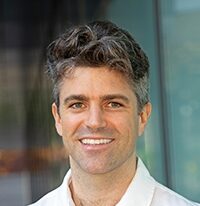
Gage Hills
Associate Professor of Electrical Engineering
Profile
Profile
My research focuses on developing energy-efficient and environmentally sustainable computing systems, leveraging three-dimensional integrated circuits. Support from the Salata Institute has been incredibly valuable in addressing this global challenge.
More specifically, my group is contributing to a global paradigm shift in computing: the evolution from energy-efficient computing to CO2-efficient computing, i.e., enabling high performance computing systems that simultaneously have a small carbon footprint. For energy-efficient computing, energy is considered as the valuable resource that is consumed achieve high-performance computing. For CO2-efficient computing, carbon emissions are instead considered as the resource. CO2 emissions include both embodied carbon, due to physical manufacturing, and operational carbon, from day-to-day use. Considering the manufacturing stage is a new concept for computer system designers.
My group is leading three directions in CO2-efficient computing.
(i) Defining metrics of carbon efficiency, instead of energy efficiency, that designers can target to optimize computing systems. See our paper at the High-Performance Computer Architecture (HPCA) conference (Best Paper Award honorable mention): “CORDOBA: Carbon-Efficient Optimization Framework for Computing Systems”.
(ii) Developing techniques to model the embodied CO2 of future computing systems that do not exist yet. See our paper at the Design, Automation, and Test in Europe (DATE) conference (Best Paper Award candidate): “Quantifying Trade-Offs in Power, Performance, Area, and Total Carbon Footprint of Future Three-Dimensional Integrated Computing Systems”.
(iii) Leveraging robust optimization algorithms to improve CO2 efficiency, despite uncertainty in carbon accounting. Preliminary results are in our HPCA submission (linked above).
My group is also pursuing new directions in reducing computing’s use of Per- and Polyfluoroalkyl Substances (PFAS), i.e., “forever chemicals”. Initial directions are summarized in our paper: “Modeling PFAS in Semiconductor Manufacturing to Quantify Trade-offs in Energy Efficiency and Environmental Impact of Computing Systems”.
Additional information about my group, including specific research thrusts, is available on our website: https://nanodesign.seas.harvard.edu
Contact
Email: ghills@seas.harvard.edu
Phone: (617) 495-1110
Assitant: Rebekah Keely - rkeely@seas.harvard.edu
Additional Website: https://seas.harvard.edu/person/gage-hills
Expertise
Design, Computer Science, Engineering, Physics, & Sustainability
The Salata institute
The Salata Institute supports interdisciplinary research that leads to real-world action, including high-risk/high-reward projects by researchers already working in the climate area and new endeavors that make it easier for Harvard scholars, who have not worked on climate problems, to do so.