In this week’s episode of Resources Radio, host Daniel Raimi talks with Dustin Tingley, a professor at Harvard University, and Alexander Gazmararian, a doctoral candidate at Princeton University about how a bottom-up approach to policy could help facilitate the clean energy transition.
More than two-thirds of Americans feel climate anxiety. Among young adults, a study published by The Lancet found, the figure tops 80 percent. Harvard Professor Sarah Dimick shares a reading list that just might help.
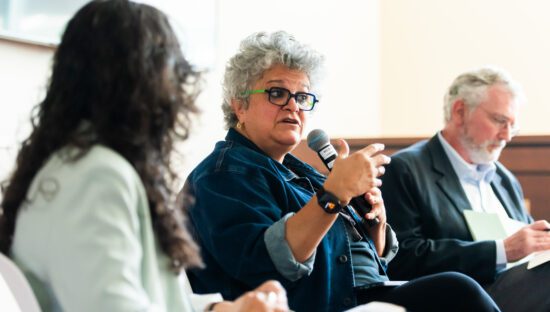
Global climate talks must be understood within the context of geopolitical realignment, a top Brazilian negotiator said during a talk at Harvard University.
The greenhouse gas methane is invisible to the human eye, so easy to ignore. But by highlighting its local impacts on human health, researchers at Harvard University hope to score a win for both people and the planet.
In low- and middle-income countries, healthcare services are increasingly on the frontlines of a climate crisis they were not built to address. In a new workshop, funded through the Salata Institute Seed Grant Program, researchers from around the world considered paths to build resilience in these systems.
The New York Times interviewed Harvard University Center for the Environment Fellow Marissa Childs, co-author of a new study in Nature exploring the impact of wildfire smoke on air quality.
At a workshop hosted by Harvard, leaders of the global effort to track methane emissions with satellite technology discussed how to coordinate their technical approaches and other opportunities for collaboration.
A climate research workshop hosted by the Salata Institute explored solutions to the problem of abandoned oil and gas wells in Pennsylvania and beyond.
The Salata Institute Seed Grant Program, launched in April to enable new interdisciplinary research in climate and sustainability, has announced its first cohort of awards. The program will support 19 faculty members working across seven Harvard Schools with funding for projects ranging from exploring a new, algae-based building insulation material to researching the carbon footprint of AI-driven computing. Read more on the Harvard Gazette website.