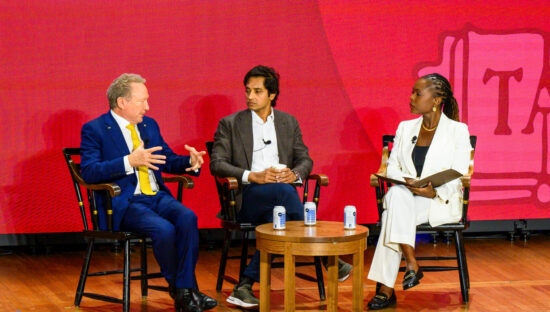
Harvard faculty discuss the possible implications of the 2024 U.S. elections for U.S. and global climate policy, the outlook for corporate climate action, and more.
As climate change makes extreme weather events like hurricanes, wildfires, and heat waves more frequent and intense, frontline health clinics around the country report that extreme weather is disrupting care delivery, and staff and providers say they are motivated to use resources that help improve clinic and patient preparedness.
Through its Student Ambassador Program, the Salata Institute is equipping Harvard University students to help build interdisciplinary climate communities across campuses.
With a growing focus on achieving sustainable progress in addressing the challenges of climate change not only over the long term but within this and the coming decades, the Harvard Project on Climate Agreements on Tuesday (Nov. 12) brought together a panel of experts on methane-emissions abatement at COP-29.
Through the COP Student Observers Program, students from Harvard College, the Harvard T.H. Chan School of Public Health, Harvard Business School, Harvard Graduate School of Design, and Harvard Kennedy School are attending the annual global climate talks.
Companies increasingly view climate solutions as strategic business drivers. Harvard Business School researchers identified 88 scalable, scientifically viable solutions to address climate change that are being pursued by U.S. public companies. CEOs should assess where investments in areas like biofuels, nuclear, and EVs align with their own growth strategies to remain competitive in a low-carbon economy.
Researchers at Harvard Business School have released the BiGS Climate Innovators 100 list, a ranking of the publicly traded companies most involved in developing climate change solutions as reported in their mandatory corporate filings.
The Harvard Initiative on Reducing Global Methane Emissions, supported by the Salata Institute for Climate and Sustainability, has released a Research Brief titled “India’s Methane Problem.” The brief explores in detail the regulatory framework in India for addressing methane emissions in various emitting sectors. The author is Zerin Osho, Director of the India Program for the Institute for Governance & Sustainable Development (IGSD). IGSD focuses in large part on reducing emissions of methane and other non-CO2 greenhouse gases. The Harvard Methane Initiative also co-hosted a side-event panel at COP-29 with IGSD, on November 12, 2024, titled “New Horizons in Methane-Emissions Abatement.”
Nili Gilbert and Andrew Forrest, both speakers at a main-stage session at Harvard Climate Action Week 2024, were included in TIME’s list of top climate influencers.